






©志村貴子・太田出版/淡島百景製作委員会
If I had a nickel for every time I was assigned an anime series based on a fictionalized version of the Takarazuka Music School, I would have two nickels—which isn’t a lot, but it’s still weird that it’s happened twice. Furthermore, if we include Kageki Shoujo!! alongside Revue Starlight, then A Hundred Scenes From Awajima makes for the third anime in recent memory to draw core visual and thematic inspiration from the Takarazuka Revue, Japan’s premier all-female theater troupe. Some quintessence within this century-old legacy of women thespians, handsome and beautiful alike, continues to capture the imagination of writers and artists. Were I to guess, it probably has something to do with all of the handsome and beautiful women.
Still, it’s interesting to consider the different approaches these stories take. Revue Starlight homes in on the fundamental surreality of a theatrical production, taking cues from Kunihiko Ikuhara in order to pull its interpersonal dramas into metaphysical spaces. Kageki Shoujo!! begins with a more traditional narrative through its heroines’ journey into their first year at the performing arts school, as they navigate the ingrained power dynamics and their own checkered pasts in order to be the top star. A Hundred Scenes From Awajima, meanwhile, takes a nonlinear vignette-based tack to achieve a wide view of its titular school across multiple generations of students. It is arguably the most narratively ambitious, and therefore, it is also the easiest to screw up.
It makes sense, then, that this would be the approach of veteran mangaka Takako Shimura. Shimura’s been writing manga since 1997, and Awajima‘s publication was spread out from 2011 through 2024, resulting in five total volumes over the course of roughly half her career to date. It’s something she worked off and on alongside many other projects that started and ended within that same time period. I can imagine Awajima as a haven she’d return to, or as a place to experiment with characters and ideas that wouldn’t necessarily fit into one of her usual pieces. Already, the adaptation has delivered a handful of distinct stories, yet they are also distinctly of Shimura’s style and predilections—quiet, tragic, yuri, emotionally incisive, and deceptively complex.
As I see it, Shimura’s notoriety in the Western sphere stems mainly from the two excellent adaptations of Sweet Blue Flowers and Wandering Son. In the subsequent years, these series stood as pillars of good LGBTQ representation in anime. When I wanted to read/watch a series about being transgender (for purely cis reasons, of course), I was instantly directed to Wandering Son. Thus, Shimura achieved a kind of monolithic presence that, in more recent years, has prompted a critical and cultural reassessment of her work, especially as the industry has localized more and more queer manga. I certainly harbor some critiques of Wandering Son in the wake of my lived experience as a trans woman. And while I believe that’s a good development spurred by a diversity of voices—a diversity that I hope only continues to grow—I also hesitate to dismiss Shimura entirely. She is not flawless, but she is damn good at what she does.
The second episode is a perfect case study of Shimura. From a distance, Emi Okabe and Yukie Onoda’s relationship unfolds with many of the classic Class S yuri tropes. Their love affair lacks any outward sign of physical intimacy or happiness, and it ultimately destroys the both of them. However, the devil is in the details. Shimura removes the audience from these characters and places us alongside Etsuko Takehara, a third party observer. It further distances us by relaying much of this information through Yukie’s letter. We don’t have the complete picture here. We don’t know how much longer Yukie held on, or why Emi ultimately died. All we see is the woman crying on the bus. That’s not the whole story, and Shimura ensures we know that much.
Therefore, it would be reductive to end our analysis of Emi and Yukie’s tale as merely another lesbian tragedy milked for melodrama. While it functions quite well as that—I cried (again)—the nuances are just as important. Shimura deftly hints at the contours of the bigger picture, including Ibuki’s initial warmth, Yukie’s jealousy, Emi’s adult life, Etsuko’s disappointment, the school’s cliques and systems, and the tricky notion of legacy. Awajima exists in a quantum state. It is the institution that drove these girls apart in the most emotionally tumultuous period of their development, and it is also the alluring gleam of a stage that follows Etsuko into adulthood and never dims, despite everything she learns about her old friend. Which of those Awajimas is more authentic? It doesn’t even matter. Etsuko supports her niece’s attendance all the same. The cycle continues.
Or does it? In the first episode, when we follow Wakana and Kinue, Awajima seems to reproduce many of the ingrained power structures. The school’s traditions deepen the divide between upperclassmen and underclassmen, the girls alternately gossip and prostrate themselves based on whatever greases the wheels of socialization, and individuals are stereotyped as “crybaby” or “prince” based on shallow impressions. Again, though, the truth is more complicated. Kinue becomes the “prince” well before she enters Awajima, the crybaby stops her peers in their tracks with her singing voice, and Kinue extends empathy to her freshman roommate Wakana when she feels vulnerable. There are one hundred scenes to get through. That’s enough room for a variety of perspectives.
Overall, I really like what I’ve seen so far. A storied institution for teen girls that functions as a pressure cooker for multiple generations of high-strung theater kids is perfect scaffolding for Takako Shimura‘s stories. It is physically and psychically impossible for any of these girls to be calm or normal, and Shimura has her own deft way of making sparks fly. The vignette format puts her efficiency on display as well. In the span of half of an episode, Kinue and Ryouko’s story unfolds like a miniature Liz and the Blue Bird. It doesn’t hit the same heights that movie can, but it’s a delicious slice of yuri angst all the same. And the short coda about Ibuki, once a bully and now a teacher, shows us that Awajima can be a place of both growth and stagnation. Perhaps Ibuki stayed to atone for what she had done. Or perhaps she became institutionalized and unable to function outside Awajima’s walls. Either way, she’s there to steward the next generation. One scene connects to another, and eventually, we’ll have an entire vista to take in.
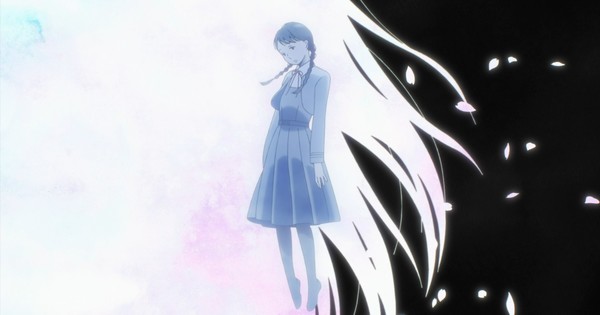
Shimura has traditionally been lucky in the adaptation department, and A Hundred Scenes of AWAJIMA is no exception. Director Morio Asaka knows his stuff when it comes to shojo and josei, having previously helmed the anime for Card Captor Sakura, NANA, all three seasons of Chihayafuru, and My Love Story!!. He and Madhouse have turned in achingly beautiful work for Awajima. Shimura’s patient pacing is similarly unhurried on the screen. Colorful bursts of flower language frequently interrupt the anime’s otherwise soft color palette. The character acting features some lovely cuts with expressive hair and hands. And that one shot of Emi smoking made my gay little heart skip a beat. Given the strong start, I’m excited to be a fly on Awajima’s walls for the rest of the season.
Episode 1 Rating:
Episode 2 Rating:
Hundred Scenes of AWAJIMA is currently streaming on
Crunchyroll.
Sylvia is on Bluesky for all of your posting needs. In high school, you could catch her in the pit orchestra, but never on stage. You can also catch her chatting about trash and treasure alike on This Week in Anime.