

Humans are not the only species negatively affected by increasingly hot and humid conditions. Intense heatwaves sometimes kill large numbers of wild animals. Eastern Australia’s giant fruit bats, known as flying-foxes, provide possibly the most dramatic illustration. In late 2018, two days of extreme heat in the far north of Queensland wiped out one third of Australia’s population of spectacled flying-foxes. The species is now red-listed as endangered.
Bat biologists have identified high humidity as a major risk factor for these mass mortality events.
In late 2020, South Africa saw its first documented heat-related mass mortality event involving wild birds. Air temperatures in the typically humid Phongolo Nature Reserve in northern KwaZulu-Natal exceeded 45°C, about 10°C higher than average conditions. Staff in the reserve started seeing dead and dying birds. Most of the victims were songbirds, which are known to be more sensitive to extreme heat than many other groups of birds.
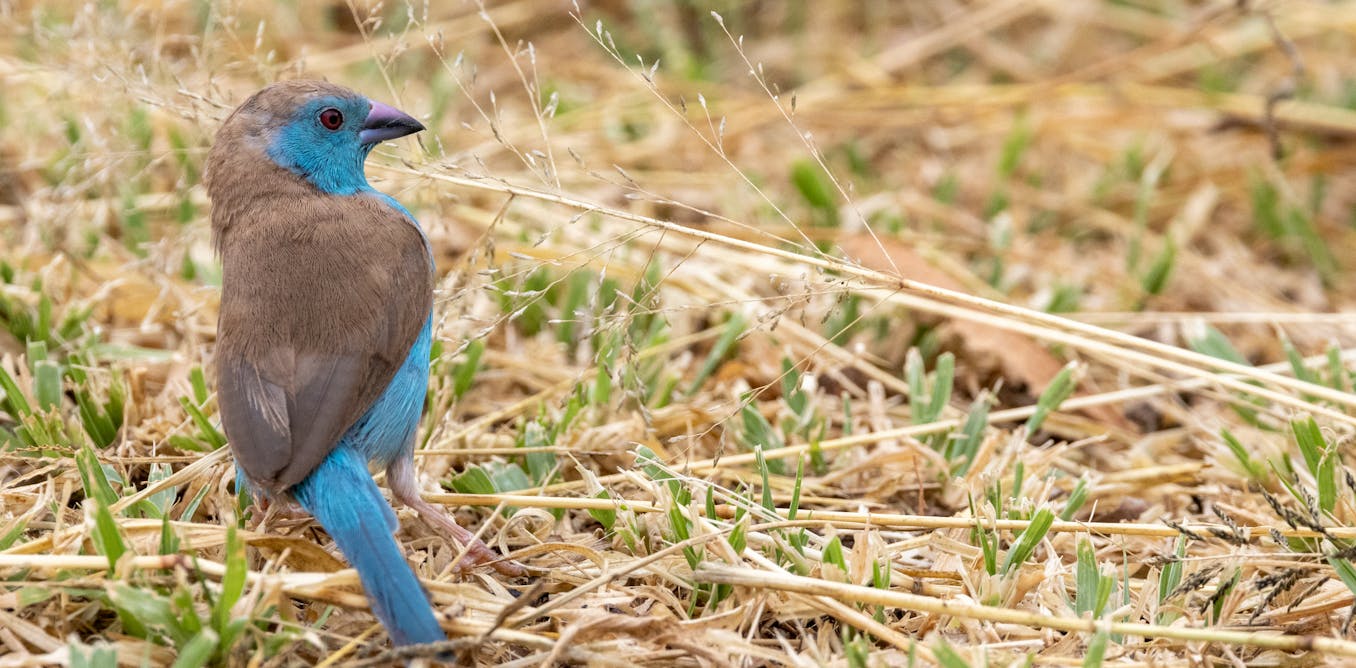
Of these, the worst-affected species was the blue waxbill, a charming little finch with a powder-blue face and belly that spends most of its time foraging for grass seeds in small flocks.
Blue waxbills made up nearly half the carcasses found by field rangers when they searched part of the reserve after the heat had passed.
The Phongolo mortality event added to the urgency of our research programme on the effects of climate change on Africa’s birds. The blue waxbills’ prominence among the victims identified them as a bellwether of the impacts of extreme heat on birds in the wetter south-eastern parts of the continent.
Since 2009, we have been leading a research team spanning the universities of Cape Town, Pretoria and several other local and overseas institutions. The over-arching goal of our research is understanding how climate change is affecting birds and other wildlife and developing methods to predict future effects.
Our expertise is mainly in behavioural ecology (Susie Cunningham) and evolutionary physiology (Andrew McKechnie). This combination has proven ideal for investigating how rising temperatures affect animals’ survival and reproduction.
Why humidity can be a killer
During hot weather, humans and other animals depend on evaporation to offload heat. Evaporation may take place by sweating (the major cooling mechanism for humans), through panting (your dog on a hot day) or other pathways. The process of changing liquid water (sweat or saliva) into water vapour uses heat, so it cools the source of the water (the body). But the air is like a sponge: when it’s already humid (wet), the air can’t hold much more water vapour.
These conditions impede evaporation and thus heat loss. On a 40°C day in a desert like the Kalahari or Sahara, evaporative cooling is efficient because the air is dry and sweat can evaporate as soon as it reaches the skin’s surface. At the same temperature on a humid day in the coastal tropics, however, sweat cannot evaporate and forms drops on the skin. This severely reduces rates of heat loss.
If body temperature increases more than a few degrees above normal levels, nervous system function is compromised, organ damage starts to occur and proteins begin denaturing. This breakdown of physiological functioning can rapidly lead to death.
The journey
In early 2022, just over a year after the waxbill event, our Masters student Nazley Liddle set out to examine the role high humidity had played in the deaths of the waxbills. She also aimed to predict areas where risks of mortality will increase in future.
Nazley investigated the waxbills’ capacity to regulate their body temperature over a range of air temperatures and humidity levels. Her results confirmed that high humidity severely compromises the birds’ ability to avoid dangerous hyperthermia (getting too hot).
For example, she found that blue waxbills can tolerate air temperature up to 48°C under dry conditions, whereas under humid conditions similar to those on the day of the Phongolo mortality event they are unable to maintain a safe body temperature if air temperature exceeds 45.7°C.
Nazley then modelled how the waxbills will fare under hotter, more humid future conditions. The modelling showed that likelihood of mass mortality events for waxbills (and other birds with similar physiology) will increase greatly in coming decades. This ranged across much of Kruger National Park, south-eastern Zimbabwe and large parts of southern and central Mozambique, including the ferociously hot Zambezi Valley.
Predicted risk of mortality becomes three to seven times higher when humidity is taken into account, compared to increasing temperature alone. Many of these areas will simply become too hot and humid during the wet season for the species to persist.
The blue waxbill study should set alarm bells ringing. Most of Earth’s 11,000 bird species occur in the tropics, many experiencing hot, humid conditions for at least part of the year.
Another recent paper from our team reveals similar increases in projected future risks of lethal hyperthermia for trumpeter hornbills. This large, fruit-eating forest species found in southern Africa plays a critical role in seed dispersal. Although biologists have often viewed tropical lowlands as safe habitats for birds from the point of view of their physiological functioning, our work is showing that increasing humidity coupled with rising temperatures poses a serious threat to birds, bats and other animals of the tropics.
There are worrying signs that climate change has already caused widespread declines in tropical birds. During 2025, several teams of researchers reported substantial declines in bird abundance, even in intact rainforests that have not been affected directly by human activities such as slash-and-burn agriculture.
Most recently, population declines of 25%-38% since 1950 among tropical birds have been attributed to increasingly extreme heat events. Tellingly, these declines have been more pronounced in songbirds compared to other groups. Rising temperature and humidity is a global-scale problem. The only long-term solution is halting human-driven climate warming.
