


U.S. science-fiction and speculative fiction author Ursula K. Le Guin‘s 1986 essay The Carrier Bag Theory of Fiction famously took on the traditional ideas of the hero’s journey and destruction in storytelling, arguing that the earliest human tool was not a weapon, but a container, such as a bag, a basket, or even a net, designed for gathering and storing food. As such, it reframed tools and technology as focused on collecting and storing energy rather than as tools for battle and domination.
The ideas of the author, who died in 2018, are back in focus and on big screens right now, thanks to the program of the 23rd edition of the Copenhagen International Documentary Film Festival, or CPH:DOX, which runs through Sunday, March 22. The lineup features at least two films inspirred by Le Guin and her ideas.
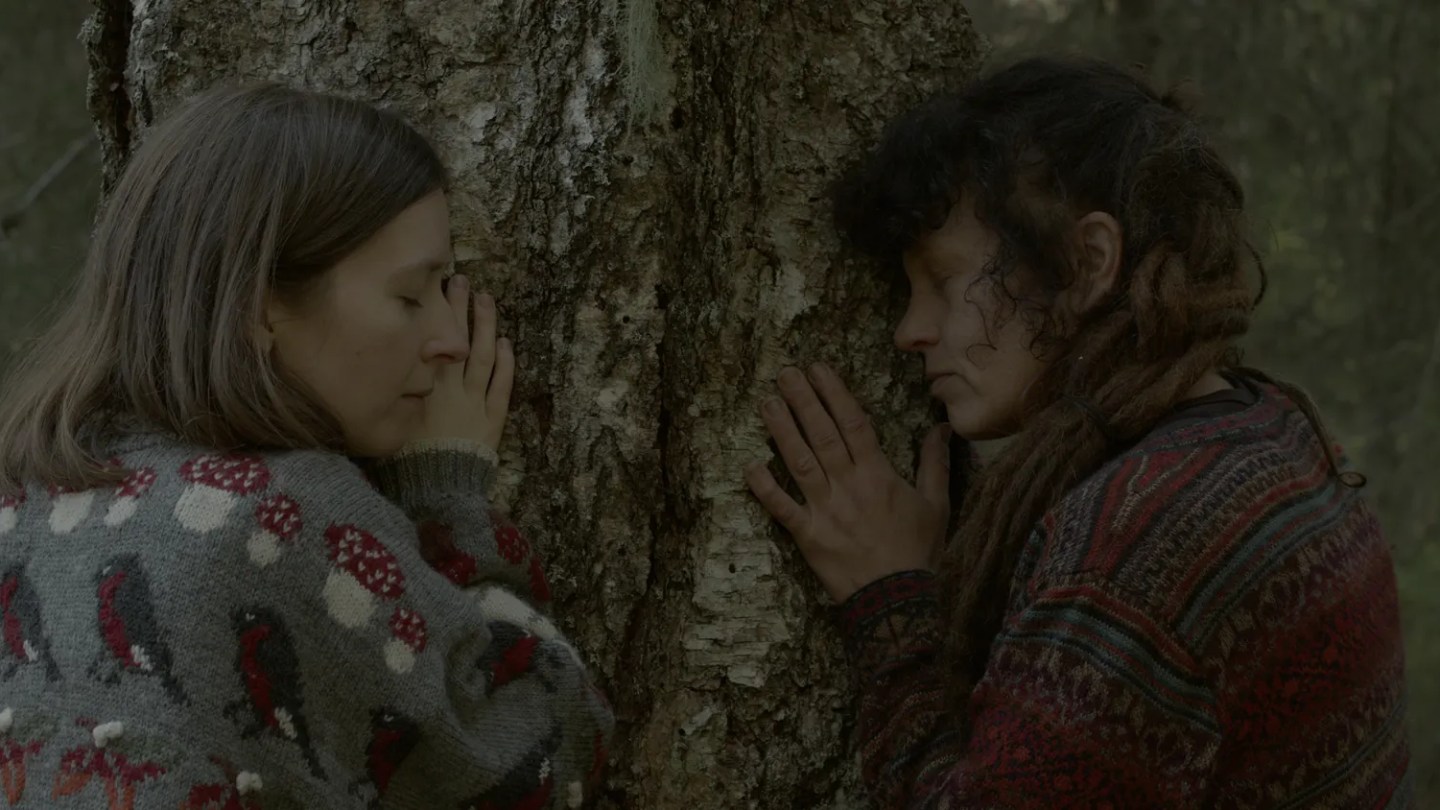
The Mother Age, directed by Irene Kaltenborn, is one of these films. “Inspired by Ursula K. Le Guin and other female thinkers, a Norwegian filmmaker invites us on a sensual and richly philosophical journey of (re)discovery in the deep Finnish forests,” notes the CPH:DOX website. “From the barren coastline of Finnmark to the deep forests of Finland, The Mother Age searches for clues that can shed light on an ancient theory dating back to the dawn of humanity.”
Rocks last, while organic materials decay, we learn from the film, which looks for possible traces to be found of a parallel history of development, so to speak. “In a time of crisis, when artists and thinkers have once again turned our attention to nature, The Mother Age contributes a quiet but nonetheless revolutionary rethinking of our relationship with the world,” the fest notes.
The doc is from producers Margo Peegel and Kaltenborn, who both also are responsible for the cinematography. Kaltenborn also edited the film, and Peegel handled the sound.
“Five years ago, Ursula K. Le Guin’s essay, The Carrier Bag Theory of Fiction, turned my world upside down,” Kaltenborn shares in a director’s statement. “I got my hands on this short but revolutionary text far too late in life, yet at the perfect time. Le Guin made me realize that ever since our ancestors walked the Earth, we have been following a singular, shared narrative.”
She continues: “If we examine the earliest entries of our archaeological records, what remains are predominantly stone knives and axes – organic materials being rarely found, as they decompose beneath the surface. Our understanding of history is based on the traces we find. While being essential tools, knives and axes have violent connotations, suggesting a history of violence and seve- rance. It really struck me, how much today’s society echoes material remnants dating back to the early ages, including their violent potential.”
Concludes Kaltenborn: “Le Guin argues for a different perspective. In her world view, everything starts with the carrying bag. After all, how can you carry much at all without a container? The bag is not merely a vessel, or a tool, it represents the concept of coexistence. Following this line of thinking, I started to look for traces in archaeology, history, literature and folklore to create a film that would delve into these parallel narratives.”
Two other writers informing The Mother Age are Elin Wägner and Elizabeth Fischer. “In many ways, this film is a tribute to them too, as well as the forest,” highlights the director. “The forest became a framework for this film, as it is likely to have been one of the first biomes inhabited by humans. Upon entering the dense Finnish forest, I was introduced to the creation myth that begins the national epic of Finland and Karelia, The Kalevala – where the world is created through both songs and the becoming of organic beings. The deeper I went, the clearer it became that signs of this parallel past are everywhere. That is, if we choose to look for them.”
As such, she calls The Mother Age “a journey of (re)discovery, that invites the audience to accompany me on a narrow path into the forest. This is the most precious gift I can offer as a director: time and space for the viewer to think for themselves.”
The forest also features in the second Le Guin-inspired film at Copenhagen.


‘Daughters of the Forest’
Courtesy of CPH:DOX
Otilia Portillo Padua (Three Voices) takes viewers on a trippy journey deep into Mexico’s forests in Daughters of the Forest Deep, about two indigenous mycologists, or experts in fungi. They look to “reconcile the past and the present, and science fiction and ancient practices, while reimagining the future for themselves and the changing world they inhabit,” reads a synopsis.
Produced by Paula Arroio, Elena Fortes and Portillo Padua, Daughters of the Forest features cinematography from Martín Boege, music by Hannah Peel and sound design by Javier Umpierrez. Lorenzo Mora Salazar is the editor.
The doc from Oscura Producciones and Sandbox Films, co-executive produced by Argentine actress Mia Maestro, features Eliseete and Julieta, two young, scientifically trained mycologists who understand both, modern science and their indigenous families’ ways of viewing nature and themselves.
Daughters of the Forest positions itself as an “immersive sci-fi documentary.”
In her director’s statement, Portillo Padua says: “Much of the science fiction I encounter remains anthropocentric and patriarchal, often set in technologically advanced dystopias. In the imaginative fiction of women, however, I discovered possibilities that felt more hopeful, less linear, and more nuanced—stories that more accurately reflect the complexity and interdependence of the world we inhabit.”
She references Spanish researcher and curator María PTQK, Afrofuturist and Indigenous science-fiction writers and, of course, Le Guin. “The spirit of sci-fi that inspires this film draws from Ursula K. Le Guin’s essay The Carrier Bag Theory of Fiction,” she writes. “In it, she challenges linear, hero-driven narratives, proposing that humanity’s earliest invention was not a weapon, but a container – a bag or basket used for gathering. Her theory reframes storytelling itself: away from conquest and domination, toward community, process, and care.”
Concludes the director: “As a filmmaking team, we use the word quest carefully. Traditional quest narratives, shaped by the hero’s journey, are tethered to swords, battles, monsters, and a troubling disregard for collateral damage. Ours are quests that lead to questions rather than conquests – journeys that gather instead of conquer. The film’s quest is to build nodes, networks, and a growing community engaged with reimagining the future. For that reason, our impact campaign will be inseparable from the making of the film. Process and outcome are intertwined.”