







“Always picture success, no matter how badly things seem to be going at the moment,” Norman Vincent Peale advised readers of his 1952 self-help book, The Power of Positive Thinking.
In the past few months, Donald Trump has told us that he was “totally exonerated” by the Epstein files, in which he and other terms related to him are referenced 38,000 times. He declared that Operation Epic Fury, which is opposed by a majority of Americans—and which many congressional Democrats believe violated the Constitution—was “about a 15” on a scale of 1 to 10 in terms of how well it’s going. He predicted that gas prices “will come down more than anybody understands” on the day oil surged past $100 a barrel. He said that “inflation is defeated,” despite a report released the same day saying inflation was up 2.7%. He claimed he “won [Minnesota] three times, in my opinion,” despite the fact he’d lost Minnesota three times. During his State of the Union Address in February, he said America “is winning so much that we really don’t know what to do about it.” And as the Pentagon deployed 2,000 soldiers to the Middle East last week from the Army’s Airborne Division, he said that not only has the war in Iran—which he euphemistically calls a “military operation”—already been won, but that it has been “successful like nobody has ever seen before.”


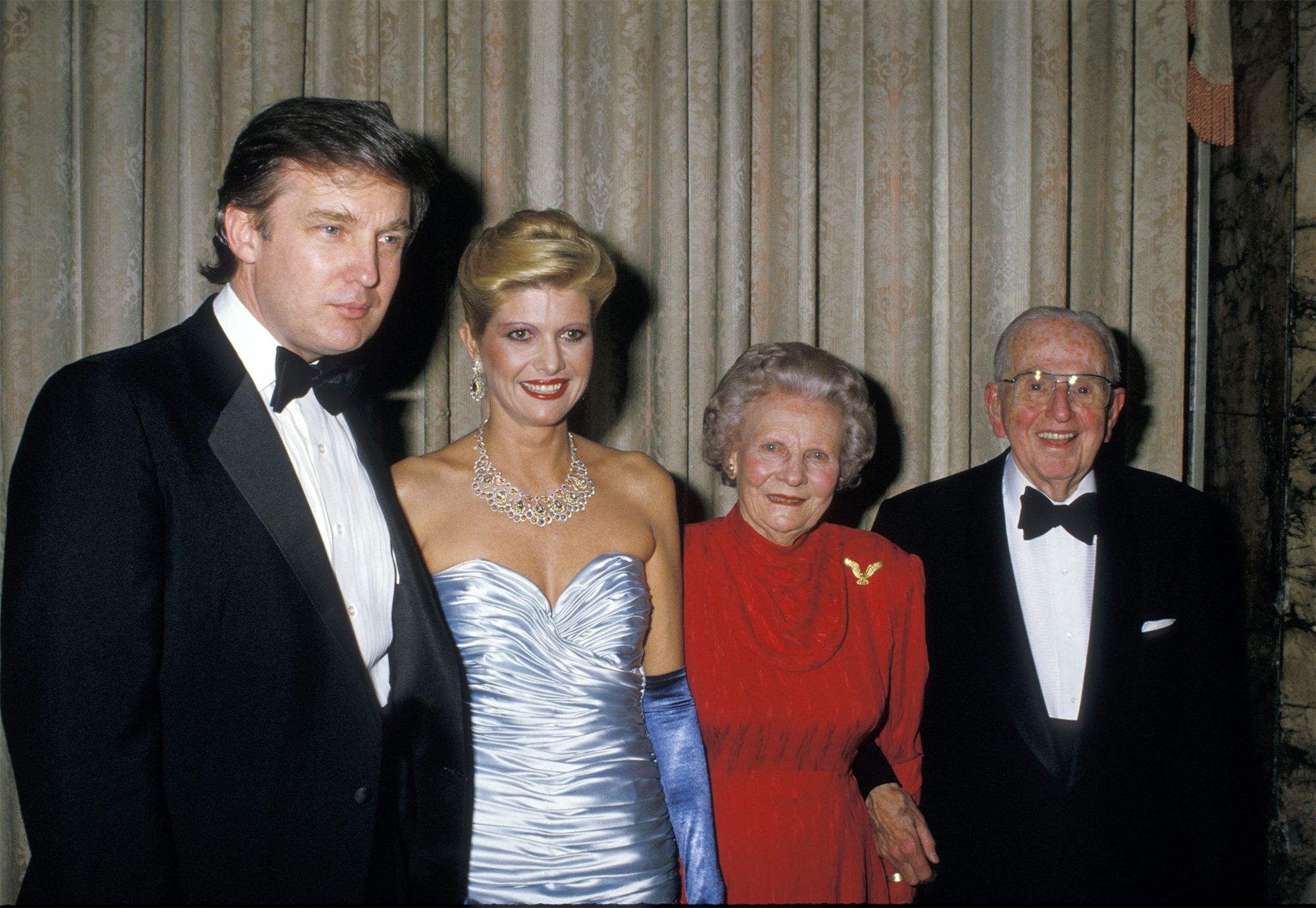
Trump and Peale at his 90th birthday celebration at the Waldorf Astoria Hotel in in New York, 1988.Tom Gates/Getty Images
If you’ve ever wondered about the source of Trump’s unbridled confidence, or why his administration continues to insist that everything is going amazingly well in the face of overwhelming evidence to the contrary, look no further than the late Norman Vincent Peale, the president’s all-time favorite thought leader.
Peale, whose easy-to-read, 256-page book remained on the New York Times bestseller list for more than three years after its publication and sold millions of copies, is credited with helping to popularize the American post-WWII “prosperity gospel,” the idea that faith—specifically Christian faith—can be applied to achieve health and material wealth. He preached that positive thoughts can cancel out negative ones; that attitudes are more important than facts, and that self-confidence is a gift from God himself.
If any of that sounds familiar, it may be because the Trump family attended Manhattan’s Marble Collegiate Church, where Peale—a.k.a. “God’s salesman”—was the pastor until 1984. The president’s father, Queens real estate developer Fred Trump, first became a Peale devotee after reading The Power of Positive Thinking, and was inspired by its message that one’s beliefs can singlehandedly bend reality. From the time he was an impressionable youth, Donald listened to sermons by Peale, who became a friend and spiritual adviser to the family. Peale would have been pleased to hear Trump describing him as “one of the greatest speakers” in a 2024 speech before a North Carolina evangelical crowd. He may have been less pleased to know that the speech was reportedly an attempt by Trump to redeem himself in the eyes of Christian voters following a random digression about the size of late golfer Arnold Palmer’s penis.
In 1988—the year Trump christened his 282-foot yacht (seized by banks just a few years later), allegedly began cheating on his first wife with the woman who would become his second, and was sued by the Justice Department for violating federal disclosure rules when, in an attempted takeover, he bought large shares of Holiday Corporation and Bally Manufacturing (Trump agreed to pay $750,000 to settle the suit)—Peale described the future president as “one of America’s top positive thinkers and positive doers.” By then, Peale had officiated Donald’s 1977 wedding to Ivana Zelníčková, as well as his sister Maryanne Trump’s 1982 wedding to John Barry. Donald’s second wife, Marla Maples, also had links to Peale insofar as she was a Marble Collegiate congregant. A 1990 New York Post cover proclaimed “They Met in Church,” even though the ex-couple reportedly met at a tennis match. The following day, the Post led with a spicier headline presumably from Maples, the source of which was, allegedly, Trump himself: “Best Sex I Ever Had.”
“Expect the Best and Get It” happens to be the title of the seventh chapter of The Power of Positive Thinking. And Peale, like Trump, loved a good hyperbole: The word “beautiful” appears in the self-help book 30 times, while “tremendous” appears 22 times; “greatest” shows up in every chapter except chapter two, for a total of 44 times. The Power of Positive Thinking, Trump has said, “was a great book then and a great book now.” Even Trump’s book titles—not to mention their themes—feel like an homage to Peale. The Art of Living, Peale’s first book, was published in 1937. Later, Peale wrote The Art of Real Happiness. Similarly, Trump’s first book was titled The Art of the Deal. Ten years (and at least three bankruptcies) later came The Art of the Comeback.
Beyond personal philosophy, Peale’s political orientation is also aligned with what would eventually become Trump’s. An enthusiastic supporter of the America First movement, a precursor to MAGA, Peale opposed internationalism in general and entry into World War II in particular. He later got involved in Republican politics, supporting the presidential campaigns of Dwight D. Eisenhower and Richard M. Nixon, another congregant at Marble Collegiate. (Before he married off the Trumps, Peale officiated at the marriage of Nixon’s daughter, Julie, to Eisenhower’s grandson, David, in 1968.) When Nixon lost to John F. Kennedy, Peale urged his pal to embrace the power of positive thinking and run again—just as Trump did in 2024. So, while observers note that Trump has violated traditional conservative values by levying tariffs, eschewing international agreements—ranging from the Paris Climate Agreement to the World Health Organization and the Iran Nuclear Deal—and threatening to seize other countries’ territory in the name of national security, he’s actually treading on a mentor’s well-worn ideological path.
The thing is, positive thinking is necessary but not sufficient when seeking international collaboration, as in the case of convincing allies to help reopen the Strait of Hormuz, through which 20% of global oil exports flow. “Numerous countries have told me they are on the way,” Trump said, even as one ally after another issued statements that they don’t plan to send warships to escort tankers through the strait amid Iranian bombardment. Just two weeks ago, Trump wrote on Truth Social that “[w]e no longer ‘need,’ or desire, the NATO Countries’ assistance—WE NEVER DID!”
But the biggest problem with a president who believes that positive thoughts beget positive outcomes—and there are many—isn’t only that it’s total bullshit. It’s that if inflation has actually been “defeated,” if drug prices are actually down by a mathematically impossible 600%, if we really don’t need allies, and if America is winning so much that we don’t know what to do about it, then there’s no reason for the administration to do anything at all, since there are no acknowledged obstacles we need to overcome.
As the late theologian Reinhold Neibuhr—one of Peale’s biggest critics—once said, the positive-thinking movement “helps [people] feel good while they are evading the real issues of life.” A Christian realist, Neibuhr was known for his now famous Serenity Prayer, asking God for “the serenity to accept the things I cannot change, the courage to change the things I can, and the wisdom to know the difference.”
With Trump’s approval ratings hovering at historic lows, his refusal to accept reality is now manifesting itself in the SAVE Act, which would require registering voters to provide documentation of US citizenship. The legislation would disenfranchise millions of voters in the midterms and likely preserve the Republican majority in Congress—a way to save Trump from a possible third impeachment. No amount of positive thinking will allow the measure to pass in the Senate, Majority Leader John Thune acknowledged two weeks ago: “I’m the person who has to deliver sometimes the not-so-good news that the math doesn’t add up, but those are the facts, and there’s no getting around it.”
Come November, we can pray that voters will have the courage to change the things they can.
-
Exclusive: Lindsey Vonn on Life After Her Horrifying Crash
-
How the Epstein Files Exposed Victims Instead of Perpetrators
-
Tradwife U: Where Right-Wing Women Seek Their Mrs. Degrees
-
Harry and Meghan’s Hollywood Dreams Hit a Speed Bump


