








STRENGTH TRAINING IS all about finding the sweet spot. You want to lift heavy enough to maximize growth, but not so heavy that you sacrifice good form or hurt yourself. You want to work out often enough to fast-track your gains, but not so often that you succumb to the perils of overtraining. And you want to stick with the same program long enough to see results, but not so long that you hit a plateau. Do all of those things just right, and you’ll never have to worry about stagnation or burnout.
For many guys, that last sweet spot—how long to stick with a training plan—is the trickiest one, says MH Advisory Board member and trainer Don Saladino, NASM.
At one end of the spectrum are those who never switch things up, doggedly plodding through the same workouts week after week for months or years, even after they stop seeing results. At the other end are those with training ADHD, changing workouts on a weekly or even daily basis (a common pitfall of scrolling obsessively through fitfluencer feeds).
“We call that program hopping,” says Saladino, adding that the results of too much variation are the same as too little: slow to no adaptation.
In other words, shooting too wide of the program variation bullseye in any direction can cause you to kiss your gains and goals goodbye. Here’s how to make sure you never miss the mark.
Program Variation 101
IN GENERAL, IT’S smart to consider injecting some change into your program every four to 16 weeks, says Saladino. That might sound like a large window, but there are a handful of ways to narrow it down. The following three are the most effective for most people, he adds.
Your Program Stops Working
We’re talking about a true plateau caused by your training program—not temporary inertia influenced by factors outside of your workouts.
“It’s when you’re training for strength, and your training loads have leveled off; or you’re training for endurance, and you’re not increasing your stamina; or you’re training for hypertrophy, and you’re not gaining mass—and that stagnation can’t be attributed to external factors such as poor nutrition, lack of sleep, or unusually high stress,” explains Saladino, adding that it’s also important to keep things in perspective. Everyone has off days, and not every workout can be filled with personal bests. “But a sustained lack of progress is the first indicator that your program could use some variation,” he says.
You Get Bored
Repetition is key to any successful training program. Doing the same workouts with the same exercises in the same way for several weeks to months (until progress begins to slow) is the most effective way to optimize muscular adaptation (i.e., growth). And while repetition doesn’t have to be monotonous, the results can be devastating if it starts to feel that way.
When you’re bored, it becomes easier to justify skipping a workout, and consistency—an essential element for achieving any fitness goal—becomes jeopardized, says Saladino.
Another potential problem with boredom is that it can lead to workout hopping. “I see it all the time—people pulling up YouTube videos to figure out what workout they’re going to do that day,” says Saladino, adding that this kind of practice typically has the same consequence as training inconsistently. There is one key difference: “With program hopping, there’s no way of measuring progress—and thus what’s working and what isn’t—because you’re changing things every time,” he continues.
Bottom line: If you’re regularly making excuses to skip the gym or scrolling social media to find something interesting to do once you’re there, it’s time to take a closer look at your program.
You Get Injured
Injury can be devastating to workout consistency, but it doesn’t have to be. Obviously, an acute pain or chronic injury serious enough to require you to avoid certain movements or immobilize a particular limb demands a period of non-use to promote healing, but that doesn’t mean you have to stop lifting entirely. “You just need to adjust your training to work around the affected area,” Saladino explains.
An injury may not require you to wholesale change your program (or completely program hop). Very often it means stopping exercises that cause pain, or swapping those moves for alternates that train the same body part free of pain. In general, you still may be able to continue your program once you’ve made those tweaks.
“You’re probably going to be doing a little more work with the uninjured half of your body, but you don’t have to ignore the injured half completely,” says Saladino. “If your right leg is injured, for example, you should still train your left leg, because there will still be some carryover—your right leg will get stronger.”
Indeed, research shows that training only one limb induces “contraction type-dependent gains in the contralateral untrained limb.” In layman’s terms, that means if you only train your right arm, your left arm will get a bit stronger as well, even if you never touch a weight with it. It’s not a 100-percent carryover—gains in the untrained limb won’t equal those in the trained one—but it can help tide you over until your injury heals.
Periodization and Competition Prep
THE THREE SCENARIOS above apply to the average lifter who hits the weights but isn’t an elite athlete or an advanced lifter who follows a “periodized” plan. Periodization is an advanced approach that divides a longer (typically year-long) training cycle into blocks, each of which focuses on a different goal or skill, such as strength, hypertrophy, power, and endurance. “Athletes, meanwhile, have to adjust the intensity and scope of their training depending on whether they’re in-season or off-season,” says Saladino, adding that such changes are typically incorporated into athletes’ advanced periodized plans.
But here’s the thing: The types of changes required to maintain constant adaptation don’t vary much between athletes and non-athletes or those who follow a periodized plan and those who don’t. “And they usually aren’t as drastic as people think,” says Saladino. “You generally don’t need to replace all of your exercises with new ones.”
Simply changing your stance, grip, tempo, or transitioning to a different exercise variation that hits the same muscles, is often all it takes to stave off a plateau. Indeed, “sometimes just changing the number of sets and reps you do for each exercise will spark new growth,” says Saladino, adding that such a strategy lies at the heart of periodization, as different set and rep ranges generally define what athletic skill you’re targeting. And all of these changes should happen against the ever-present backdrop of progressive overload, or continually increasing the challenge to your muscles (e.g., by reaching for heavier weights) as you become stronger.
It’s also important to keep in mind that switching things up every four to 16 weeks is a general rule, not an immutable one. “If you’ve been following a program for longer than that and you’re healthy and mobile, and still enjoying the program and making gains, why change it?” says Saladino.
Similarly, don’t be afraid to listen to your body and occasionally change a workout to accommodate it. “If you get to a workout where you’re supposed to lift heavy and you’re feeling absolutely crushed and exhausted, maybe you just do some pump work that day,” suggests Saladino. “That kind of self-assessment and flexibility is really important—as long as it doesn’t snowball into program hopping.”
Options for Your Next Program
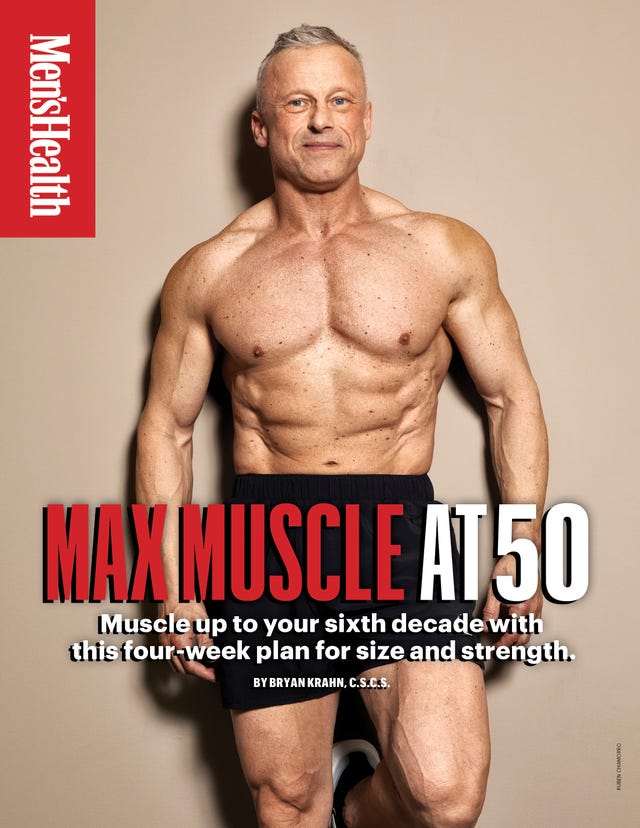
NEED INSPIRATION FOR your next plan? We’ve got plenty at Men’s Health, from Saladino’s own Superhero Shred program to our Max Muscle at 50 plan for older guys, or, if you have lofty goals, the Ultimate Guide to Maingaining.








Trevor Thieme is a Los Angeles-based writer and strength coach, and a former fitness editor at Men’s Health. When not helping others get in shape, he splits his time between surfing, skiing, hiking, mountain biking, and trying to keep up with his 10-year-old daughter.


