

Advertisement

FRSC and the Strategic Approach to Road Safety
By Lawal Dahiru Mamman,
In his seventeenth-century reflection on human interdependence, the poet John Donne famously observed that “No man is an island, entire of itself; every man is a piece of the continent, a part of the main.” In 21st-century administration, the same principle applies to law enforcement and disaster management agencies. No institution can operate as an isolated island and expect to survive a modern crisis.
For public safety administration, institutional success is rarely achieved through isolated actions. A single enforcement drive, no matter how rigorous, cannot solve systemic highway hazards if it operates independently of national emergency grids, strategic media advocacy, and key economic stakeholders.
Modern governance requires what policy analysts term a total system architecture, an integrated framework where operational enforcement, rapid medical triage, public education, haulage compliance, and international technical collaboration operate in complete harmony.
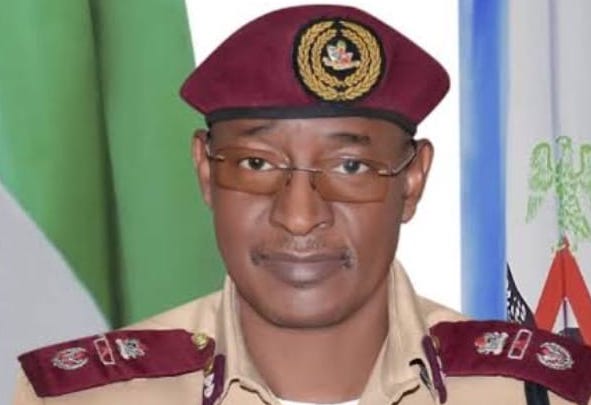
The Federal Road Safety Corps (FRSC), under the leadership of Corps Marshal Shehu Mohammed, seems to understand this concept in its totality.
In the last four weeks, it has demonstrated how a modern, data-driven security agency executes this multi-front strategy through a series of high-level engagements with government, civil society, the diplomatic community, and the media, illustrating a deliberate effort to reposition the FRSC from a localised traffic management unit into a central pillar of the national security and public safety architecture.
Unifying National Emergency Grids
In post-crash care, as pointed out in a previous article, the “Golden Hour” — the immediate post-injury period where prompt medical intervention determines survival — depends entirely on communication speed.
Historically, our emergency response landscape suffered from fragmented contact points. Citizens in distress had to navigate different telephone numbers for the police, fire services, road safety marshals, and regional ambulance networks. This fragmentation wasted critical minutes, leading to avoidable fatalities.
The active participation of Corps Marshal Shehu Mohammed in a strategic meeting presided over by Vice President Senator Kashim Shettima marked a decisive step towards resolving this structural delay. The multi-agency initiative focuses on expanding the functionality, responsiveness, and national reach of the 112 National Emergency Number.
Integration of the FRSC’s nationwide command structure, real-time tracking, and specialised rescue units into the 112 framework creates a unified national response system.
For the motoring public, the objective is straightforward yet transformative: a single, memorable toll-free number that triggers a coordinated, multi-agency response, drastically reducing emergency arrival times on major inter-state corridors. Put simply, national communication infrastructure is being channelled into a direct life-saving mechanism.
Strategic Media Partnership
Public education on road safety is often reduced to basic slogans or seasonal safety flyers. However, altering human behaviour across a diverse population of over twelve million registered drivers requires sophisticated, targeted, and continuous communication strategies.
Recognising this, Corps Marshal Shehu Mohammed convened a specialised two-day workshop entitled “Strengthening Strategic Communication for Effective Road Safety Advocacy.”
What gave this training national significance was the active collaboration of Nigeria’s media leadership: Mallam Jibrin Baba Ndace, Director-General of the Voice of Nigeria (VON); Malam Ali Mohammed Ali, Managing Director of the News Agency of Nigeria (NAN); and representatives from the Nigerian Television Authority (NTA).
Through this convergence of public education officers and executive media administrators, the Corps is building a modernised framework that replaces reactive press releases with data-backed, audience-centred messaging.
Whether warning drivers about the physics of night-travel fatigue or educating commercial hauliers on container latching, information is being deployed as a preventive tool to stop crashes before they occur.
Diplomacy and Sub-Regional Security
The operational effectiveness of a national agency is further strengthened through international technical exchange. The recent courtesy visit to the FRSC Headquarters by the Deputy British High Commissioner to Nigeria, Mrs Vickie Seymour, alongside Regional Security Adviser Mrs Lesley Giles, underscores the growing international interest in Nigeria’s transport security infrastructure.
Road safety intersects directly with transnational security, intelligence gathering, and regional stability. Transport corridors that lack structured vehicle identification or automated tracking systems become vulnerable to organised crime, arms trafficking, and illegal movement.
In September, discussions between the FRSC leadership and British diplomatic representatives focused on syncing vehicle identification databases to track stolen automobiles and transnational crime syndicates operating across sub-regional borders.
They also focused on accessing advanced international training frameworks for FRSC crash investigators, forensic analysts, and digital traffic monitoring personnel, and adapting global best practices in urban traffic management and intelligent enforcement technologies to Nigeria’s high-density road networks through capacity building.
This engagement demonstrates how the administration uses diplomacy to attract technical support and build institutional capacity without incurring massive capital expenditure.
*Taming Heavy Haulage Hazards*
No discussion of highway safety in Nigeria is complete without addressing heavy freight and articulated vehicles. The destruction caused by unlatched shipping containers, overloaded axles, and poorly maintained freight trucks remains one of the most persistent hazards on corridors like the Lagos-Ibadan, Benin-Ore, and Kaduna-Kano highways.
To tackle this issue directly at the operational level, Assistant Corps Marshal Ibrahim M. Bazama, representing the Corps Marshal, received the National Executive Council of the National Union of Container and Freight Truck Hauliers of Nigeria (NUCFTHN), led by its President, Comrade Ogbebor Nathaniel.
Rather than relying solely on punitive roadside impoundments, the FRSC is pursuing a balanced approach that combines voluntary union compliance with firm statutory enforcement. Freight operators represent a major engine of the national economy, moving food, industrial raw materials, and imported goods from ports to hinterlands.
Joint compliance frameworks, mandatory pre-trip inspections at freight parks, and training on container latching mechanics are how the FRSC and NUCFTHN will be addressing the root causes of truck-related fatalities.
Bottom Line
The synchronisation of these four engagements — national emergency telecom integration, strategic media advocacy, international diplomatic partnership, and freight union collaboration — illustrates the administrative approach of Corps Marshal Shehu Mohammed.
Road safety is not an isolated traffic exercise; it is an interconnected ecosystem requiring institutional coordination, technical capability, and proactive public engagement. With clear internal policy, strong inter-agency and international partnerships, the FRSC is establishing a comprehensive framework to transform Nigerian highways into secure, efficient, and life-preserving corridors for national productivity.
The engagements are commendable and the approach is solid. Now, let us work the talk for safer highways in Nigeria.
