

Two moves this week, on top of a deal struck earlier this year, point to the same shift: the giants of Wall Street (and Wall Street South) are now central to how American soccer builds toward its next decade.
U.S. Soccer confirmed Monday that Mauricio Pochettino will remain the U.S. Men’s National Team head coach through 2030, in a deal supported in significant part by a philanthropic leadership gift from Ken Griffin, founder and CEO of the hedge fund and financial services giant Citadel.
Griffin is again the lead donor (additional support comes from Scott Goodwin, Adam Freede and several commercial partners) behind the move, according to a person familiar with the gift, extending a role he first took on in 2024, when his gift helped U.S. Soccer secure Pochettino ahead of the 2026 World Cup.
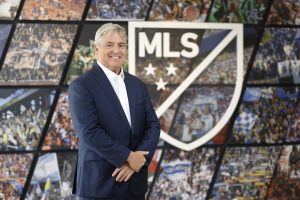
The same day that Pochettino’s return was confirmed, Major League Soccer named its third commissioner, succeeding Don Garber: Larry Berg, a co-owner of the marquee MLS franchise LAFC and a roughly three-decade veteran of private equity — and now private credit — giant Apollog Global Management. Berg eventually rose to senior partner at Apollo before joining 26North, the private equity firm backed by Josh Harris (the man whose Philadelphia 76ers just signed LeBron James) in 2023
At a press conference at Major League Soccer’s headquarters in New York, Berg cited his background in private equity as a key factor behind him getting the job—and a factor driving how he approaches being commissioner.
“So I do think there’s a lot of characteristics in private equity that apply to other things, which is not a surprise,” he said. “It applies to everything. It’s about sense of urgency. It’s about rolling up your sleeves, being in the trenches, asking good questions, aligning people toward a common goal. There’s a lot of parallels, and I had a lot of experience on many boards, which gives me a lot of experience in governance.”
These same qualities served him at LAFC, he added. “I had invested in soccer clubs before, but I had never helped run a soccer club. But I do think those things translated, and I think will translate here as well.”
His LAFC co-owner Bennett Rosenthal, co-chair of the succession committee that picked Berg and himself the co-founder at yet another private-equity giant, Ares Capital Management, said there’s a special similarity between Berg and the way private equity typically operates in sports ownership. “Private equity and quote ‘regular business’ comes in and generally takes control of the company on more than 50%, installs their own management team, makes necessary changes to benefit the shareholders,” he said.
“In sports, private equity is a great source of capital… but the most they can own is 30%, and they have no governance rights.” He added: “I think it’s important for Larry to understand that some people have a ‘He’s a private equity guy’ [mentality, but] Larry’s a very broad-based business person.”
‘Keep the owners who hate you away from the ones who are undecided”
Berg’s own remarks leaned on his 12 years as an owner rather than his finance career. Addressing MLS’s ownership group in his acceptance remarks, he said he’s “seen firsthand” the commitment, passion, and long-term vision that have transformed MLS. “You invested when there were no guarantees. You believed where many people didn’t, and together you built something truly remarkable.” He described the commissioner’s job itself as a matter of managing that ownership group: “At the end of the day, this is a governance job with 30 owners and a lot of constituents.”
Jimmy Haslam, the Columbus Crew owner who is a more old-fashioned truck-stop billionaire than the private equity variety, served as the committee’s other co-chair and said the league’s broader ownership base was closely involved in the search itself, not just the outcome. “We had five other owners who were members” of the succession committee, he said, and “the ownership involved in the process was tremendous.” He also credited Garber with building that ownership group in the first place, noting Garber had been responsible for recruiting 28 of the league’s 30 current owners.
Haslam added that Berg’s business background helped build confidence among that same ownership group during the search. “Larry’s private equity background, and the understanding of factors of success, meaning people, process and culture, it’s what we built at LAFC,” he said. “That really helped Larry in the process, and it really helped get our partners in the league a lot of confidence that Larry’s going to be able to collaborate, take in a lot of data and make great decisions, which I think is what makes a great private equity investor.”
The outgoing Commissioner, Garber, offered his own reflection on ownership dynamics, looking back at advice he received from his former boss, NFL commissioner Paul Tagliabue, when Garber left the NFL to take the MLS job in 1999. “He said two things then that I thought about for many years, but sitting here today are no longer relevant,” Garber said. “The first thing was, ‘You’re going to see what life is like without leverage.’” The second piece of advice, Garber said, came with laughs: “In order to be successful, you need to keep the owners who hate you away from the ones who are undecided.”
Garber said neither piece of advice applies to the league that he’s handing off. “They are so connected with each other, and they’re so connected with our leadership and the rest of our staff,” he said of MLS’ current ownership group. “We no longer have to think about what we need to do to get them to align.”
Managing commercial rights
The third leg of the shift sits below the MLS first team altogether, and predates this week’s news. In April, MLS and KKR formed a 50-50 joint venture called Hometown Soccer Holdings, in a deal reportedly worth $150 million to $200 million, to centrally manage commercial rights for most MLS NEXT Pro clubs.
Affiliated MLS teams keep control of soccer operations—coaching, player contracts, travel—while the new venture takes over venue relationships, ticketing, marketing, local media and other revenue-generating functions. Berg cited that deal directly when the subject came up again later in the press conference. “We recently partnered with KKR on our MLS National League,” he said. “I think that institutional capital… and obviously, having had a 30-plus year experience of private equity, it puts me in a good position to work on specific things like that.”
Private equity’s push into major U.S. leagues has accelerated sharply since 2019, when MLB became the first to allow institutional investors to buy minority team stakes; the NBA, NHL and MLS soon followed, and even the NFL opened the door to PE ownership in 2024. Fortune has tracked that shift over several years, from an early 2023 look at the surge in PE sports investments to more recent reporting on billionaires increasingly treating sports franchises as a top “trophy” asset class.
