







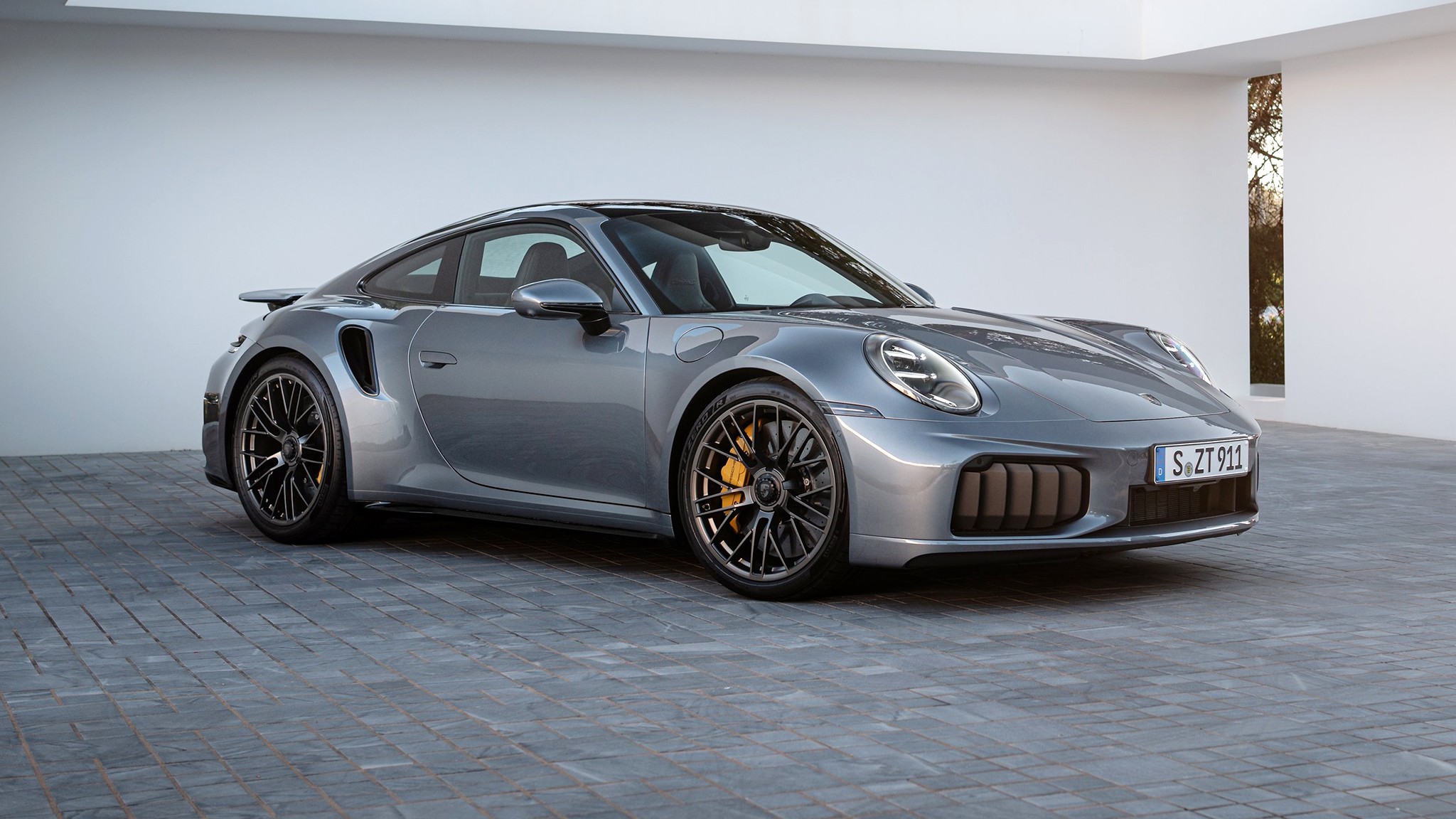
My head snaps back as the hybridized 2026 Porsche 911 Turbo S rockets forward. Moments before, Jörg Bergmeister—the sports car racing champion and Porsche test driver—had switched drive modes in the 911 Turbo S development prototype and punched it toward the first corner of Porsche’s Weissach track.
In Porsche’s record-setting Taycan Turbo GT, I’ve launched friends and family into the horizon with that electric car’s seemingly endless thrust. It’s got more than 1,000 hp to the new 911 Turbo S’ mere 701 hp, yet the 911 feels just as quick.
So that’s what that’s like from the passenger seat.
How did Porsche do it?
“911s Are All the Same”
Anyone who thinks 911s are all the same hasn’t paid attention to the lineup in a while. A dizzying array of options exists so (rich) enthusiasts can feel like a kid in a candy store.
Some are RWD, others AWD, and power is naturally aspirated, conventionally turbocharged, or hybridized. Each difference subtly affects the character of the car.
Now, the flagship model leads with hybrid technology.
Astoundingly Quick
With standard AWD, the 2026 911 Turbo S picks up where the 911 GTS hybrid leaves off.
Top speed is 200 mph, incredible for any car, let alone one that attempts to balance road-tripping comfort with all-out capability. For those keeping score, however, the previous Turbo S was good for 205 mph.
Acceleration from 0 to 60 on the new model is a head-snapping 2.4 seconds, two tenths quicker than before and close to the quickest Taycan Porsche offers.
“Two and a half seconds [from 0 to 100 kph] is at the corner of what is possible for physics,” Michael Roesler, 911 model line director, jokes. Roesler says that now, but we suspect there’s more in the tank before the 911 becomes fully electric one day.
Maybe that won’t happen too soon, though. When asked whether the 911 Turbo S could become a plug-in hybrid (such as some Mercedes-AMGs), he responds in the negative, quipping: “Is this a 911 or a lorry?”
Curb Weight Goes the Wrong Direction
Going hybrid on any car means a weight gain, and the 2026 911 Turbo S is no different. Porsche estimates the coupe’s curb weight has increased by 180 pounds. We’ll be the ultimate judge of how the car feels to drive, but Porsche gets ahead of the weight story.
A prototype of the new 911 Turbo S completed a lap of the Nürburgring in 7:03:92 minutes, about 14 seconds quicker than the last version. Bergmeister says the car feels more agile than before.
Though today’s experience is passenger-seat only, we’ll be looking for both capability and an engaging feel—something that’s difficult to achieve but rewarding when cars achieve it—when we get a chance at driving the production version. In MotorTrend‘s experience, testing a half century’s worth of sports cars, the 911 is one of the most consistently excellent models around.
That’s why we’ll give the engineers the benefit of the doubt on how the car feels, as well as how it sounds—American-spec models may be louder than the European-spec development prototype we experienced.
How Porsche Upped Performance
Improving the 911 Turbo S didn’t happen simply from hybridizing the car, but we’ll start there. A total of 701 hp is 61 hp more than the outgoing Turbo S, and it comes between 6,500 and 7,000 rpm. Max torque is 590 lb-ft, available from 2,300 to 6,000 rpm.
That torque figure matches the outgoing car’s, but the real story here is the added responsiveness hybridization makes possible.
Where the GTS hybrid has one electric exhaust gas turbocharger, the Turbo S has two of these so-called eTurbos in Porsche’s T-Hybrid setup. Each spins faster than the GTS unit and is larger than those in the previous Turbo S.
The eight-speed dual-clutch automatic transmission has an integrated motor, and a small 1.9-kWh battery pack is the same one from the GTS.
Other enhancements include:
- The rear tires are slightly wider than before, measuring 325/30 ZR 21s. For a fun apples-to-oranges comparison, that’s 67 percent wider than the Prius’ base tire. Fronts come in at 255/35 ZR 20.
- New brake pads that promise more feel, and the rear discs are 20 mm bigger than before. These are the largest ceramic composite brakes Porsche has ever fitted to a production 911.
- Better aerodynamics from vertically stacked cooling air flaps in front with an active front diffuser.
- A rear wing that tilts to reduce drag or lift as necessary.
- The Porsche Dynamic Chassis Control system is now electrohydraulic for faster response (reduced body roll), and the front axle lift is quicker to deploy, too.
That’s a good thing, because we’d hate to scrape the front of our $272,650 car on a driveway. As for the drop-top, the 911 Turbo S Cabriolet now starts at $286,650. Porsche notes this price doesn’t include any potential tariffs, but we suspect buyers considering a 2026 911 Turbo S won’t mind if the already-high price climbs a little higher still.
Who knows—hold onto one long enough, and owners may just sell it for what they paid. We checked with the experts at Black Book, and they confirmed what we suspected: The 911 Turbo S holds its value better than the average high-end sports car.
Look At It
Porsche points out that some trim pieces inside and out are finished in Turbonite, a gray color exclusive to Turbo variants. In person, we can confirm how awesome this looks over a car painted dark gray.
That’s cool, but the biggest visual impact comes from how wide this thing is. You can’t miss the stance, which is about 2 inches wider on this Turbo model than the already wide-track standard Carrera models.
Car-spotters should know the 2026 911 Turbo S has a redesigned rear fascia and available oval-shaped titanium exhaust outlets.
Two Unexpected Options
If you’ve read this far, you already know how entertaining Porsches are to configure. The extensive options list helps owners—and dreamers—get closer to their perfect build. Now there are two interesting new ways to send 911 Turbo S builds across the $300,000 threshold.
The first are lightweight carbon-fiber windshield wiper arms. Excited? What if we told you these wiper arms cut weight by just over a pound compared to the standard components?
If that doesn’t move you, how about a Porsche Design watch available with accents in every color you can finish a 911 with? The watch’s strap is made from original Porsche leather and stitching thread. The winding rotor can be selected to match the wheels of the car it accompanies.
Why the 911 Turbo S Matters and What Holds It Back
If all this talk of wiper arms (woo!) and customizable luxury watches sounds unnecessary, well it is. No one needs a $300,000 rear-engine sports car with 701 hp. The 911 Turbo S’ biggest weakness remains: It shares the same basic design as 911s that cost half as much.
Still, there’s purpose to this new flagship. The hybridization demonstrates there’s still plenty of life in gas sports cars, ones that sound better than electric sports cars ever could.
No, not everyone will understand the point of a sports car whose capabilities few drivers will ever exploit. A full 38 percent of 911 buyers have already owned a 911 before, so they probably know what they’re getting into.
Soon enough, we’ll get behind the wheel, and the enthusiast community will know whether this iconic model lives up to the standard set by its predecessors. We can’t wait to try it.


