

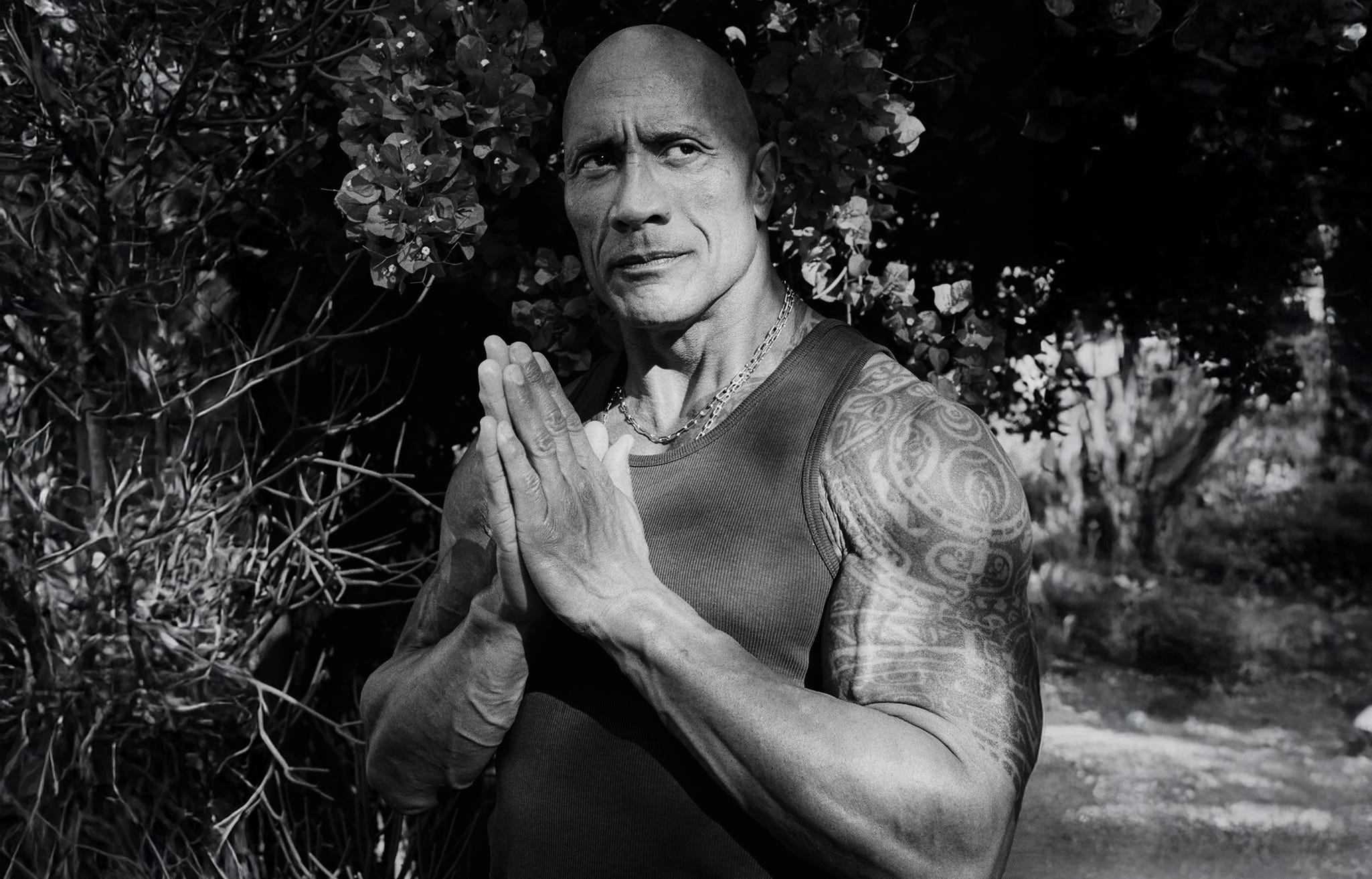
He’s at thirty-five thousand feet in the bird, somewhere over the Mojave Desert, and Dwayne Johnson is talking about his balls. One of his balls, actually—the one on which he felt a lump last Friday night while he was taking a shower. It hurt when he touched it. His tequila on the rocks sloshes gently in the mahogany cup holder as he describes the lonely terror he felt in that moment, then beyond that moment, for the rest of the night at home, and for the whole weekend, when he kept hoping it would get better and it got worse. On Monday he was supposed to stand on a stage with Kevin Hart and Jack Black promoting the newest Jumanji movie, yukking it up and smiling for a thousand photos, but all he could think about was whether his left testicle might kill him before his fifty-fourth birthday.
“I didn’t even tell Lauren,” he says of his wife, whom he has known for almost twenty years and been married to for seven. “I didn’t want to worry her before I knew if it was anything to even worry about.”
He takes a sip. He calls the private jet “the bird” because it’s kind of funny. The time is 11:15 on a Thursday morning. When we took our seats about a half hour ago for the quick flight from Los Angeles to Las Vegas, he had looked at his watch, then up at me, then again at his watch—then he raised that Dwayne Johnson eyebrow. He smiled, looked up at the flight attendant, Marilyn, and with a soft politeness in his voice asked if she wouldn’t mind retrieving the bottle of Teremana tequila, the company he cofounded, from the back of the plane. “It should be in the closet,” he said, pointing to the rear of the eight-seater. The fact that there was a bottle of tequila stashed away looked as if it was news to Marilyn.

“By the way: I’m fine,” he says, returning to the topic of his ball. “But I didn’t know that then, and the thing was really painful.”
He finally called his doctor late Sunday. First thing Monday, the doc felt the lump and said it was probably epididymitis, inflammation of a tube at the back of the testicle that stores sperm, but it could be cancer.
What’s your schedule today? the doctor had asked.
Johnson told him about the all-day Jumanji event.
His doctor said Johnson needed to get an ultrasound first thing the next morning.
“So I had to live with that for those twenty-four hours, not knowing—and I had to be on all day, joking around, making speeches,” he says.
He takes another sip. “But! I’m okay. So.” He smiles, then the plane hits a quick pocket of turbulence and he cinches his seat belt a little tighter. He doesn’t like turbulence.

Shirt by Dolce & Gabbana; vintage trousers, available at Doppelganger NYC; watch, necklace, and sunglasses by Cartier.
This article appeared in the Summer 2026 issue of Esquire
subscribe
The revelation that one of the world’s highest-paid actors doesn’t have testicular cancer but rather just a touch of the old epididymitis is not even the point of Johnson’s story, really. The point of the story is the fact that he’s telling it at all. I’m not suggesting that his recounting to a reporter a truly scary episode was strategic or premeditated. In fact it seemed to come up only when some unrelated thing I said made him think of it. But he is telling it to me, which means something inside of him wants me to know it and, by the transitive property, wants you to know it too.
We all want to be seen how we want to be seen. It’s why we dress the way we do, why we use product in our hair or don’t, why we post what we post on social media or brag about how we don’t even have social media. But this guy. He has perfected the art of being seen how he wants to be seen. He’s brilliant on the socials—upbeat and generous and self-effacing and unrehearsed. His movies are loved by the masses. People have talked seriously about wanting him to run for president. Does he really need to be doing this interview to help sell the live-action Moana movie? And even if, okay, yes, this is part of his obligation to market the movie, does he need to have me on the bird going to Vegas? And did we need to drink—no exaggeration—an entire bottle of tequila last week over lunch? And does he need to send me all these great texts—audio texts, video texts, text texts—for the days and weeks after Vegas, when his agreed-upon participation in this article is complete? Don’t get me wrong: I’m enjoying every minute and every text, because yes, he is as disarming and jocund and charming as you hope and imagine he is. But between the movies and the tequila company, the dude is worth something like a billion dollars. Moana will surely do blockbuster numbers at the box office and then stream for decades, Esquire interview or not. I think I’m okay company, but this all seems to be going extraordinarily well, and I really want to know why.
We’ll be landing soon.
“Are you good?” he asks, clinking his ice. “Do you want any more?”

Knit cardigan, knit shirt, and trousers by Hermès; shoes by Ferragamo; necklace by Cartier; watch by Jaeger-LeCoultre.
So, right: the lunch. A week before. The plan is to meet at one o’clock at the Hotel Bel-Air. His team emailed a few days ago asking if I’d like anything to drink during the interview. I said tequila, then worried that that was maybe not what they meant—like maybe a normal person would have said sparkling water or a matcha latte. But, bless his team, they replied with enthusiastic emojis, and when I sit in a curved open-air booth in the corner, an unopened bottle of Teremana Añejo stands at attention on the white tablecloth, a thin layer of frost melting into glacial beads sliding down the glass.
We don’t break into it right away. Right away he starts asking me questions. He’s across from me in the booth, and I’m answering while at the same time taking him in, and yes, he is a large man, with cantaloupe biceps and a neck that I want to try to see if I can get my fingers all the way around. His team has said he has a “hard out” at three o’clock, and we are minutes in and I’m trying to figure out a way to stop talking about myself, but that’s what he seems to want to do. He already knows where I went to college, all of that. Around the nine-minute mark, he twists the cap off the bottle and gives us each a sturdy pour. He asks more questions. He learns I’m from Connecticut, where he attended middle school and part of high school, and whatever the hell else I’m telling him, and I’m realizing that I’m blowing the interview because we’re at the nineteen-minute mark and I haven’t learned a thing about Dwayne Johnson.
Except that, of course, I have.
“I really like the question,” he says, after I finally get one in. The question was, How thin or thick is the line between Dwayne Johnson and “Dwayne Johnson,” and how does he maintain that barrier?
“Is it a lot of work to control what the world sees of you? When you go into public Dwayne mode, can you be as real as maybe you want to be all the time? We’re obviously not going to sit here for two hours and you tell me your deepest, darkest secrets—”
He cuts me off.
“Well, when it reaches about that line”—he laughs a little and holds his finger across the bottle just a couple inches from the bottom—“that’s when it all comes out.”

Coat, vest, and trousers by Giorgio Armani; shoes by Mark Chris; watch by Chopard.
I reach for the bottle.
“I’m sorry,” he says, genuinely apologetic. “Let me do that.”
He repours for both of us then continues, explaining the escalating levels of life, of which he is in the fifth:
“I love the question because I’ve reached this point in my life, Ryan, where I feel like I’ve worked hard to just be at peace. As dudes, as young men, teenagers, twenties, we’re trying to find ourselves. Then, in the thirties, that teenage bravado and confidence begins to wane because you’re like, Oh shit, I got to figure stuff out. You hit your forties and you’re trying to figure who you are. Feels like you got your job locked down. Hopefully you got your family. But wait: Who am I? What’s my why? By the time I hit my fifth level—I’m fifty-three—I was working hard just to find what peace meant. Things in my world have become less presentational, less broadcast-y, more ‘I’m going to put in the work, and I’ll keep it as quiet as I can.’ ”
The work is acting. Last year, Johnson acted in what he calls “an art-house drama,” The Smashing Machine, directed by Benny Safdie and based on the life of mixed-martial-arts fighter Mark Kerr and his battle against painkillers. Johnson’s performance succeeded at the highest level. He spoke every line as if it had just come into his head. He was restrained, quiet, even meek. I remember seeing The Smashing Machine and thinking: Oh my God, the Rock is going to get an Oscar nomination for Best Actor. He didn’t. I attempt an awkward, añejo-tongued question about whether that was disappointing for him.
“You should have been nom—how do I even ask this?”
“How? Just ask it!”
“Okay. Awards are kind of stupid unless you win one—then they’re great. How do you feel about it, a year later?” (Right now, use the stopwatch on your phone to count nineteen seconds. That’s how long Johnson pauses before answering. It’s a long, long time.)
“It would have been incredible to get nominated for an Oscar. … I realized very quickly that it’s a rare thing to reach this pinnacle where you’re even having these conversations. And it’s exciting! It would have been amazing. I wish it happened. But it didn’t. But in no uncertain terms did I ever think, Oh, that doesn’t matter. I always thought it mattered. And it has lit a fire in my spine”—he laughs suddenly, as if surprised by his own artful phrase, then is serious again—“which is: Let’s go back to work.”
The man who used to stand in a wrestling ring and shout, “If you smell what the Rock is cooking!” is working with some of the most respected directors alive. He has another movie coming up with Safdie and two others after that: one with Darren Aronofsky, the brilliant, enigmatic director of Requiem for a Dream and The Whale, and one with Martin Scorsese, who is Martin Scorsese.

Shirt by Dolce & Gabbana; vintage trousers, available at Doppelganger NYC; watch, necklace, and sunglasses by Cartier.
Aronofsky has known Johnson since he directed The Wrestler in 2008. “For a film that went deep and explored some hard questions, it was wonderful when the wrestling community embraced us—including its biggest star,” Aronofsky says. “Dwayne was very vocal in his support of me and the film.” He calls Johnson’s performance in The Smashing Machine “fearless.”
“Dwayne is remarkable in The Smashing Machine,” Scorsese says. “He and Benny, along with Emily Blunt and Ryan Bader, went deep together. They got into some challenging and uncomfortable territory that really stunned and enlightened me. Dwayne is one of a kind.”
The waiter appears.
DJ: Do you want a little something? Whatever you want.
RD: I’ll have a nibble. You brought your own thing?
DJ: I did. I brought a thing.
RD: You brought healthy, like, “Rock” food?
DJ [without missing a beat]: Well, just for the story. Then I’ll go to In-N-Out after this.
RD: Seriously, what did you bring.
DJ [holding up a container from home]: It’s shredded chicken and ground buffalo.
RD: May I have the Baja Gulf prawns, please?
DJ: Do you have a spinach salad?
Waiter: We could do that.
DJ: With balsamic vinegar on the side?
Waiter: Got it.
DJ: And maybe carrots? And what else can you put in there?
Waiter: Cucumber, asparagus, I guess. Uh, cucumber. Broccolini.
DJ: Broccolini. Good for the colon, I hear!
RD: Okay. Hold on, sorry. I didn’t know—may I actually get that salad too, please, instead of the prawns?
We return to the difference between the public DJ and the … private is the wrong word, but … the normal DJ. When he was filming the live-action Moana in Georgia, Lauren was home in Los Angeles with their daughters; he and Lauren were going through some stuff. It was the kind of stuff you go through in a marriage. They had little kids, and that’s hard, and Johnson was working for weeks in another state, and that’s extra hard, and things just weren’t going great at home. Nothing catastrophic. This wasn’t Armageddon. Just … you know. Stuff.
Johnson had been divorced once before he got together with Lauren. He and his first wife, Dany Garcia—with whom he remains friends; she has produced many of his films—had bought a dream house, added onto it, everything seemed terrific, they had a baby girl … and then, “a year later, I’m in a little apartment.” The shock and pain of that split stung, and a few years passed before he felt ready to propose to Lauren. “Cold-Feet Johnson over here,” he says. But he did, and they had their girls, and they were a family.
Most people, when we’re going through what’s known as a rough patch, it sucks, but we can go to work and get through the day. The words spit the night before in frustration; the clang of the coffee mug on the counter piercing the cold silence of the next morning; the pit in our stomach, the regrets, the avoidant looks; the chilly, distant tone as we hang up the phone—through all of this we can swallow hard and breathe deep and smile for the kids and go to work and do our job.
What if … what if this moment, using AI to study himself after some tequilas and ground buffalo, is the beginning of the Rock running for president?
Johnson? His job was to show up in front of hundreds of people each day and be the happiest man alive. If you haven’t seen the original, animated Moana from 2016, you need to know that the character Johnson voiced is a giant vessel of positivity. He sings a buoyant, happy song and flies over the ocean transforming into, among other things, a gleeful whale, using his charm and wisdom to convince young Moana that she can harness the sea to save her people (or something like that). In this new live-action version of the film, he is Maui in flesh and blood, singing, dancing, working that smile that’s as big as his head…
“… And we’re going through our stuff. And you know that, hey, the end goal here is, We’re going to anchor in even stronger and make this thing work. The heartache of it from the moment you wake up and you know: I have to face this, and we have to face it together, when we decide to face it together—which we did—but first I had to go on set, and this character of Maui is a joy bomb. I’m trying to imbue this young girl, Moana, with confidence and power. And, and, and—”
He shakes his head a little, takes a sip.
“Every day is a mess.”
He and Lauren talked to someone they trust, and they anchored in even stronger and they made the thing work. (Near the end of our interview, she will leave him a voice text, and you can hear the smile—you can hear the adoration—in her soft, sandy voice: “I hope your interview at the hotel is going amazing! I already know it is.”)
Toward the end of The Smashing Machine, Safdie creates a soundtrack moment as powerful as the use of “Layla” in Goodfellas, “Fight the Power” in Do the Right Thing, or “Ode to Joy” in Die Hard. During an operatic eight-minute scene in which a struggling couple is giving in to near-total emotional destruction, “Jungleland,” the 1975 Bruce Springsteen song that’s an opera in itself, plays pretty much uninterrupted, its cadence timed perfectly to the rhythms of the scene. Johnson, as Kerr, flips from quiet to explosive.
“His film knowledge is incredible,” Safdie says. “I can talk about Jimmy Stewart’s performance in It’s a Wonderful Life and relate it to Mark Kerr, and Dwayne knows exactly what I’m talking about. In the subtle breaths he was taking and the pauses he made—I realized I could ask Dwayne to do anything.”
In my brain at the moment—remember that a bottle of tequila is a lot of tequila—“Jungleland” is a good segue to politics and the fact that I’d seen a Springsteen show in L.A. two nights before: “You could be like Springsteen, who I saw the other night—he’s on this tour people are calling the No Kings tour, because he’s seventy-six years old and, fuck it, this is what he wants to say,” I tell him.

Vintage shirt by Wrangler; tank by Calvin Klein Underwear; vintage jeans by Levi’s; watch by Piaget.
“So is this more of a political show?”
I say yes, it is overtly political. I ask whether he stays away from talking much about politics because he wants everyone to see his movies, which would be a perfectly understandable thing.
He doesn’t fill the silence right away. He sits back, looks up. Then: “Let me think about this for a moment.”
He allows more space.
“What I have learned through experience,” he says, “is that I need to keep—need, not want—the main thing the main thing. And the main thing for me, the thing that in the morning I swing my legs out of bed and I run towards, is creating. It’s art. It’s storytelling. I’ve learned I’m going to keep my politics to myself. There are moments when, hey, there’s nothing we can’t talk about. If I’m wrong, I’ll tell you I’m wrong. Or if I feel like I got a leg up and this is the right way to go, I’ll share it with you. Politics is omnipresent and it’s forever. I don’t like it. [Laughs.] I hate it at times. I hate the slinging. I hate all the bullshit that comes with it. Because when I hear you talk about Springsteen, who I love, and this idea that he’s speaking directly to Trump in his concerts, my first thought as you were telling me that, in my head, I went, Oh, then why don’t they talk? They should sit down and talk. I don’t know where that goes, but I do know that’s an important step.”
The waiter, noticing our large cubes of ice have gone small and melty, asks, “Did we care for another ice block?”
Yes, please, Johnson says.
The politics question is relevant not only because of the regular pondering in the media about whether he will run for president, and not only because politics sooner or later enters every conversation with anyone these days. It’s relevant because of the tangential topic of masculinity and its role in whom we choose to lead us. The history of the world has been a challenging time to be a woman, and in the past decade or so men have been learning a fraction of what that’s like—and some of them are throwing a tantrum. On social media, man-boys preach aggressive misogyny and self-abusive looksmaxxing, and the president of the United States grabs ’em by the pussy. A portion of the male population has regressed to measuring self-worth using metrics including handsomeness, physical size, and extreme wealth while also devaluing kindness, honesty, humility, respect for women, and sensible cars.
He disappears into his own heart for a moment, and when he speaks, it is hard to hear him from in there. “That became the low point a little later,” he says.
Johnson has never heard of looksmaxxing, the extreme devotion to physical appearance that for some young men includes breaking their jaws with a hammer in an attempt to sculpt a chiseled face. (“Dude, that sounds terrible.”) But he understands that as a masculine 236-pound muscleman, a former professional wrestler, and an internationally famous actor who makes many manly movies, he is looked up to, maybe even by some of the same confused young men who have also checked out the bros of TikTok.
“I’m hyperaware of my position, who I am and what I am to young men,” he says. “I know because I hear from them every day, Ryan, on social-media comments. DMs. Just guys out there. And I don’t want that to go away, because I know what it’s like to struggle as a young man and try to stay on the right track and make fucked-up decisions and do things that are fucked-up and pay the price, get arrested. So yeah, I’m aware.”
He replies—not to all of them. He can’t. But he tries. He figures if they took the time to write him asking for help, they might listen to his answers if he writes to them personally, using their names, the way he does with me in this conversation. If he does that, he’s got a shot—“the shot that I’m talking about is a few things that help them identify what masculinity really means and to embrace it.”
Here are some of the things he tells them:
Respond to challenges and bad things that happen to you. Not react. Take a moment to respond. Big difference, and that’s where the power is—when you respond instead of react.
It’s okay to be kind.
It’s okay to be respectful, not only to your boys but to the ladies in your life.
If you say you’re going to do something, do it.
If you can’t do it, say you can’t do it.
This is a big one, because I’ve been there: If you’re hurting, if there’s pain, if you’re unsure or insecure about something, ask for help. Talk about it. It doesn’t make you any less masculine.
Three hours and most of the bottle into the conversation, the subject matter skips around, tethered only to the logic of slight impairment. The discussion of masculinity has led us (naturally, it feels) to talking about artificial intelligence and its possibilities and threats. Johnson is cautiously interested, even excited.
“I’ve always been an advocate for embracing big change—after taking a hard look at it,” he says. “We can either stick our heads in the sand and be afraid, or we can say, Okay, we’re here. Let’s see. Let’s explore.”
The waiter again. He’s leaving for the day and politely wonders if we can settle the bill. I offer to put it on Esquire, which is customary, but Johnson tells me my money’s no good here, using those words.
“And if you want another block of ice, let me know,” the waiter says.
“Yes, please, we’ll have two more rocks,” the Rock says.
I thank him for paying. He looks at the check, signs it, then looks up at me with wide, searching eyes and says, “Um?”
“ChatGPP,” I say, a little slurry.
“Right!”

Shirt and trousers by Commas; loafers by Dolce & Gabbana; necklace and ring by Cartier.
I’ve never used it, I tell him, too loudly. Is it an app? Do you go to a website? He fumbles his phone from his pocket and starts thumbing across screens, searching.
“It’s—it’s—it’s—here. Yeah, it’s an app. It’s right here on my phone. ChatGCP. GPT.”
He’s new to it too, he says. He tried it for the first time just a few weeks ago. He had finished filming Jumanji in Hawaii, and he was off his fitness routine. One night he downloaded ChatGPT, signed up, and asked it what he should do. He framed his query in detail—Johnson likes detail. He told it what he’d eaten that day, how much he’d slept the night before, and what he wanted to accomplish. He said he wanted an intense workout with drop sets and a rest/pause on the final three. (He’s telling me all this, using weight-room vernacular, as I’m slurping tequila, no idea what he’s talking about.)
“And Ryan, within three seconds it comes back with a training program that’s lights-out, pencils-down spectacular. Like it came from ten of the greatest coaches I’ve ever worked with,” he says. “Very specific. I wound up having an extraordinary fucking workout. And then it’s telling me, ‘Make sure you’re taxing this muscle group halfway through—and make sure you’re getting enough carbs, and let’s add a little salt to your diet tonight because you’ve had a long day.’ ”
His eyes pivot to me, the whites bigger than any whites of any eyes I’ve ever seen. DJ, amazed. Now we’re just two buzzed guys who don’t realize we’re buzzed. (“I feel fine.” “Me too. Totally.”) And we’re playing with this new toy like it’s a Magic 8 Ball.
“Let’s ask it something,” I say.
“What comes to your mind?”
“Is Dwayne Johnson running for president?”
“All right,” he says, and starts typing. “Maybe we have to reframe it.” He starts over: “How about, ‘Do … you’—I can’t fucking believe I’m doing this.”
He rubs his chin. “Okay: ‘Polls … have … been taken. The majority of Americans want Dwayne Johnson to run for president.’ Right? Oh, and then maybe: ‘Why?’ ”
He looks at me. We both nod gravely. Yes. An open-ended query makes it interesting. By asking why people might vote for him, Johnson is essentially asking AI to do exactly what it does: scrub the entirety of the human record for not only what people think of Dwayne Johnson but also how they consume him. An instant poll of everyone.
His finger hovers over the screen then taps enter. Boom. Less than a second later, words, so many words, fill screen after screen, faster than the human eye can follow. When it stops, we huddle over the screen and read together in silence.
Short answer: It’s less about people seriously evaluating policy—and more about how Dwayne Johnson is perceived in a cultural and emotional sense. Here’s what’s really driving those poll numbers. 👇
1. Massive likeability + trust factor
Consistently ranks as one of the most liked public figures in America.
• He’s seen as authentic, hardworking, and positive
• His public persona = discipline, resilience, humility
• People feel like they “know him” through social media
2. Anti-politician sentiment (this is BIG)
A major driver is actually frustration with traditional politicians.
• Many Americans feel politics is divisive, corrupt, or ineffective
• So a non-politician with leadership traits becomes appealing
In fact, one poll found 63% of people think celebrities could be good politicians if they had the right team [Newsweek]
👉 Translation: People aren’t necessarily voting for the Rock—they’re voting against the current system.
“Dude,” he whispers.
“Wow.”
“Tell me when I can scroll.”
As he scrolls line by line through screen after screen, we take turns mumbling words and lines with awe and wonder, like Goonies reading the treasure map.
“ ‘Strong leader’ archetype…”
“Taps into a very old psychological pattern: People associate strength, confidence, and charisma with leadership ability.”
“Four: Bipartisan/non-divisive…”
“Emphasized unity and bringing people together…”
“Football, WWE, Hollywood, business empire…”
“Overcame early struggles…”
“That narrative equals ‘self-made leader.’ ”
“Check out the last thing it says: ‘If you want, I can break down whether he’d actually be viable in a real election.’ ”
He hasn’t flinched. He is just staring at his phone. What if this is how it happens? What if … what if this moment, using AI to study himself after some tequilas and ground buffalo, is the beginning of the Rock running for president?
“I gotta show this to my team,” he says. He might be joking. But he’s not laughing.

Sweater and trousers by Giorgio Armani; necklace by David Yurman; bracelet and rings by Bulgari.
Five years ago, Johnson debuted a TV show on NBC called Young Rock, a sitcom that told the choreographed but generally true-to-life story of his youth. The concept was that it’s 2032 and Johnson, playing his future self, is in fact running for president of the United States. As he campaigns around the country, he gives interviews in which he tells stories about his past, and those stories become extended flashbacks, with actors playing Johnson at various ages.
The light outside the restaurant windows has gone gray. The glistening sliced limes and lemons the waiter brought for the tequila hours ago—long before we blew past the hard out at three o’clock—have shriveled some. Johnson’s arm is slung over the back of the booth.
As a kid he had multiple honorary uncles—pro wrestlers who were friends with his father, the wrestler Rocky Johnson, including Andre the Giant, “Rowdy” Roddy Piper, Randy Savage, and his actual uncles, Sika and Afa Anoa‘i, known in the pro-wrestling world as the Wild Samoans. All those guys are depicted on Young Rock. It’s all there: young Dwayne flirting with girls and getting caught shoplifting, his parents splitting up, the injuries he endured while playing football at the University of Miami.
But kids watched Young Rock, so certain episodes in Johnson’s life were not written into the episodes of the show.
When he was fifteen, he and his mother were living in Hawaii but couldn’t afford the rent on their apartment and were evicted. Dwayne’s mother sent him to live with his father in Tennessee, where he was working. When Dwayne arrived at the airport after a long trek, duffel bag over his shoulder, he looked around for his father. A man approached him and said Rocky had asked him to pick up Dwayne and drive him to a motel. When they arrived at the Alamo Plaza motel on Murfreesboro Road southeast of Nashville, Johnson found that his father was not there either. Dwayne would be living with a man named Bruno, a friend of his father’s.
The Alamo Plaza was a one-story place where you parked the car outside your door. Dwayne used to walk ten minutes down the highway to the Piggly Wiggly and steal eggs and bread. Bruno owned a plug-in electric griddle, and they would eat eggs and toast. Sometimes they saved up for the cheap all-you-can-eat buffet at the restaurant next to the motel and sat eating for hours.
In an interview in 2025, Johnson described the eviction in Hawaii as the deepest pain he had experienced in his life. I asked him whether that moment when he stood as a teenager at the airport in Nashville, expecting to see his father’s smile but instead being driven away by a stranger, might have been a worse moment. The lowest point.
Johnson looks at the table. The tequila is gone. He disappears into his own heart for a moment, and when he speaks, it is hard to hear him from in there. “That became the low point a little later,” he says. At the airport, he felt only a kind of logistical confusion—Wait, what? Who are you again? My dad said what?—and a tinge of the shaky, built-in fear of climbing into a stranger’s car. The asphyxiating realization that his father didn’t want to pick him up, didn’t want to wrap his arms around his boy, a boy who had just been evicted from his home and then traveled six thousand miles alone, counting the minutes until he saw his dad—it didn’t crush him in the moment. That took years to crush him, and there are moments when it crushes him still.
Two months after he arrived in Nashville, Dwayne’s mother arrived as well. Around three o’clock one afternoon, she pulled into the Alamo Plaza parking lot. Rocky was there, and Dwayne, and Bruno.
“Wait a second,” she asked her son after a few minutes, disbelieving what she was seeing. “Where do you live?”
“Here,” Dwayne said.
“And you live here with your dad?”
“No, with Bruno.”
“With—who’s Bruno?” She turned to her husband. “And where do you live?” she asked Rocky.
And Rocky said, “Oh, I got a place.”
Ata Johnson is a smart woman, and Rocky had made her look like a fool, coming all this way to Tennessee only to find out he was living with—living with!—another woman. She froze, as if her body were momentarily unable to move because her mind needed all its power to process what she was learning.
Rocky, placating, suggested they all get something to eat and talk this thing out. They drove to a Shoney’s Big Boy for hamburgers. Dwayne sat in the booth and listened to his parents. He watched their faces, listening and looking for any hint that it was all going to be okay after lunch, that his dad would smooth things over like he always did. When Johnson looks back on that lunch now, he knows he was watching his world fall apart, but he had no idea what was about to happen.
“We go to leave,” Johnson says. “I jump in the car that my mother just drove across the country, and they get in the car my dad is driving.”
The car his dad was driving was a light-blue four-door Nissan Maxima. As the three of them left the restaurant, his mother noticed that the Maxima had Illinois plates even though Rocky had been living in Tennessee. Ata froze again, as she had at the motel. Only this time, all the air went out of her body. She didn’t say anything. She just slowly slid into the passenger seat of another woman’s car.
Dwayne could drive because you could get your license at fifteen in Hawaii then. He was following the light-blue Maxima. Then his father, driving the Maxima, swerved hard to the right across two lanes over to the shoulder, and then onto the gravel beyond.
Johnson seems to view this magazine story as a good chunk of the world asking him how he’s doing and caring about the answer, so he’s going to give it.
Dwayne pulled up behind them. The passenger door opened, and his mother got out of the car and started walking toward Dwayne’s car. Good, he thought. She’s coming to ride with me.
But then she banked in front of his car, a look in her eyes like he had never seen. She crossed in front of the bumper and kept walking over the gravel and into the oncoming traffic of I-40, into the speeding cars and eighteen-wheelers and pickups, the Doppler sound of horns screaming into Dwayne’s ears as the figure of his mother—his mom—staggered between the violent blazes of rubber and metal and glass, their horns honking and honking.
He got out of his car and sprinted into the road, dodging the rush-hour traffic with fast, terrified footwork, grabbed his mother, and carried her back to the safety of the car.
After that, after he had found a place to live with his mother, he enrolled himself in public school and drove himself every day. His mother kept the curtains drawn on the apartment windows and mostly stayed in bed. Every day, when Dwayne came home from school, she was sleeping, but there was a pot of Cheeseburger Hamburger Helper on the stove, which was better than nothing.
Even people who speak eloquently of being wounded are still hiding wounds. Even those who have worked to make the pain go away are still working, because life can always slip suddenly backward, and we have to be ready.
In the weeks after the Bel-Air lunch and the trip to Vegas—where he was presenting Moana to a convention of movie-theater owners called CinemaCon—Johnson has been communicating with me mostly via voice text. Long, often funny voice texts. After he takes the time to personally connect me with Aronofsky, Safdie, and Scorsese—which is unusual for a process that typically involves copious emails to publicists, layers removed from the celebrity himself—I send him a voice text thanking him very much. Moments later, he sends one in which he sings, in his Maui voice, the title of perhaps the most famous song from Moana: “You’re wel-come!” Then, his voice dropping an octave, he says, “How fucking cheesy was that?” In that same recording, he said something else that slid by upon first playback but emerged the third time as four of the most important consecutive words he said in our entire time talking.
He said—and I could hear the smile—“History is always watching.”
We have one shot at this, he was saying. The article you’re reading, yes—he and I obviously have one shot at that. But also how we choose to go through our lives.
When we tell each other about our shit times, our times of weakness and fear and, yes, trauma, it can be scary. We do it with trepidation at first, letting the icy water of the lake slip under our swim trunks and shrink our scrotum, reaching that little sperm tube we didn’t know we had—the epididymis. What if they don’t really want to hear it? What if they were just asking, “How you doing?” but didn’t really want to know? Johnson seems to view this magazine story as a good chunk of the world asking him how he’s doing and caring about the answer, so he’s going to give it. The answer, of course, is that he’s doing well, and not just because of the movie money or the tequila money or the easy access to the bird. He and Lauren got through the stuff. He has three daughters who love him and whom he loves. He just bought Bruno a house. As for the thing that makes him swing his legs out of bed in the morning, he’s working with directors at the top of their craft. He knows the future is watching. He has known that since his father stood in wrestling arenas in rust-belt cities and county fairgrounds all over America, and he knows that most people have forgotten Rocky Johnson.
Today, in his house in Beverly Hills, Dwayne Johnson has an office with a door that opens not onto a motel parking lot but onto a small portico ringed by verdant shrubs and soft grass. In his office, on a shelf above a painting of a rainbow by one of his daughters, there’s a small, clean glass frame, and in the frame is a postcard of the Alamo Plaza motel.
Opening image credits: Tank by CDLP; necklaces by Cartier.
Photographs by Shaniqwa Jarvis
Styling by Ilaria Urbinati and Savannah Mendoza
Grooming by Pircilla Pae using Papatui, represented by A-Frame Agency
Production by Russ Lemkin at 3Star Productions
Tailoring by Cecilia Aragon
Director of Video: Kathryn Rice
Senior Video Producer: Rae Medina
DP: Jake L. Mitchell
Camera Operator: Jacob Garcia
Senior Editor: Sam Miller
Esquire Executive Design Director: Martin Hoops
Esquire Visual Director: James Morris
Esquire Entertainment Director: Andrea Cuttler
Esquire Editor in Chief: Michael Sebastian
