







Theater review
DOG DAY AFTERNOON
2 hours,15 minutes, with one intermission. At the August Wilson Theatre, 245 W. 52nd St.
There’s been a robbery!
A new Broadway play starring Jon Bernthal and Ebon Moss-Bachrach has stolen the title of the classic New York film “Dog Day Afternoon” and slapped it on a midseason-replacement sitcom.
You certainly recognize the plot, no-nonsense characters and Brooklyn bank setting from the 1975 Best Picture-nominated heist film with Al Pacino.
But the weird show that opened Monday night at the August Wilson Theatre has contorted it into something altogether unfamiliar: a stress-free series of drama-deflating punch lines that add up to little more than a barstool yarn.
For a play about a real-life 1972 bank robbery and hostage situation, the stakes are curiously medium, as if everything will magically return to normal on next week’s episode.
Yet once you accept that this “Dog Day” is a very different breed — a frivolous comedy, basically — it is just watchable enough.


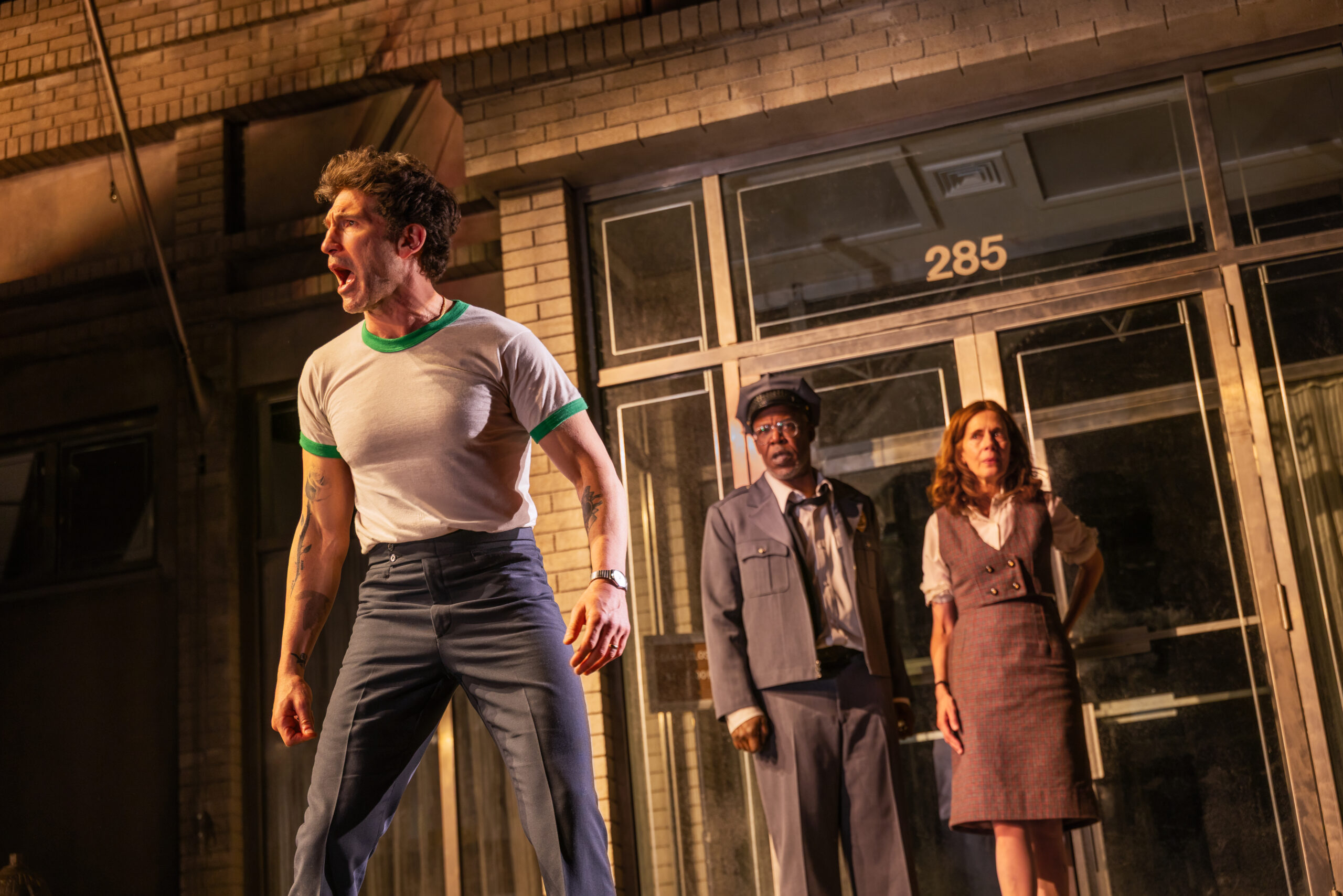
Bernthal, while not as steely as Pacino, puts his own charismatic spin on Sonny, the desperate man who traps nine workers inside the Chase Manhattan Bank in Gravesend to secure $2,500 for his lover’s sex-change operation.
Unlike threatening and shaky Pacino, Bernthal is smooth, confident and charming. He practically flirts his way inside the business at closing time. Driving his nice-guy image home, the “Walking Dead” star is dressed less like Paci and more like Chachi.
He’s solid. And some of the script’s extraneous jokes about doughnuts, Mister Rogers or Bellevue land. I laughed a few times.
However, in the wake of pharma-CEO killer Luigi Mangione, it’s striking that a play in which weapon-wielding criminals become flamboyant local folk heroes settles on irrelevant silliness as its one and only tone. Fifty-one years later, the film still hits much harder.

The goal was always to depart. Playwright Stephen Adly Guirgis has said his adaptation would not only borrow from the movie, but also incorporate more of the actual event it’s based on. Known for his quirky, larger-than-life Big Apple creations, he wanted to add some humor. Director Sidney Lumet’s film includes a riot, but it is not exactly a laugh riot.
Well, Guirgis beefed “Dog Day” up, all right, in a rather self-indulgent way that comes mostly at the expense of power (there’s none) and structure (flatter than North Dakota).
The burglary is bungled from the start — and not just by the criminals. When Sonny, Sal (Moss-Bachrach) and Ray Ray (Christopher Sears) hold up the bank at gunpoint, the employees continue to chat and toss off zingers, only louder. They are barely alarmed by possible death.
Theirs is the sort of cute terror found in the song “Coffee Break” from “How To Succeed in Business Without Really Trying,” when the 9-to-5ers can’t get their afternoon java.
Like in that wacky workplace musical, the women are personality types, not people.

Their stalwart leader is Colleen (Jessica Hecht), the stern head teller who sees protecting her girls as her duty. While Hecht is always a welcome and formidable presence, even she can’t hoist up her cinder-block cashier.
The banky bunch becomes fast friends with their captors. Everybody’s comfy. It may be 95 degrees outside on this sweltering day, but in here it’s cool and relaxed.
Take when Sal, a largely unnoticeable Moss-Bachrach, hits the manager, Mr. Butterman (Michael Kostroff), on the head with the back of his shotgun. The combat is so feathery soft and obviously fake, you get the sense they’re trying to spare the delicate audience any trauma.
We mustn’t let their pulses race!


Everywhere you look, edges are being sanded down.
Guirgis bulks up a dumb squabble for dominance between street-smart NYPD Detective Fucco (John Ortiz) and interloper FBI Agent Sheldon (Spencer Garrett). The writer chose the name Fucco so his rival can keep calling him “F–ko.” Hardy har har.
And I was let down by Esteban Andres Cruz’s performance as Leon, Sonny’s “wife” who should be the emotional center of the story. That the character is heightened and unmoving isn’t all the actor’s fault. The speech, as written, has a removed stand-up-routine quality. And director Rupert Goold hasn’t staged the scene vulnerably enough.
How remarkable that a half-century-old movie treats a trans character with more sensitivity and nuance than a brand-new play.

Even the main gimmick is half-assed. At the end of Act 1, ticket buyers become the mob outside the bank. As working-class New Yorkers begin siding with Sonny’s us-against-the-man message instead of law and order, Bernthal eggs on the audience to chant “Attica! Attica!,” in reference to the 1971 upstate prison uprising.
Some do, some don’t. Many giggle. The buildup to the chaos is weak, and the unnatural, forced effect resembles an old sitcom staple: the “Applause” sign.
Britain’s Goold, who’s directed a lot of dogs, either doesn’t know how to create tension, or just doesn’t want to. His tendency, as it was in the PTSD-bad musical “Tammy Faye,” is to amp up American characters into unbelievable “It’s a Small World After All” cartoons. Sure, they say funny lines, but we don’t care about them. They don’t engage us.
The ending, so chilling and tragic on-screen, elicits nary a gasp here.
What’s astonishing is that the people in charge keep allowing Goold to hold up Broadway theaters.


