


By Leon Stille – Feb 09, 2026, 5:00 PM CST
- Denmark’s €4 billion CCS tender did not collapse but exposed the gap between political ambition and the real-world complexity, risk, and timelines of large-scale carbon capture projects.
- Most bidders withdrew due to compressed timelines, uncertain access to licensed CO? storage, rigid risk allocation, and price caps that deterred early-stage but viable projects.
- The remaining bid, led by Aalborg Portland, highlights where CCS is most ready today—hard-to-abate sectors like cement—making the tender a valuable learning exercise rather than a policy failure.

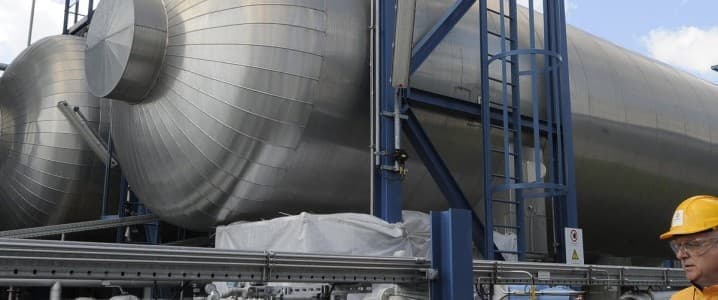
At first glance, Denmark’s flagship carbon capture and storage tender looks like a disappointment. A €4 billion subsidy scheme designed to catalyse a competitive CCS market ended with just one remaining bidder. Nine out of ten pre-qualified applicants walked away. Targets will not be fully met. Headlines quickly followed, framing the outcome as a failure.
That interpretation is understandable. It is also incomplete.
What happened in Denmark is less a policy collapse than a reality check. The tender exposed the gap between political ambition and project-level reality in one of the most complex decarbonisation technologies ever attempted. And paradoxically, that makes it one of the most valuable CCS policy experiments to date.


Denmark’s CCS programme was never small. The government set aside 28.7 billion Danish kroner, roughly €3.9 billion, to support projects capable of capturing and storing 2.3 million tonnes of CO? per year between 2029 and 2044. For a country of Denmark’s size, this was a bold industrial and climate intervention.
The intent was clear. CCS was not being treated as a niche pilot or research exercise, but as a core tool for achieving national climate targets. If fully realised, the tender would have delivered emissions reductions equivalent to several percent of Denmark’s total annual emissions. Few countries have attempted anything comparable at a national scale.
Early interest seemed to confirm the promise. Sixteen applications were submitted in early 2025. Ten were pre-qualified. On paper, this looked like the start of a competitive market formation moment.
Why Almost Everyone Walked Away
By early 2026, reality intervened. One by one, bidders withdrew. In the end, only Aalborg Portland remained, offering a project capable of capturing up to 1.5 million tonnes of CO? per year, and last minute, another bidder submitted a final bid with details unknown. Even if awarded, the tender would probably fall short of its original target.
This mass withdrawal was not driven by a lack of interest in CCS, nor by a lack of capital. It was driven by design choices that underestimated the complexity and risk profile of CCS projects at this stage of market maturity.
Timelines were one major friction point. The tender was structured around political milestones, particularly 2030 climate targets, rather than the development realities of CCS. Storage appraisal, permitting, infrastructure development and financing alignment take time. Compressing those timelines shifts excessive risk onto developers.
Storage access was another constraint. While Denmark has promising offshore storage potential, access to bankable, licensed storage on acceptable commercial terms remains limited. Without guaranteed storage, capture projects cannot reach final investment decision, no matter how generous the subsidy.
Risk allocation also mattered. The tender imposed strict penalties and guarantees for delays or changes, even where those risks lay outside the control of project developers. In a first-of-a-kind market, that kind of rigidity is not discipline. It is deterrence.
Finally, the price cap embedded in the tender created an artificial ceiling that discouraged realistic bids. CCS costs are still uncertain and site-specific. Imposing a hard cap may protect public budgets, but it also filters out projects that are technically viable yet commercially marginal in early stages.
Why the Remaining Bids Matter
It is tempting to see the survival of a single bidder and the mysterious second bidder as evidence of failure. A more accurate reading is that the tender succeeded in identifying where CCS is most ready to deliver impact today.
The remaining known project is a large cement plant. That matters. Cement is one of the hardest sectors to decarbonise. A significant share of its emissions are process-related and cannot be eliminated through electrification or efficiency alone. CCS is not an optional add-on for cement. It is the only credible deep decarbonisation pathway.
If implemented, the Aalborg project would reduce Denmark’s emissions by several percentage points on its own. That is not marginal progress. It is system-level impact. In climate terms, it arguably delivers more value than multiple smaller, more speculative projects. The second bidder is as of yet unknown but could even more reduction.
In that sense, the tender did exactly what it was supposed to do. It revealed where CCS can be deployed at scale today and where the ecosystem is not yet ready.
A First-of-a-Kind Always Looks Messy
Denmark’s officials deserve more credit than criticism. Designing one of the world’s first large-scale CCS subsidy schemes is not a procedural exercise. It is frontier policymaking.
Every early CCS programme, from North America to Europe, has struggled with similar issues. Storage uncertainty. Risk allocation. Cost discovery. Contract design. Denmark simply encountered these challenges in a more visible and concentrated way because of the scale and ambition of its tender.
Calling this a failure risks discouraging precisely the kind of experimentation that CCS deployment requires. The real failure would be pretending that CCS can be rolled out with conventional procurement logic and perfect foresight.
Lessons That Matter Far Beyond Denmark
The Danish experience offers valuable lessons for every government considering CCS or carbon removal funding.
Timelines must reflect project reality, not electoral calendars. Storage development must be treated as enabling infrastructure, not an afterthought. Risk should be shared in proportion to control. And cost discovery must be allowed to happen, even if it produces uncomfortable numbers.
Perhaps most importantly, policymakers must accept that early CCS funding will not always maximise competition. It will maximise learning.
The question is not whether every euro was allocated. The question is whether the tender revealed how to do better next time.
What Happens Next Will Define the Narrative
Denmark now faces a choice. It can award the subsidy to the two remaining bidders and secure a meaningful emissions reduction this decade. Or it can cancel and re-tender with revised terms that reflect the lessons learned.
Either path can still be a success if handled transparently and constructively. Awarding the project would demonstrate that first movers are rewarded. Re-tendering could unlock broader participation in a second round with better-aligned conditions.
What would truly undermine the effort is paralysis or quiet abandonment.
Why This Was Still a Good Outcome
From a distance, it is easy to count bidders and declare winners and losers. From a system perspective, Denmark achieved something more important. It stress-tested CCS policy under real conditions.
It learned where the bottlenecks are. It learned which sectors are ready. It learned how risk perceptions shape participation. These insights are worth far more than an oversubscribed tender that produces little actual CO? reduction.
CCS will not scale because policies are perfect. It will scale because governments are willing to iterate in public. Denmark has done that. Others should be paying attention.
The Danish CCS tender did not fail. It did what pioneers are supposed to do. It showed the rest of the world where theory meets reality, and how to move forward from there.
By Leon Stille for Oilprice.com
More Top Reads From Oilprice.com
- Oil Tanker Rates Soar Amid Shipping Shortages and Middle East Tensions
- The U.S. LNG Boom Is Lowering Europe’s Energy Costs and Raising America’s
- India’s Oil Pivot: The U.S. Gambit That Could Break Russia’s War Economy
Download The Free Oilprice App Today




Leon Stille
Leon Stille has a background in energy sciences (MSc and BSc) and is pursuing a PhD in energy policy. He currently runs his own company,…