





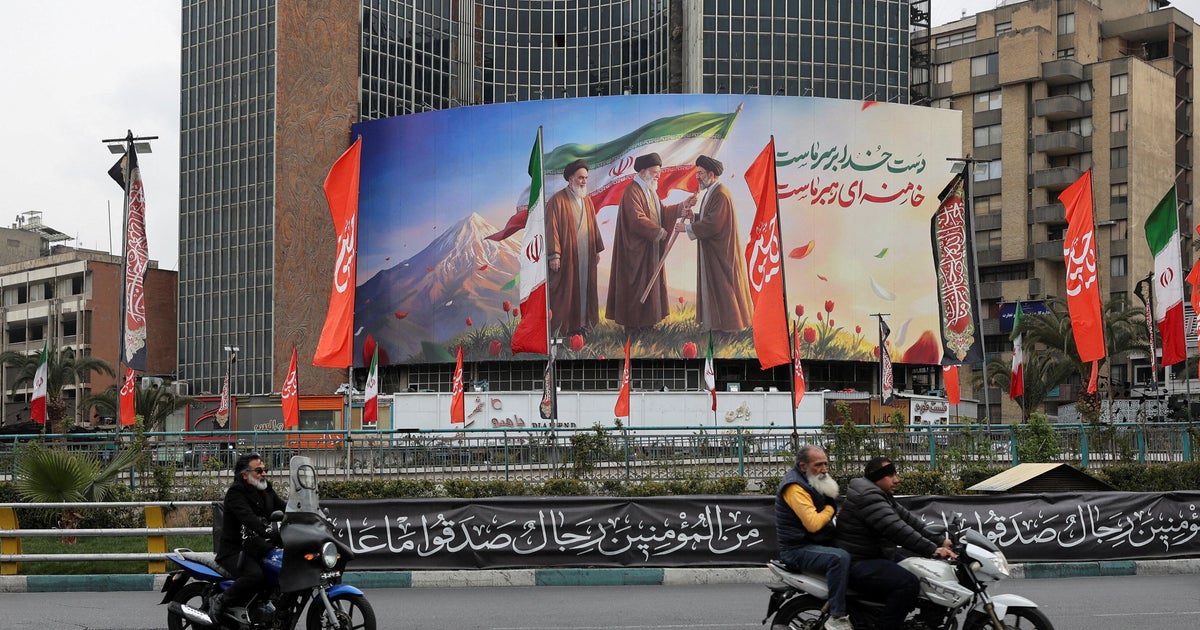
Leaders of the U.K. Germany and Italy discuss working together on Straight of Hormuz
The British government said Prime Minister Keir Starmer had spoken on the phone Tuesday with the leaders of Germany and Italy about the importance of shipping transit through the Strait of Hormuz.
The three leaders “agreed on the vital importance of freedom of navigation for vessels through these waters,” the U.K. government said, and they “agreed to work closely together in the coming days in the face of Iranian threats.”
President Trump, in a social media post on Monday, threatened to attack Iran “TWENTY TIMES HARDER than they have been hit thus far” if it did “anything that stops the flow of Oil within the Strait of Hormuz.”
That shipping traffic through the Strait included about a fifth of the global crude oil supply before the war. It has ground to a virtual halt over the last 11 days, as Iran lashes out with missiles and drones across the region.
IDF claims Hezbollah is hiding strategic weapons in a Beirut suburb
Israel Defense Forces spokesperson Nadav Shoshani on Tuesday accused the Iranian-backed group Hezbollah of hiding strategic weapons in the Dahieh suburb of Beirut, “beneath the residential buildings of Lebanese residents.”
Dahieh, long considered a stronghold of Hezbollah, was the site of the 2024 Israeli strike that killed Hezbollah’s one-time leader Hassan Nasrallah.
In a social media post, Shoshani said the arms included “missiles, drones and additional weapons funded by the Iranian terror regime and designed to harm Israeli civilians,” warning: “This is not a reality we will accept — not for Israeli civilians, nor for Lebanese civilians.”
Smoke rises from the site of an Israeli airstrike on Beirut’s southern suburbs, March 10, 2026. Ibrahim AMRO/AFP/Getty 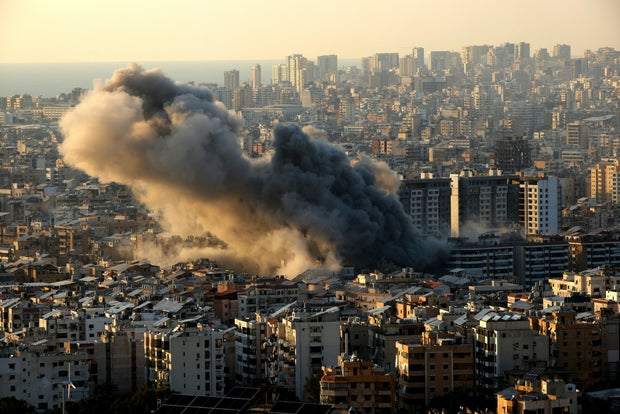

Iranian parliamentary spokesman claims war has “shifted in favor of Iran,” with a 90% targeting success rate
Ebrahim Rezaei, the spokesperson for the National Security and Foreign Policy Commission of the Iranian Parliament, claimed Tuesday that his country was winning the war with the U.S. and Israel, and he wielded a statistic that mirrored an assertion by the U.S. Chairman of the Joint Chiefs of Staff earlier in the day to make his point.
“Based on reports submitted to the commission, the balance of the war has shifted in favor of Iran, and the initiative is now in the hands of Iran’s military forces. The success rate of missile and drone strikes is estimated at over 90%,” Rezaei declared, without offering any evidence to back up his claims.
Earlier Tuesday, Joint Chiefs chairman Dan Caine told reporters at the Pentagon that the U.S. military had struck more than 5,000 targets in Iran since the start of the war and that ongoing U.S. and Israeli strikes had resulted in a 90% reduction in the Islamic Republic’s missile launches against Israel and Persian Gulf states.
U.S. Secretary of State Pete Hegseth, during the same briefing, said Iranian leaders were “desperate, scrambling,” and that the U.S. and its allies were “winning” the war.
Rezaei said Iran was not engaged in any negotiations with the U.S. — something President Trump has said he’s open to under the right conditions — and that all focus was on the battlefield and delivering a “regretful and exemplary” response to the country’s enemies.
State Department says most Americans who asked for assistance in Middle East have declined help to leave
The State Department on Tuesday said most Americans in the Middle East who had requested help later declined assistance to leave the region when offered.
“Most Americans who have requested assistance have declined assistance when offered, opting either to remain in country or book more convenient commercial flight options,” assistant secretary of state Dylan Johnson said in a statement.
Johnson said over 40,000 Americans had returned to the U.S. from the Middle East since the war began, and the State Department has directly assisted over 27,000 Americans abroad. That assistance can include just providing information.
“While commercial flight availability across the region continues to improve, Department of State charter flights and ground transport operations continue to operate,” Johnson said. But he added that the government’s chartered evacuation flights were operating “with less than 40% occupancy on average.”
Iran claims 30 spies and enemy agents arrested
The Iranian Ministry of Intelligence claimed Tuesday that 30 operatives, including spies, field agents, and media collaborators connected to the U.S. and Israel and what it called terrorist groups had been arrested.
“A foreign national, acting on behalf of two Gulf states as a proxy for the U.S.-Israeli enemy, was arrested in Khorasan Razavi. The individual had been gathering military and security intelligence in Iran and transmitting it to the Gulf states, which then passed it to the U.S.-Israeli enemy,” the intelligence ministry said in a statement, giving details on one of the alleged spies.
According to the statement, another “Zionist agent” was caught collecting and sending information about the locations and movements of Iranian military and law enforcement units and defense installations to enemy forces.
Iran regularly executes people accused of spying for Israel or the U.S.
Russian Foreign Minister Lavrov speaks on the phone with his Iranian counterpart
Russia’s Ministry of Foreign Affairs said Foreign Minister Sergey Lavrov spoke Tuesday with his counterpart in Tehran, Iranian Foreign Minister Abbas Araghchi, about “the evolving situation in the Middle East.”
Lavrov “reiterated his principled position in favor of a swift de-escalation and a return to a political and diplomatic resolution, which the Russian side remains committed to facilitating, while taking into account the security interests of Iran and its neighbors in the region.”
Netherlands says it moved its Iran embassy staff to Azerbaijan
The Netherlands moved the staff from its embassy in Iran to neighboring Azerbaijan, citing increasing safety risks, Dutch Minister of Foreign Affairs Tom Berendsen said in a social media post Tuesday.
Berendsen said he had spoken with the Dutch ambassador to Iran and his team, and they had reached Azerbaijan safely.
“We are closely monitoring developments in Iran. If the security situation permits, we will decide when and in what form our embassy in Iran can resume its activities in Tehran,” Berendsen said.
Iraq seeking new oil export routes amid Strait of Hormuz disruption
Iraqi authorities are exploring alternative routes to export oil after transit through the Strait of Hormuz was disrupted by the Middle East war, an oil ministry spokesperson told AFP Tuesday.
Saheb Bazoun said that “much like other countries in the region, oil production and marketing have been severely impacted, leaving the government no choice but to seek alternative” export routes. Iraq has several oil shipments stuck at sea, he said.
Iraq is a founding member of the OPEC group, and crude oil sales make up 905 of the country’s budget revenues. Before the war, it was exporting more than 3.5 million barrels per day.
Iraqi authorities are considering several options for exports, including a pipeline that runs through Iraq’s northern Kurdistan region to the port of Ceyhan in Turkey, and the possibility of transporting oil by land.
CBS/AFP
Just a week of war with Israel has displaced almost 700,000 people in Lebanon, U.N. says
The United Nations Refugee Agency says more than 667,000 people across Lebanon have registered with the government’s online displacement platform over the last week alone, since Israel’s offensive against the Iranian-backed Hezbollah group escalated.
The UNHCR said the number had increased by over 100,000 in a single day, and that it continued to rise.
UNHCR also said it was seeing significant movement of people from Lebanon into neighboring Syria amid the war, with Syrian authorities reporting over 78,000 Syrian nationals coming back across the border from Lebanon since the U.S.-Israeli strikes on Iran began. Israel ramped up its attacks on Hezbollah in tandem with its operations in Iran, ordering tens of thousands of people to evacuate from a vast swath of southern Lebanon as it sent troops across the border.
UAE says 8 Iranian ballistic missiles and 26 drones intercepted today alone
The United Arab Emirates Ministry of Defense said the country’s air defenses had intercepted eight Iranian ballistic missiles and 26 drones on Tuesday alone, with another Iranian missile falling into the sea.
“Of 35 drones detected, 26 were intercepted and 9 fell within UAE territory,” the defense ministry said in an update shared on social media.
“Since the beginning of the overt Iranian attacks, 262 ballistic missiles have been detected: 241 destroyed, 19 falling into the sea, and 2 on UAE soil. A total of 1,475 Iranian drones were detected, with 1,385 intercepted and 90 crashing within UAE territory. Additionally, 8 cruise missiles were detected and destroyed,” the UAE’s ministry said, noting that the attacks had killed at least six people in the country and left more than 120 others wounded.
Israel warns of incoming Iranian missiles as U.S. defense chief says Iranian launch capacity down to 10%
As U.S. defense chief Pete Hegseth told reporters at the Pentagon that the ongoing U.S. and Israeli strikes on Iran had driven a 90% reduction in the Islamic Republic’s missile launches, sirens blared and the Israeli military warned citizens that a new salvo of Iranian missiles was heading for the country.
The Israel Defense Forces said it had “identified that missiles were recently launched from Iran towards the territory of the State of Israel” and that the country’s air defenses were “working to intercept the threat.”
Just minutes before the latest launch from Iran, the Israeli Air Force said it had “located and eliminated a launch squad and prevented firing at Israeli territory,” on Monday evening.
Israel’s military has issued thousands of very similar warnings of incoming Iranian missiles since the war began, and while the vast majority of the Iranian weapons are intercepted, some missiles have slipped through Israel’s defenses, killing at least 14 people, including two service members.
Joint Chiefs Chairman says U.S.-Israeli strikes have seen Iran’s missile attacks reduce 90%
Dan Caine, the Chairman of the U.S. Joint Chiefs of Staff, said Tuesday that ongoing U.S. and Israeli strikes on Iran had resulted in a 90% reduction in the Islamic Republic’s missile launches against Israel and Persian Gulf allies.
Caine said the joint strikes had hit some 5,000 targets in Iran, and that the U.S. continued to degrade the Iranian navy. He said that was one of the three core objectives of the U.S. operation, along with destroying the Islamic Republic’s missile and drone launch facilities and targeting its military industrial capacity.
Hegseth insists Iranian leaders are “desperate, scrambling”
“For 47 years, these barbaric savages in the Iranian regime have murdered our brothers in arms, my guys, your guys, our guys, through their terrorist proxies and cowardly attacks, now they race toward a nuclear bomb to hold the world hostage.”
Hegseth insisted that Iranian leaders were “desperate, scrambling,” and that the U.S. and its allies were “winning” the war, despite Iran’s continuing missile and drone attacks taking more lives in Israel and in Bahrain Monday and overnight.
Hegseth insists war going well as he promises the “most intense day of strikes” against Iran to date
U.S. Secretary of Defense Pete Hegseth said Tuesday would be the “most intense day of strikes” against Iran to date, reiterating the Trump administration’s assertions that the war, now in its 11th day, was progressing according to plans and depriving Iran of its military capabilities.
Hegseth said as a result of those ongoing strikes, the previous 24 hours had seen the lowest number of Iranian missile launches during the war.
Iranians at funeral for officials killed in war tell CBS News they’re still hoping for victory
CBS News attended the burials on Monday of a number of individuals the Iranian government said were military and intelligence officers and their relatives at a cemetery about 16 miles south of Tehran. CBS News was able to attend with government permission.
The Iranian government has not allowed the media to publicize anti-regime voices from within Iran, and no one against the war or the regime would speak to CBS News on camera at the burials, even with the promise of anonymity.
Many of those being buried were killed by Israeli airstrikes, including IRGC cyber security specialists, intelligence officers and their family members, the Iranian government said. CBS News could not independently verify this.
Iranians attend a burial ceremony on March 10, 2026, at a cemetery south of Tehran, for individuals said by the government to have been killed in Israeli airstrikes during the ongoing U.S.-Israeli war on Iran. CBS News/Seyed Bathaei 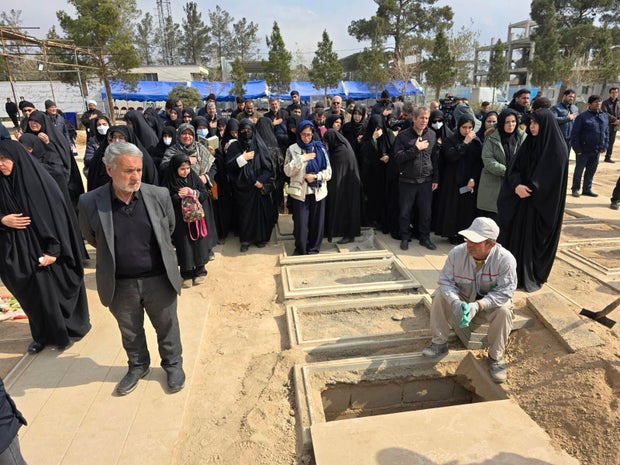

There was an overwhelming presence on Tehran’s streets Monday of Basij paramilitary fighters, meanwhile, many carrying AK-47s as they carried out random checks on vehicles and individuals around the city, questioning people’s reasons for travelling.
“My brother worked at the cyber department. Last week, on Monday, their building was hit. From what we heard, they said their project was so important that a bounty had been placed on them,” one woman at the cemetery told CBS News. “My brother is in a better place right now, and we are proud of him. I hope that the religion of Islam truly remains strong and established, and that the U.S. and Israel are destroyed, because they commit so much oppression.”
Another man at the cemetery told CBS News “it is a war and everyone has their worries,” but “God is with us. God willing, the Islamic Republic of Iran will be victorious in this war.”
Hegseth and Joint Chiefs chair Dan Caine to give news conference on ongoing war
Defense Secretary Pete Hegseth and Chairman of the Joint Chiefs of Staff Dan Caine were scheduled to hold a news briefing Tuesday morning on the ongoing U.S. operations against Iran.
You can follow updates from the news conference in this blog, and in this article, and watch the briefing live in the player at the top of this page.
Senior official says Iran does not fear Trump’s “empty threats,” warns it could be Americans “who disappear”
Ali Larijani, the Secretary of Iran’s Supreme National Security Council, threw President Trump’s latest threat back in his face on Tuesday, warning that Iran would not be cowed by the U.S. leader’s “empty threats” and even threatening to make Americans “disappear.”
Re-sharing a Monday post by Mr. Trump, in which the American leader threatened to strike Iran “TWENTY TIMES HARDER than they have been hit thus far” if the Islamic Republic continued impeding the flow of crude oil through the Strait of Hormuz, Larijani said:
“The Iranian people of Ashura do not fear your empty threats; even those greater than you have failed to erase them… so beware lest you be the ones who disappear.”
Iran’s military vowed earlier Tuesday to keep up its strikes on Gulf states and shipping in the region, both of which have sent oil prices up and stock prices down over the course of the past week, though Mr. Trump’s suggestion on Monday that the war would end “very soon” did ease those market strains, at least in the short term.
Mr. Trump boasted that U.S.-Israeli strikes had destroyed much of Iran’s military capacity, saying U.S. objectives were “pretty well complete,” though neither Iran nor Israel have indicated any interest in a near-term deal to end the fighting.
Boss of Saudi Aramco warns war could have “catastrophic consequences” on oil markets
The head of energy giant Saudi Aramco warned Tuesday that the U.S.-Israeli war with Iran could have “catastrophic consequences” on oil markets, describing the crisis as unprecedented.
CEO and president Amin H. Nasser said it was vital to reopen the Strait of Hormuz, which typically carries about 20% of global oil supplies but has been closed by the ongoing war.
Oil prices have swung wildly over supply disruptions, rocketing 30% Monday before plunging again on predictions by President Trump that the war would end “very soon.”
A satellite image shows smoke rising in the Ras Tanura oil refinery in Saudi Arabia, operated by Saudi Aramco, after a drone attack, in Ras Tanura, Saudi Arabia, March 2, 2026. Vantor/Handout/REUTERS 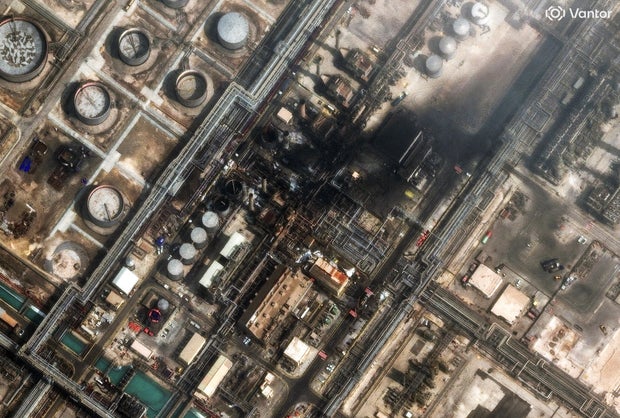

“The disruption has caused a severe chain reaction in not only shipping and insurance but there’s also a drastic domino effect on aviation, agriculture, automotive and other industries,” Nasser told a media call to announce Aramco’s 2025 earnings. “There would be catastrophic consequences for the world’s oil markets the longer the disruption goes on, and the more drastic the consequences for the global economy. While we have faced disruptions in the past, this one by far is the biggest crisis the region’s oil and gas industry has faced.”
CBS/AFP
U.K. maritime authority says cargo ship in Persian Gulf reported a splash and a “loud bang in close proximity”
A ship likely came under Iranian attack in the Persian Gulf on Tuesday, off the coast of the United Arab Emirates’ capital, according to an advisory from the British military’s maritime trade authority.
A day after President Trump issued a new warning to Iran to stop inhibiting the flow of crude oil through the vital Strait of Hormuz shipping lane, the apparent attack on the bulk carrier not far west of the Strait’s western entrance could indicate an expansion of the Islamic Republic’s assaults against shipping in the region.
The United Kingdom Maritime Trade Operations center said a captain aboard the cargo ship reported seeing “a splash and heard a loud bang in close proximity of” the vessel, which was not immediately identified.
— UKMTO Operations Centre (@UK_MTO) March 10, 2026
Iran continues to attack Gulf Arab states, with drone killing a woman in a Bahrain apartment building
Iran launched new attacks Tuesday at Gulf Arab countries as it keeps up pressure on the region.
Incoming missile sirens sounded early in the morning in Dubai in the United Arab Emirates and in Bahrain, while Saudi Arabia said it had destroyed two drones over its oil-rich eastern region and Kuwait’s National Guard said it had shot down six drones.
One Iranian drone strike hit a residential building in Bahrain’s capital, Manama, overnight, killing a 29-year-old woman and wounding eight others, the country’s Interior Ministry said.
The UAE ministry blamed the deaths on “blatant Iranian aggression against a residential building in Manama.”
A building damaged in a reported Iranian drone strike, amid the U.S.-Israeli conflict with Iran, in Manama, Bahrain, March 10, 2026. Stringer/REUTERS 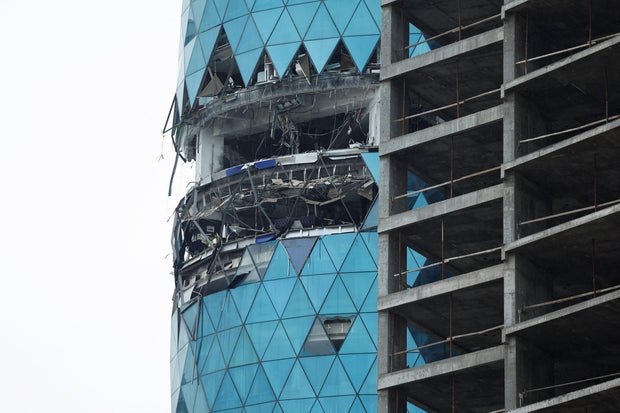

Iran has repeatedly hit Bahrain, which hosts the U.S. 5th Fleet.
Israeli strikes also hit southern and eastern Lebanon overnight, state media reported Tuesday, as Israel targets the Lebanese group Hezbollah, a powerful Iran proxy.
In addition to firing missiles and drones at Israel and American bases in the region, Iran has been targeting energy infrastructure which, combined with its stranglehold on the Strait of Hormuz, sent oil prices soaring early this week.
CBS/AP
UAE says its consulate in northern Iraq targeted with “terrorist drone attack”
The United Arab Emirates said its consulate in the northern Iraqi city of Erbil was targeted with drones on Tuesday, after Iran vowed to continue its attacks against U.S. interests and allies in the region.
“The United Arab Emirates has strongly condemned and denounced the unprovoked terrorist drone attack that targeted the UAE Consulate General in the Kurdistan Region of Iraq, which resulted in material damage with no injuries reported,” the UAE Foreign Ministry said in a statement, adding that “such acts represent a dangerous escalation and a threat to regional security and stability.”
The semi-autonomous Iraqi region’s Kurdistan Regional Government also issued a statement strongly condemning what it called unlawful attacks targeting civilians, civil institutions, and diplomatic missions, citing the overnight attack on the UAE’s mission.
The U.S. military has a significant number of troops and hardware deployed to bases at Erbil’s international airport and just outside the city, and there is also a U.S. consulate in the city. The U.S. bases have been targeted by Iranian drones since the war began, but there have been no casualties.
Iran says negotiations with U.S. not on table, and it’s ready to continue strikes “as long as it takes”
“I don’t think talking with the Americans would be on our agenda anymore,” Iranian Foreign Minister Abbas Araghchi told PBS News on Monday, saying Tehran had a “very bitter experience” during previous negotiations with the U.S.
Iran has responded to the U.S.-Israeli attacks with drone and missile strikes targeting Israel and U.S. interests and Gulf Arab states across the region. Shipping traffic through the strategic Strait of Hormuz, through which nearly 20% of the world’s crude oil usually transits, has ground to a virtual halt.
Iranian forces have repeatedly targeted oil tankers passing through the strategic waterway since the war began.
In the interview with PBS News, Araghchi insisted that Iran was acting in “self-defense,” and he insisted that the Islamic Republic was “prepared to continue attacking them with our missiles as long as needed and as long as it takes.”
CBS/AFP
Iran says it “will not allow the export of a single liter of oil” and it will “determine the end of the war”
Iran’s powerful Islamic Revolutionary Guards Corps (IRGC) mocked President Trump’s apparent bid to lessen the economic impact of the war, warning: “The Iranian armed forces … will not allow the export of a single liter of oil from the region to the hostile side and its partners until further notice.”
“It is we who will determine the end of the war,” said the IRGC, which is seen as close to Iran’s new supreme leader Ayatollah Mojtaba Khamenei, in a statement carried by Iranian state media. “The equations and future status of the region are now in the hands of our armed forces. American forces will not end the war.”
Mr. Trump indicated Monday that he would decide when the war would end and threatened to strike Iran “TWENTY TIMES HARDER than they have been hit thus far” if it continues blocking the flow of crude oil tankers through the Strait of Hormuz.
CBS/AFP
Netanyahu warns “We are not done yet” in Iran, amid mixed signals from D.C.
Prime Minister Benjamin Netanyahu warned that Israel’s military offensive against Iran was “not done yet,” saying the operation was degrading Iran’s clerical leadership.
“Our aspiration is to bring the Iranian people to cast off the yoke of tyranny; ultimately, it depends on them. But there is no doubt that with the actions taken so far, we are breaking their bones – and we are not done yet,” Netanyahu said during a visit to the National Health Command Center on Monday night, according to a statement published Tuesday.
Netanyahu’s rhetoric came after slightly mixed signals from the Trump administration. President Trump said Monday that the war was “going to be ended soon” and that U.S. objectives were “pretty well complete.”
Asked about the Pentagon posting on X the same day that, “We have Only Just Begun to Fight,” Mr. Trump said: “I think you could say it both. The beginning, it’s the beginning of building a new country.”
CBS/AFP
Trump says “I’m willing to live with” final report on bombing of girls’ school
President Trump said he’s the only one in his administration who has suggested that Iran bombed a girls’ school “because I just don’t know enough about it.”
A preliminary U.S. assessment suggests that the U.S. was “likely” responsible for the deadly attack but did not intentionally target the school and may have hit it in error, a person briefed on the preliminary intelligence told CBS News.
“It’s something that I was told is under investigation,” Mr. Trump said. “But Tomahawks are used by others. … Numerous other nations have Tomahawks. They buy them from us.”
Mr. Trump said he would accept “whatever” the investigation shows.
“I’m willing to live with that report,” he said.
Without providing evidence, the president had said Saturday that the U.S. believes the bombing “was done by Iran” and cited information he had seen.
Trump vows to hit Iran “TWENTY TIMES HARDER” if it blocks Strait of Hormuz
President Trump warned Iran against blocking the Strait of Hormuz, a crucial chokepoint for the world’s oil industry, as the war with Iran has brought shipping traffic in the strait to a virtual standstill — causing oil prices to spike since the war began.
“If Iran does anything that stops the flow of Oil within the Strait of Hormuz, they will be hit by the United States of America TWENTY TIMES HARDER than they have been hit thus far,” he said on his Truth Social platform. “Additionally, we will take out easily destroyable targets that will make it virtually impossible for Iran to ever be built back, as a Nation, again — Death, Fire, and Fury will reign upon them — But I hope, and pray, that it does not happen!”
Mr. Trump has repeatedly threatened to ramp up strikes on Iran if it disrupts the Strait of Hormuz, which lies between Iran and the Arabian Peninsula and carries roughly 20% of the world’s oil. Earlier Monday, he told CBS News he was considering taking over the waterway.
Vance attends dignified transfer for 7th U.S. service member killed in Iran war
Vice President JD Vance participated in a dignified transfer for Army Sgt. Benjamin N. Pennington, the seventh American service member who was killed in the U.S.-Iran conflict.
Vance flew to Dover Air Force Base in Delaware for the arrival of Pennington’s remains. The vice president was seen saluting during the ceremony, alongside Defense Secretary Pete Hegseth and Chairman of the Joint Chiefs of Staff Gen. Dan Caine.
A Kentucky native, 26-year-old Pennington was assigned to the 1st Space Battalion in Colorado. He was injured during a March 1 attack on a base in Saudi Arabia and died from his injuries a week later, according to the Pentagon.
A dignified transfer for six other U.S. service members who were killed took place last weekend, with President Trump in attendance.


