







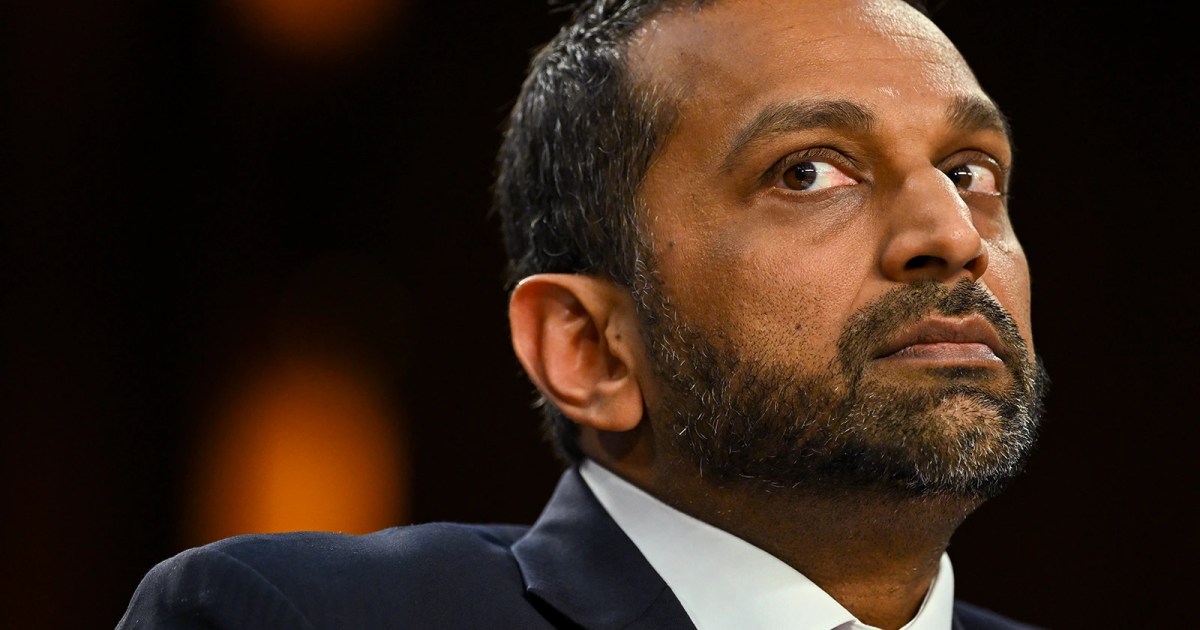
With fewer agents and a strained budget, the FBI under its director, Kash Patel, has brought thousands fewer criminal cases than previous administrations, an MS NOW review of Justice Department data shows. The findings rebut Patel’s repeated claims that he has led a crackdown on violent crime.
Patel has boasted that the FBI has arrested 54,000 violent criminals, which he describes as a 90% increase in arrests from the same period in the Biden administration. What he doesn’t mention is that his count is inflated by including arrests that state and local police forces and other federal agencies have made when an FBI employee is present.
Many of those arrests are not FBI cases, the FBI acknowledges.
In reality, the FBI has referred 15% fewer criminal cases for federal prosecution during the second Trump administration than during the same period in the Biden administration. And, while the FBI does not break down its criminal referrals into types of cases, the data also shows that the DOJ prosecuted 15% fewer cases of violent crimes during the first 16 months of the Trump administration than during the same period of the Biden administration.
There were nearly 3,800 fewer people charged federally with violent crimes during the first part of the second Trump administration than during the comparable Biden period — the opposite of what Patel says. That figure includes cases referred from all federal agencies, not just the FBI.
MS NOW analyzed public DOJ data obtained and shared by Justice Connection, a group of former DOJ and FBI employees who have accused the Trump administration of weaponizing the department and breaking long-revered norms to pursue President Donald Trump’s political ends. The data covers all criminal cases with a filing date recorded for a U.S. district court.
The biggest priorities shift in the second Trump administration has been a huge increase in arrests and charges related to immigration crimes. Patel has required FBI agents to support immigration enforcement, which has traditionally not been part of their mission.
According to the public DOJ data, immigration cases comprised a whopping 59.3% of all federal criminal cases filed by the DOJ from February 2025 through July 2026 — compared to 41.1% over a similar period in the first Trump administration and 35.5% over a similar period in the Biden administration.
“Kash Patel is actively dismantling decades of statistical integrity just to feed a political narrative,” said Christopher O’Leary, a former senior FBI official and MS NOW contributor.
“We are seeing a historic institution reduced to a metrics game, where the FBI is poaching credit for arrests made by other law enforcement agencies and departments. This artificial inflation of the stats is a deliberate smoke screen designed to mask internal chaos and the mass exodus of experienced talent by manufacturing an illusion of productivity that simply does not exist on the ground,” he said.
Patel’s FBI is not just bringing fewer criminal cases than under former President Joe Biden — it’s also bringing fewer than it did under the first Trump term, the MS NOW review of DOJ data shows. The FBI has made fewer criminal referrals so far under Patel than during the same period of the first Trump administration, when Christopher Wray was FBI director, according to DOJ figures.
In a statement to MS NOW, the FBI did not dispute the data showing a reduction in criminal referrals, but it pointed to the declining rate of violent crime. However, that decline has been a nationwide trend for several years after crime briefly spiked during the Covid-19 pandemic from 2020 to 2022. It’s been steadily declining ever since.
“This FBI and our law enforcement partners delivered the largest year of violent crime reduction in American history, achieved the most significant drop in the national murder rate ever recorded since 1936,” the FBI said in a statement.
Patel’s claim of a 90% increase in “violent crime arrests” by the FBI leaves out crucial context: that Patel is taking credit for the work of other agencies.
By Patel newly including state and local arrests, as well as arrests by other federal agencies, his FBI progress report radically changes the way the FBI counts its cases to include work the FBI did not do.
The FBI has not previously counted other agency arrests as part of its caseload, according to internal DOJ data and the accounts of current and former officials. There is no way to say how many of the local police arrests — which Patel now claims credit for — would have been made regardless of the FBI’s presence.
In its statement to MS NOW, the FBI disputed that it changed how it tallies arrests, saying it has always included “violent crime arrests where the FBI has equity in the case and investigation.”
That is false, multiple former FBI officials told MS NOW.
Former FBI agent Daniel Brunner said the FBI previously always resisted counting state and local arrests as FBI achievements.
“It’s never been done,” he said. “And when agents attempted to do it, it was always pushed back on at the local division. Headquarters did not want false numbers, they wanted the truth from the field.”
Brunner said the FBI would keep separate stats on how often agents assisted local law enforcement but didn’t count those as FBI operations.
Patel’s FBI is different.
For example, when the FBI in September announced the results of “Operation Summer Heat” in Louisiana, officials said the FBI partnered with more than two dozen local, state, and federal law enforcement agencies to arrest 662 individuals. The release did not say which, if any, were FBI arrests.
The FBI plays a very small role in policing violent crime nationwide, and has focused on investigating major criminal networks and complex conspiracies, as well as threats to national security. There are approximately 13,000 FBI agents, compared to around 788,000 sworn law enforcement officers across the country. But even that disparity underplays the small role the FBI plays in policing violence, because most FBI agents do not work full-time on violent crime cases. Murder, rape, robbery and other criminal violence are largely a matter for state and local law enforcement, using state laws and state courts.
Since the 9/11 attacks, the FBI’s priority mission has been stopping terrorism. The bureau is also devoted to hunting foreign spies, ferreting out political corruption and white collar fraud, and disrupting complex criminal schemes and organized crime.
Moreover, federal data shows the FBI has suffered a major reduction in its workforce since Trump came into office and installed Patel as the agency’s director. The bureau has lost more than 1,600 criminal investigators and 335 analysts since January 2025. Most of them have not been replaced, current and former FBI officials say. And the FBI’s budget has not kept up with inflation.
And taken at face value, Patel’s count of the FBI making or participating in 54,000 arrests shrinks in significance when taken into broader context. There have been 11.3 million arrests nationwide since January 2025, according to the same FBI data.
“You’re talking about a drop in the bucket,” said Jeff Asher, a former CIA analyst who studies crime stats. “Federal task forces can be very useful, but as causal factors they tend not to be statistically significant.”
John Roman, an expert on crime trends at the University of Chicago, said Patel’s new method of taking credit for local arrests when the FBI is present likely reflects the dramatic shift in FBI priorities under this administration. Stepped up immigration raids, with FBI assistance, will certainly lead to more local arrests with FBI in tow, Roman said. But it doesn’t necessarily ensure the best use of FBI resources or make Americans safer.
“The question is: are we really getting bad people off the streets and deterring crime by others?” Roman asked.
The FBI’s Rapid Response account on X put out a slickly produced video last week, portraying Patel as having overhauled the FBI’s approach, to great effect. After experts said the video violated the law against government participation in politics because it disparaged Democrats, the FBI took it down. A spokesperson did not respond to questions about why.
“Patel’s FBI made crushing violent crime the mission,” the narrator in the video says. “It moved more than one thousand positions out of Washington and into the field, dismantling gangs, choking off fentanyl, and taking violent offenders off the street.
“And it worked. Since Patel took charge in February 2025, about fifty-four thousand violent crime arrests, up roughly ninety percent; more than thirty-one thousand gangs disrupted; over three thousand two hundred kilograms of fentanyl seized.
“That’s a crime-first FBI under Director Patel.”
Current and former FBI officials say these claims are deeply misleading.
“He’s taking credit for other agencies’ efforts,” said Michael Feinberg, a former FBI agent and MS NOW contributor. “The vast majority of violent crime are state and local offenses.”
The FBI can bring a creative approach to violent crime gangs by using federal racketeering statutes, Feinberg said, but there is no evidence of any increase in that approach under Patel. In fact, the data shows that fewer federal crimes are being prosecuted.
The FBI did not address this claim but said, “We are putting a stronger emphasis on interagency coordination than we ever have, with surges in key areas like Washington D.C., Memphis TN, and more delivering successes to get violent crime under control. As a result, Memphis reported a 50% decrease in homicides this summer, and Washington D.C. is on track for its lowest homicide numbers since 1990.”
The biggest shift of law enforcement resources in the second Trump Administration has not been towards violent crime, but towards immigration enforcement and prosecutions.
Some notable — and misleading or false — claims about crime and enforcement Patel has made in public appearances:
- “1.1 million fewer violent” crimes: on Oct. 2, Patel told Fox News that there were “1.1 million fewer” violent assaults, rapes, robberies and homicides. In fact, 1,119,768 was the entire estimated 2025 violent crime total, and the FBI says the year-over-year decline was 9.3%. He appears to have confused the total with the decline.
- “197% increase” from 34,000 to 67,000 arrests: In February, Patel made a basic math error in an op-ed under his own byline. The increase is 97.1%; 67,000 is 197% of 34,000.
- “Rape, robbery, assault, all down double-digits”: Patel said this in August, but two of the three named categories were not down double digits. The FBI’s own release — which contained Patel’s quote in a video — put robbery down 18.5%, but rape down 7.6% and aggravated assault down 7.2%; overall violent crime was down 9.3%.
- The Massachusetts Immigration and Customs Enforcement sweep: Patel said in May 2025 the FBI had joined ICE to round up “370 violent and dangerous fugitives.” ICE’s own description was 370 alien offenders; it said 205 had “significant criminal convictions or charges.”
- “Operation Restore Justice”: On May 7, 2025, Patel said the operation lasted a month, involved 450 warrants, and rounded up nearly 400 child predators. DOJ’s same-day release says the named operation lasted five days and produced 205 arrests.
In its response to MS NOW, the FBI did not address any of these examples.


