




Advertisement


Cost of Living Protests Paralyse France, Belgium, Italy, Portugal
Europe witnessed a fresh wave of discontent on Saturday as hundreds of thousands of citizens staged demonstrations over soaring living costs, mounting pressure on governments across the European Union.
The coordinated day of action on 17 October 2026 saw major rallies in four countries — France, Belgium, Italy and Portugal — with France recording its most chaotic day of civil unrest in years.
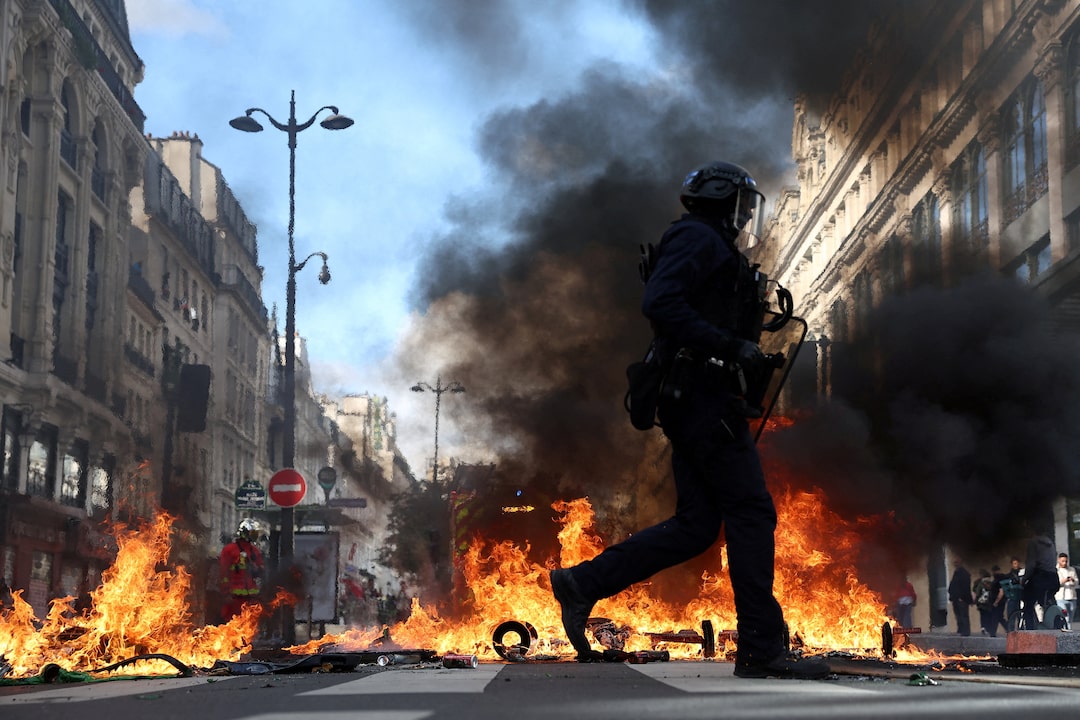
In France, the Interior Ministry put the turnout at over 550,000 nationwide. What started as student-led agitations in recent weeks escalated into widespread confrontations. Security agencies said splinter groups hijacked otherwise peaceful marches to attack public infrastructure, ransack high-end shops and supermarkets, and set police vans ablaze.
Prime Minister Sebastien Lecornu confirmed that about 1,200 suspects were apprehended while 150 officers sustained injuries. Speaking to troops in central Paris, he said it was “a miracle the casualty figure was not higher.”
Reports from AFP indicated looting in at least nine cities including Paris, Marseille, Lyon, Lille, Toulouse, Bordeaux, Nice, Nantes and Limoges. Paris Mayor Emmanuel Gregoire lamented that entire streets in the capital were left “devastated”.
The historic town hall in Limoges, built over 140 years ago, was gutted by fire allegedly started by masked demonstrators. Municipal buildings in Marseille and Lille were also breached and vandalised, while the tourism office in Lyon was set on fire.
President Emmanuel Macron vowed on X that perpetrators would face prosecution and punishment.
Belgium’s capital, Brussels, which has been grappling with student protests over tuition hikes, saw police resort to tear gas and water cannons after demonstrators reportedly hurled projectiles and ignited fires. Similar crowd-control measures were deployed in Liege, in the eastern part of the country.
In Lisbon, Portugal, tens of thousands poured into the streets to denounce high living costs, stagnant wages and a worsening housing crisis. Housing prices in the country have more than doubled since 2017, with new rental rates rising at almost the same pace.
Protesters mounted about 40 tents at the popular Rossio Square to draw attention to homelessness, exorbitant rents and low pay. The government, however, struck a defiant tone. Parliamentary Affairs Minister Carlos Abreu Amorim insisted on Friday that his administration “will not yield to shouts from the street,” a remark demonstrators said showed leaders were disconnected from reality.
Italy recorded similar unrest. In Milan, an initially peaceful demonstration against global conflicts and economic hardship spiralled into violence in the city centre. Shops were vandalised, property set on fire, and the usually crowded Piazza del Duomo emptied.
According to LaPresse, hooded youths pelted riot police with stones and pavement slabs and barricaded streets with restaurant tables before setting them alight. Security operatives responded with water cannons and tear gas. At least two officers were wounded and some 50 protesters, many believed to be underage, were taken into custody.
Prime Minister Giorgia Meloni, reacting on X, said: “Demonstrating is a right. Setting our cities ablaze is not,” accusing “hooligans who exploit demonstrations to sow chaos.”
Milan Mayor Giuseppe Sala, of the centre-left, admitted the grievances were legitimate but said attacks on law enforcement and destruction of public property could not be justified. In Bologna, authorities also reported isolated stone-throwing and clashes.
Commenting on the development, Professor Alberto Alemanno of HEC Paris Business School told Al Jazeera that while the protests were not centrally coordinated, they were driven by shared frustrations — including poor funding for education, escalating living costs and bleak post-graduation prospects for young people.
He described France as the epicentre, warning that the movement was already spilling into other countries, with early mobilisation signs in Greece, Germany and Austria.
According to him, the timing is critical as Europe heads into what he called an “unprecedented super-cycle of national elections” in the next 12 months, with polls expected in Spain, France, Italy and Poland.
“Inevitably, all these protests will dominate political discourse,” Alemanno said.


