

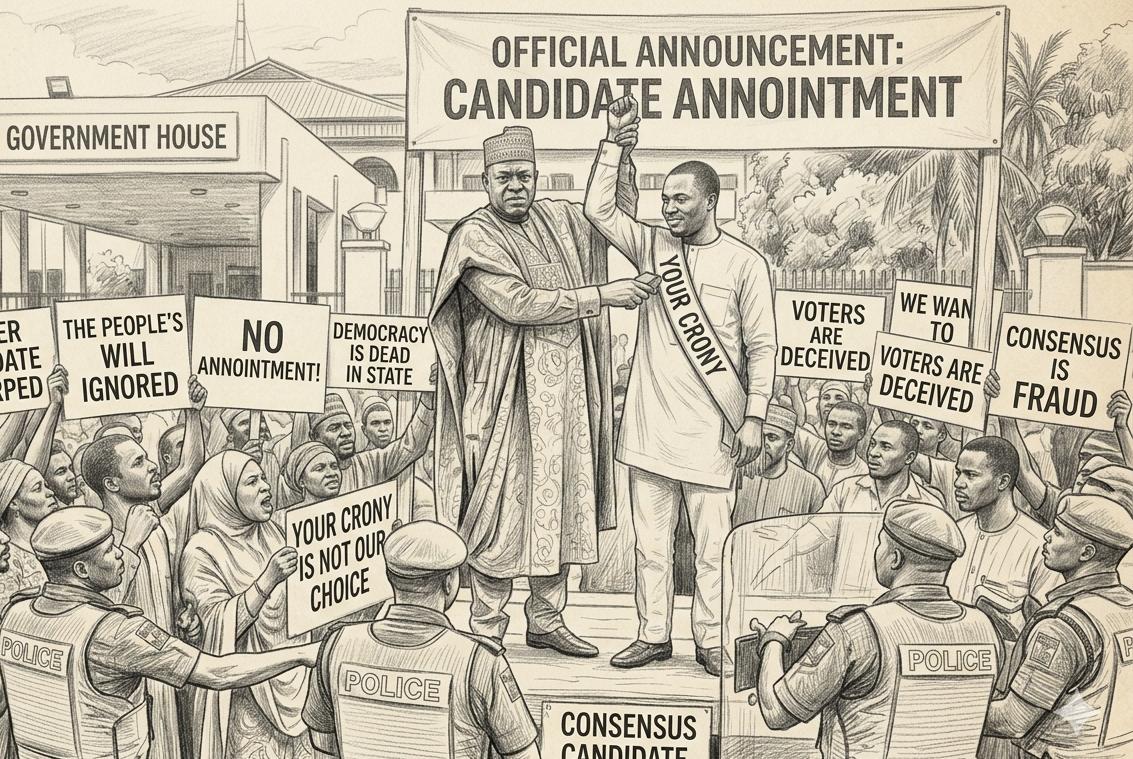
Consensus Fraud: When Governors Usurp the Voter’s Mandate, by Yushau A. Shuaib
A single word has quietly colonised Nigeria’s pre-election vocabulary — consensus. It is deployed with confidence, knowing they will not be challenged. Yet what is being paraded as consensus in many states today is nothing of the sort. It is imposition — laundered, repackaged, and dressed in democratic clothing.
With the 2027 elections only months away, at least 22 governors have already endorsed President Bola Ahmed Tinubu as their “consensus” presidential candidate. At the state level, these same governors are replicating the model downward — anointing successors, selecting senators, choosing members of the House of Representatives, and determining state assembly tickets. Children of politicians, relatives of the wealthy, and allies of the powerful — some lacking experience, exposure, or even basic qualifications — are suddenly emerging as “consensus candidates.”
Meanwhile, the electorate, for whom this entire democratic architecture supposedly exists, watches from the sidelines. This is not a democracy. It is a hostage situation in Agbada.
This crisis traces back to President Bola Tinubu’s closed-door meeting with APC governors, after which he effectively empowered 31 of them to determine the fate of aspirants in their states. Kwara State Governor AbdulRahman AbdulRazaq later confirmed that the President had given governors latitude to conduct primaries through consensus or direct voting. What sounded procedural in Abuja has since reshaped politics nationwide, granting governors sweeping control over who advances — and who is quietly removed from the path.
Senior lawmakers reportedly appealed to the President for automatic tickets, but he maintained that governors hold the real influence in their states. The result is growing unease within the party, especially among federal legislators who lack strong ties to their governors.
One is tempted to feel sympathy for these lawmakers. One is tempted — but it is difficult. Many of them helped build this structure. They defected, genuflected, and complied — only to now discover that the machinery of impunity does not distinguish between victims and collaborators.
This pattern is already visible across several states. In Nasarawa, Governor Abdullahi Sule has named Senator Ahmed Wadada as his preferred successor, while associates of former Inspector General of Police Mohammed Adamu allege pressure on ward executives to endorse that choice. In Ebonyi, Governor Francis Nwifuru presided over a meeting where aspirants were openly “anointed,” prompting former Governor David Umahi to insist that no one be barred from buying forms. The state APC later warned that defying the governor’s directive would be treated as disloyalty.
In Adamawa, elders of the Gongola Peoples rejected what they described as attempts to impose a governorship candidate. In Ogun, APC members in Ijebu East protested alleged imposition of legislative candidates. In Yobe, a photograph of Governor Mai Mala Buni raising a preferred aspirant’s hand signalled that the decision had effectively been made.
Similar tensions are emerging elsewhere: in Borno, Governor Babagana Zulum is reported to have endorsed a preferred aspirant against the wishes of Vice President Kashim Shettima. In Kwara, Governor AbdulRahman AbdulRazaq’s choice is said to conflict with preferences attributed to the presidency. Reports from Gombe also suggest resistance to a candidate viewed as misaligned with local expectations.
The deeper danger is that manipulation can hide inside the law itself. The Electoral Act permits consensus primaries, and INEC’s 2026 Regulations allow parties to choose candidates through direct, indirect, or consensus methods. Consensus, when genuinely negotiated, is lawful and even efficient. But there is a vast difference between a true consensus and one manufactured through gubernatorial pressure. One reflects democracy; the other is a procedural disguise for illegitimacy.
What is at stake is not the comfort of politicians but the confidence of 93 million registered voters heading into the 2027 elections. Many already believe their votes do not matter and that outcomes are predetermined — a belief reinforced by a triangle of compromise involving security agencies, INEC, and the judiciary.
Political elites deepen this distrust by framing defections to the ruling party as guarantees of victory, regardless of voter choice. When governors hand pick candidates before delegates even vote, they are not only sidelining aspirants — they are sidelining the voter. The message is unmistakable: your preference was never part of the process.
This is the quiet coup no one is naming loudly enough. The ballot box is becoming a prop — a ritual used to ratify decisions already made in government houses across the 36 states.
At this critical juncture, three institutions must rise to the occasion. First, the President, Bola Ahmed Tinubu, as leader of the ruling establishment, must resist the temptation to condone or benefit from these distortions. Leadership demands not just political survival but the protection of democratic norms. Silence risks normalising practices that undermine the system itself.
Second, the Independent National Electoral Commission (INEC), under Chairman Prof. Joash Amupitan, must assert its constitutional authority more firmly. It is not enough to supervise general elections while ignoring the flawed processes that produce candidates. Electoral integrity begins at the primaries. Without credible candidate selection, even the most transparent general election becomes a compromised exercise.
Third, the judiciary, long regarded as the last hope of the common man, must guard against becoming an instrument for legitimising illegitimacy. The Chief Justice of Nigeria, Hon. Justice Kudirat Kekere Ekun, must ensure that courts prioritise substantive justice over technicalities. A judiciary that consistently validates the outcomes of corrupt processes becomes a co author of those processes. History does not forgive that.
Ultimately, the greatest casualty of consensus abuse is the Nigerian voter. Nigeria’s political history shows that imposed candidates rarely produce stability: the winner of a manipulated primary often enters the general election weakened, while the aspirant who quietly accepts a “consensus” defeat may later contribute to the party’s internal fractures. The fallout between Atiku Abubakar and Nyesom Wike in 2023 remains a reminder of how unresolved disputes can shape a party’s future. Voters, too — after being told their voices do not matter — tend to remember, and sometimes respond decisively.
Nigeria is approaching another such moment. Reports indicate that within the major opposition party, supporters of Peter Obi and Rabiu Kwankwaso are considering defections to other platforms due to internal tensions involving Atiku Abubakar. Meanwhile, decisions being made in government houses across the federation will shape far more than who wins in 2027. They will determine whether that election strengthens Nigeria’s democratic development or accelerates its democratic decline.
The coming week may prove decisive for the political process leading to the 2027 general election. The gladiators may be deciding the tickets. But the people — sovereign, long suffering, and watching — will have the final say. They always do.
Yushau A. Shuaib
Author of A Dozen Tips for Media Relations
[email protected]
