





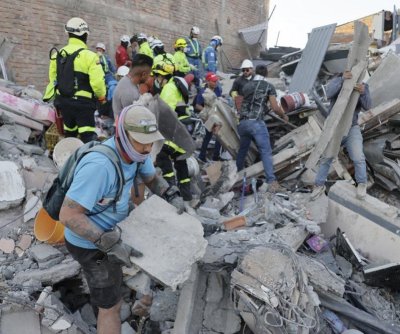
Rescuers search through the debris of a damaged building in Pereira, Colombia, on Tuesday after a 7.4-magnitude earthquake struck the country the day before. Photo by Carlos Ortega/EPA
Aug. 11 (UPI) — Colombia entered a second day of search-and-rescue operations Tuesday after a magnitude-7.4 earthquake struck the country a day earlier, killing at least 181 people, injuring hundreds and destroying numerous buildings, according to local authorities.
The Colombian Association of Capital Cities said the number of injured had risen to 1,310 and 153 buildings had collapsed, primarily in the country’s Coffee Region and the western department of Valle del Cauca.
Cali recorded the highest death toll, with 95 fatalities, followed by Pereira with 72, Quibdó, nine, and Manizales, five.
Local authorities warned the death toll could rise as rescue crews continue searching damaged and collapsed structures.
The powerful earthquake caused extensive damage to healthcare facilities and other infrastructure across western Colombia. In Cali, the capital of Valle del Cauca, parts of the facade of the University Hospital of Valle partially collapsed, forcing the urgent evacuation of patients.
Emergency crews are focusing their efforts on buildings that completely collapsed, where an unknown number of people may remain trapped.
In Cali, authorities said at least 193 people remained trapped beneath the rubble of 56 residential and commercial buildings that collapsed.
The Cali mayor’s office said rescuers had pulled 37 people alive from the rubble in recent hours.
In one rescue, emergency crews found a mother and her 6-month-old baby alive beneath a concrete slab that collapsed inside their home. Rescuers were guided to them by a search dog’s alerts and the woman’s faint cries.
Video posted by InfoMundo on X showed emergency crews rescuing the baby alive from the rubble as search operations continued across the city.
Internacionales || UN RESCATE QUE DEVUELVE LA ESPERANZA EN COLOMBIA
Imágenes muestran el momento en que equipos de emergencia rescatan con vida a un bebé tras el terremoto de magnitud 7.4 que golpeó Colombia.
En medio de la tragedia, los rescatistas continúan trabajando… pic.twitter.com/Bgw0QeZmkg— InfoMundo (@NotiInfoMundo) August 11, 2026
In Pereira, the mayor’s office said 53 people remained trapped in 58 structures that were destroyed in the urban area. Rescue crews prioritized 15 buildings where search dogs and acoustic detection equipment identified possible signs of survivors.
Authorities in Pereira also coordinated a complex operation to evacuate 16 people trapped inside cabins of the city’s Megacable aerial cable car system.
The cable cars were left suspended dozens of feet above the ground immediately after the earthquake. After six hours of rappelling and vertical rescue operations by specialized personnel, all passengers were brought to safety, the mayor’s office said.
Con carros canasta se atienden las personas atrapadas en las góndolas del Megacable
En este momento los organismos de socorro y el equipo operativo de la Empresa de Energia, a través de sus carros casta están realizando las labores de rescate de las personas que quedaron en las… pic.twitter.com/Qs1xymef9J— Alcaldía de Pereira (@Alcaldiapereira) August 10, 2026
The national government and the Colombian Association of Capital Cities said more than 2,500 people remained missing or out of contact across the affected areas.
Interior Minister Rodrigo Lara told Radio Bli that more than 300 rescuers had been deployed to the most critical collapse sites. An additional 45 rescuers from Bogotá were also sent with canine search teams.
International assistance began arriving Tuesday. The U.S. government announced $15.5 million in humanitarian aid, while a 47-member urban search-and-rescue team from Ecuador, accompanied by canine units, joined the Colombian Red Cross and Colombian Civil Defense in rescue operations.
The Colombian Geological Service said the main earthquake struck at 7:34 a.m. local time, with its epicenter near the municipality of San José del Palmar in Chocó department at a depth of about 60 miles.
The agency described the earthquake as the longest-lasting seismic event recorded in Colombia in the 21st century, with intense shaking perceived for 40 to 50 seconds.
The earthquake’s intermediate depth allowed seismic waves to travel long distances through rigid rock inside the Earth without rapidly losing strength, prolonging the shaking at the surface. In parts of western Colombia, residents reported feeling the earthquake for as long as two minutes.
The Colombian Geological Service has recorded more than 60 aftershocks, the strongest with a magnitude of 4.8.
President Abelardo de la Espriella formally declared a national state of disaster to accelerate the deployment of financial assistance and logistical resources to the affected areas.


