







We need your help this Earth Day!
2X match to support our work
The story you’re about to read is free to access—no paywall, no subscription, no ads—but it isn’t free to produce.
Our nonprofit newsroom investigates the biggest threats to our planet, holds decision-makers accountable, and pushes back on climate disinformation so facts stay front and center.
We need your support to keep this work going. Please donate right now in honor of Earth Day and your gift will be doubled.
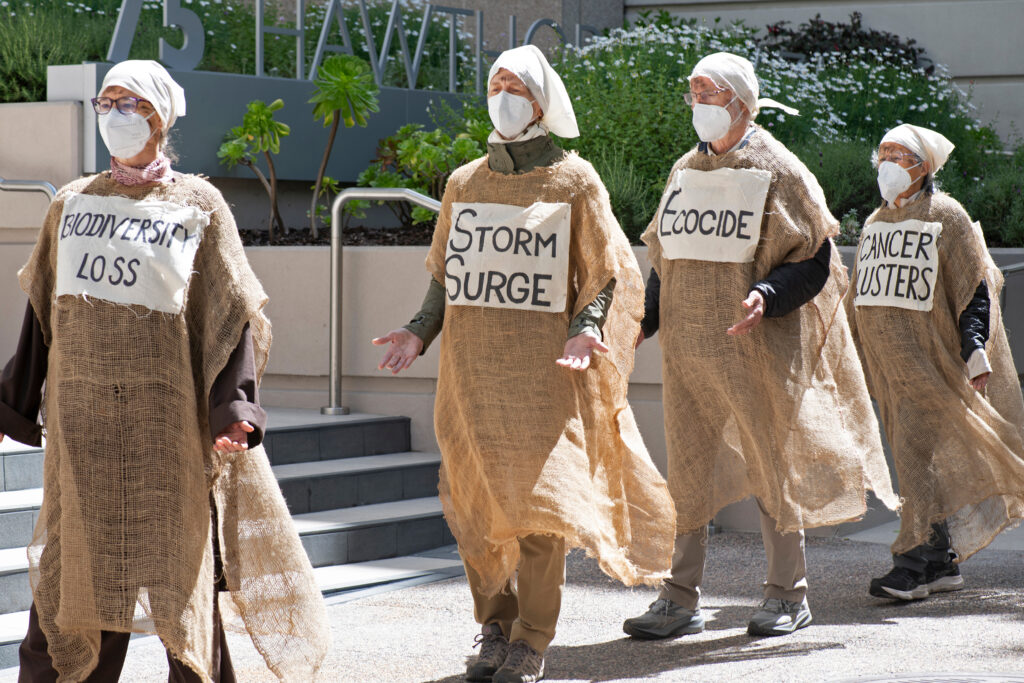
A procession of mourners representing sea level rise, melting permafrost, ecocide and other climate calamities grieved the demise of a groundbreaking climate rule outside the Environmental Protection Agency’s Region 9 headquarters in downtown San Francisco on Tuesday.
The “lamentors” wore sackcloth and ash, an ancient symbol of mourning, to express their sorrow and the collective grief ahead for those destined to suffer without the foundational tool to regulate climate pollution.
“We are gathered to pay our respects to the endangerment finding, for the brief life it had that was taken from us too soon,” said Michelle Merrill, an evolutionary anthropologist who organized the “funeral service” with other climate activists and Scientist Rebellion Turtle Island, a multi-disciplinary group of scientists battling the climate crisis.
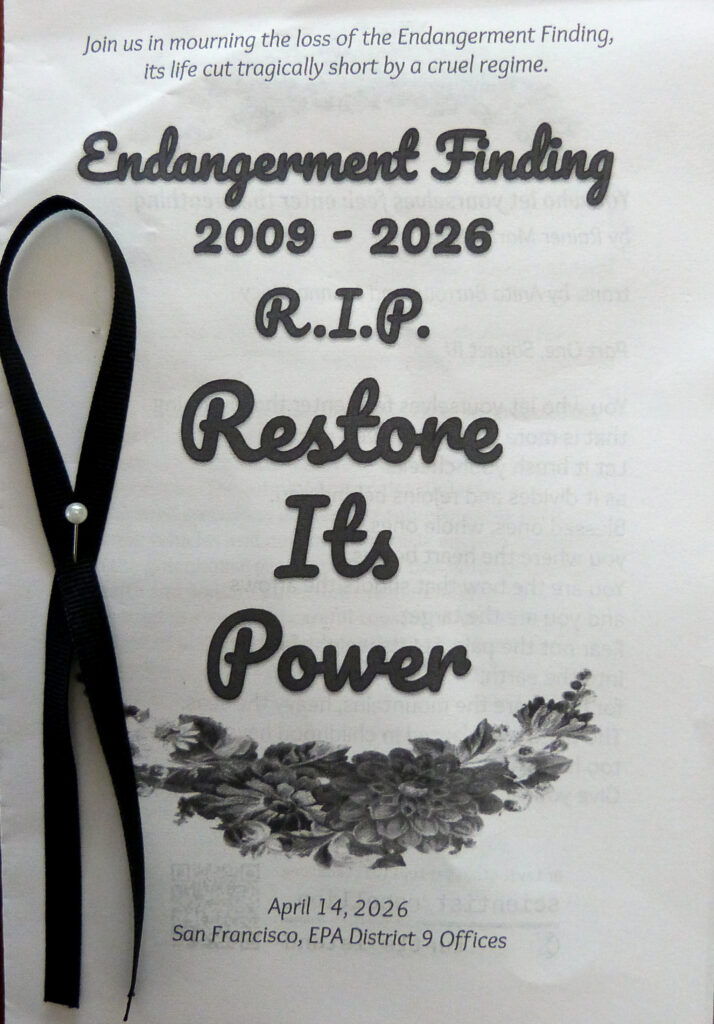
On Feb. 12, the EPA rescinded its 2009 “endangerment finding,” which recognized that carbon dioxide and other greenhouse gas emissions threaten the health and welfare of current and future generations. The rule allowed the agency to set standards under the Clean Air Act to curb fossil-fuel emissions from vehicles, power plants and other climate-polluting industries. Its repeal goes into effect April 20.
The organizers held a moment of silence to mark the passing of the finding, sang dirges and read poems and eulogies as a few curious onlookers stopped briefly to ask what the group was protesting. No EPA employees took part in the event, but one organizer said a few expressed gratitude that citizens were out supporting their work.
Repealing the endangerment finding means the government will no longer have the right to regulate greenhouse gases, said Paul English, an environmental epidemiologist who volunteers with Scientist Rebellion. “That’s going to contribute to the climate catastrophe, result in more heatwaves, extreme weather events, wildfires and the loss of habitat, and ultimately affect public health in this country and the world.”
Pressed to act by a Supreme Court ruling, the EPA originally issued the endangerment finding during the Obama administration based on scientific conclusions drawn primarily from assessment reports produced by the Intergovernmental Panel on Climate Change, the U.S. Climate Change Science Program, the U.S. Global Change Research Program and the National Research Council. The agency also reviewed more than 380,000 public comments in deciding whether to regulate greenhouse gases under the Clean Air Act.

The Trump administration, English said, “has used no science to overturn this finding, as far as I can tell.”
President Donald Trump told EPA Administrator Lee Zeldin to reconsider the “legality and continuing applicability” of the endangerment finding in an executive order issued on his first day back in office.
At an event with Zeldin in February, Trump celebrated the rollback of the rule as the “single largest deregulatory action in American history,” calling the endangerment finding “a disastrous Obama-era policy.” The Supreme Court first ruled that the Clean Air Act covered greenhouse gases in 2007, but the Republican George W. Bush administration declined to act on that decision.
Zeldin has returned the agency to focusing on fulfilling its statutory obligations of protecting human health and the environment “backed by gold standard science, not doomsday models designed to scare the public into compliance,” an EPA spokesperson said.
Congress never gave the EPA authority to impose greenhouse gas regulations for cars and trucks, the spokesperson said. “Using the same types of models utilized by the previous administrations and climate zealots, EPA now finds that even if the U.S. were to eliminate all GHG emissions from vehicles it would not result in any material impact on global climate indicators.”
This story is funded by readers like you.
Our nonprofit newsroom provides award-winning climate coverage free of charge and advertising. We rely on donations from readers like you to keep going. Please donate now to support our work.
The move to repeal the endangerment finding is “a fundamental betrayal of EPA’s responsibility to protect human health,” Joseph Goffman, a top EPA air official during the Biden administration, told Inside Climate News in February. “It is legally indefensible, morally bankrupt and completely untethered from the scientific record.”
Greg Spooner, a physicist with Scientist Rebellion, said he’s upset to see the endangerment finding being used as a tool to destroy America’s ability to regulate greenhouse gases. “The United States is such an important country in terms of the future of the climate, and dismantling our ability to regulate the emission of fossil fuel gases that are driving the climate crisis is just catastrophic for the world.”
In a eulogy for the endangerment finding, Spooner mourned a life “tragically cut short.”
But he urged his colleagues to also prepare for a fight.

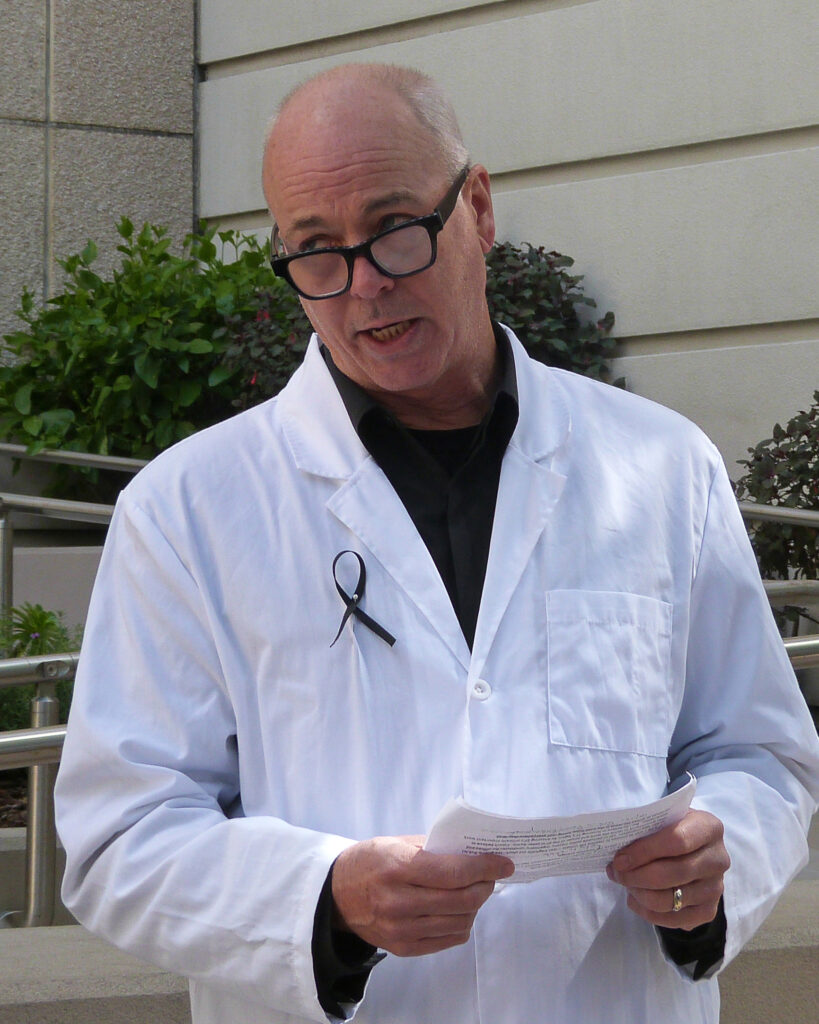
“Let us persuade policymakers, organizers, candidates for office, regular citizens, to revive the spirit and power of the endangerment finding,” Spooner said.
After the administration announced its final move to repeal the finding, Democrat-led states and public-interest groups wasted little time filing lawsuits to challenge the move. Two dozen states joined by a dozen cities and counties named the EPA and Zeldin in a lawsuit filed in the U.S. Court of Appeals for the D.C. Circuit in March, a month after a coalition of health, environment and community organizations filed a suit in the same court.
Spooner thinks most people haven’t grasped the scale of the administration’s attack on American science. “We are seeing just a catastrophic destruction of science of all kinds,” he said.
Last month, vigil organizers distributed condolence cards to EPA staff in San Francisco to let them know they are not alone.
“I know, as a scientist, what it feels like to lose the ability to do the work that you’re doing when it feels important,” Merrill said. “We feel their pain and want them to know that we’re hurting too, and we care about them.”
With all of the cuts that have already happened and fear that there will be even more, Merrill and her colleagues are wondering, “how are we going to rebuild from this?” she said. “Eventually this is going to change.”
And when it does, they’ll be ready.
About This Story
Perhaps you noticed: This story, like all the news we publish, is free to read. That’s because Inside Climate News is a 501c3 nonprofit organization. We do not charge a subscription fee, lock our news behind a paywall, or clutter our website with ads. We make our news on climate and the environment freely available to you and anyone who wants it.
That’s not all. We also share our news for free with scores of other media organizations around the country. Many of them can’t afford to do environmental journalism of their own. We’ve built bureaus from coast to coast to report local stories, collaborate with local newsrooms and co-publish articles so that this vital work is shared as widely as possible.
Two of us launched ICN in 2007. Six years later we earned a Pulitzer Prize for National Reporting, and now we run the oldest and largest dedicated climate newsroom in the nation. We tell the story in all its complexity. We hold polluters accountable. We expose environmental injustice. We debunk misinformation. We scrutinize solutions and inspire action.
Donations from readers like you fund every aspect of what we do. If you don’t already, will you support our ongoing work, our reporting on the biggest crisis facing our planet, and help us reach even more readers in more places?
Please take a moment to make a tax-deductible donation. Every one of them makes a difference.
Thank you,


Reporter, California
Liza Gross is a reporter for Inside Climate News based in Northern California. She is the author of The Science Writers’ Investigative Reporting Handbook and a contributor to The Science Writers’ Handbook, both funded by National Association of Science Writers’ Peggy Girshman Idea Grants. She has long covered science, conservation, agriculture, public and environmental health and justice with a focus on the misuse of science for private gain. Prior to joining ICN, she worked as a part-time magazine editor for the open-access journal PLOS Biology, a reporter for the Food & Environment Reporting Network and produced freelance stories for numerous national outlets, including The New York Times, The Washington Post, Discover and Mother Jones. Her work has won awards from the Association of Health Care Journalists, American Society of Journalists and Authors, Society of Professional Journalists NorCal and Association of Food Journalists.


