







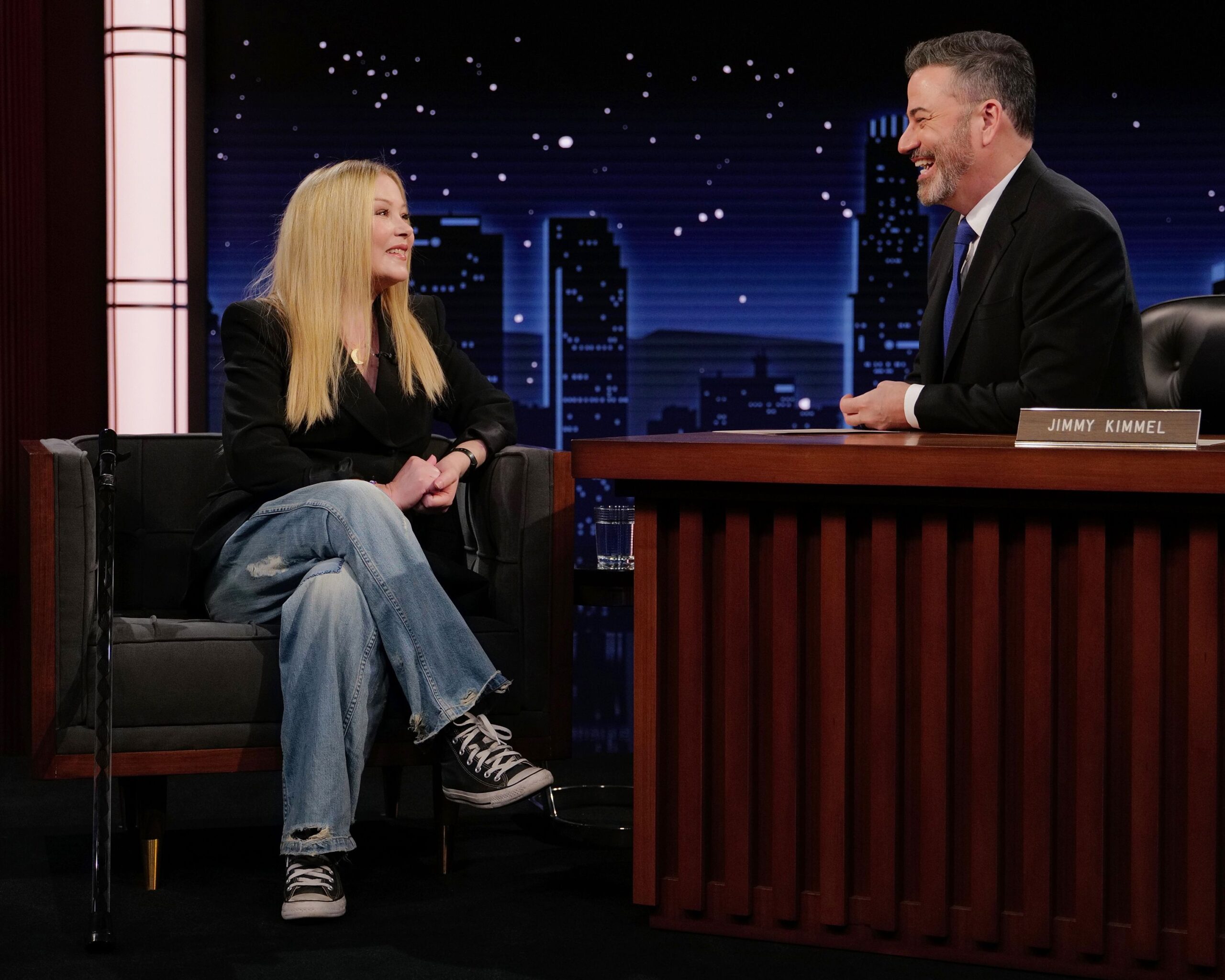
Actress and ’90s icon Christina Applegate is known for many roles, but especially as Kelly Bundy, the edgy, “dumb blonde” in the controversial and beloved sitcom, Married… with Children. In the last few years, the 54-year-old has largely retreated from the spotlight and public life after being diagnosed with multiple sclerosis, a condition that makes her feel as if she is “on a three‑day‑long sleepless bender,” she writes in her recently released memoir.
Emotional and honest, sometimes dark and often funny, You With the Sad Eyes is a raw and revealing portrait of the actress. Applegate paints a vivid picture of her messy trauma-filled childhood and coming of age while becoming a TV star. She unpacks her complicated entanglements with men, the emotional toll of enduring devastating illnesses, but also the joy, surprise, and discovery of living her life with admirable bravery.
For her book, Applegate mined her memories, but also the journals she has written in since age 13. For years, she hadn’t intended to revisit them, but the challenge of putting her story on the page changed that. “Lucky you—the box is open,” she tells readers in the Preface.
In many ways, Applegate’s memoir is born from the reality that many people with a debilitating chronic illness face. “I no longer care what I say or how I come across or how it makes anyone feel,” she writes. “I don’t have patience for bullshit anymore, no patience for things that are meaningless or merely ‘extra.’ Add to that, I don’t have room for inauthenticity or hidden meanings.”
SELF spoke with Applegate about the process of writing it all down and the truths she has found as she navigates a chapter of life that’s filled with a new kind of uncertainty—but also, thankfully, the love and community she has always hungered for.
SELF: Your memoir is incredibly powerful. Can you tell us why you decided to write this book, and why now?
Christina Applegate: I have nothing else to do. Seriously, I’m just sitting here. Maybe it was time to turn off Bravo for a couple years. I was approached, and someone said, “Did you ever feel like writing a book?” And I was like, “Well, I’ve got a lot to say, so let’s do it. Let’s go there. Let’s write it down. Let’s get it out. Let’s puke it out!”
I’m gathering that you’ve always been a writer because you include so much material from your journals in your book. What role has journaling played in your life?
Probably a huge one with helping me with writing and how to use words in a beautiful way. When I would journal, I would write about what had happened that day or all the thoughts and stream of consciousness. And then I would always write a poem, a poem that would come from wherever that would end up being about that day, the experiences that I was having. So I was constantly writing poetry. There’s hundreds and hundreds and hundreds of poems in my journals that come right after a sad story or a happy story or whatever. So it definitely has built up that writing muscle, I believe, in order to be able to write my book.
How many journals have you filled?
Probably, like, 15 at least. They’re thick. And they’re full and some of them are completely falling apart. And yeah, they are in a locked box, just like my memories.


Matt Winkelmeyer/Getty Images
What advice do you give to people who are struggling with their health, emotional or relationship challenges, or trauma? What are some tips you give people who are trying to process really difficult things?
It’s so weird. I don’t have any advice. It’s like I’m still trying to figure it out myself, but maybe we can all figure it out together if we talk about it enough. But I’m still not on the other side of acceptance with my disease. Self-worth is really huge. I think I’d love to go and shake all the girls with anorexia, but at the same time, I totally understand how that can take over your mind, your body, your soul, and everything like that. But if I could just be like, “Food is amazing. Love food. It’s important… You’re beautiful,” that would be helpful, I suppose.
What has it been like doing media for your book and talking about all of your experiences?
Well, I have to say that during the time that I was doing the on-camera stuff, I had the worst flu I’ve ever had in my life. So that was my challenge: to get me through the day. I was in a bad [MS] flare, and then also insanely sick, and I’ve never had to push through like that. So there you go. That’s how it felt. I don’t even know what they were asking me. I don’t know what I was saying. I was just like, “Don’t die right here. You don’t want to die on Jimmy Kimmel.”
Are there any other projects you have planned for the future?
I’m looking forward to not doing anything for a bit, going back to my Bravo shows, but also I’m creating this community called Next in MS. And that’s going to be easy because it’s just getting together with people and talking about the real stuff that goes on with our disease. It’s an online community, but it’s going to be with me. I’m not a good mediator, so it’s not going to be like that. It will be raw, just get in there, get honest, talk freely, and say as many cuss words as you want.
This interview has been edited and condensed for length and clarity.
Related:
- How 4 People With Multiple Sclerosis Stay Active Day-to-Day
- Christina Applegate Said Her BFF Jamie-Lynn Sigler Inspires Her on Bad MS Days
- Here’s What ‘Processing’ Trauma Really Means—And How It Helps You Heal
Get more of SELF’s great service journalism delivered right to your inbox.


