








China’s cumulative solar capacity reached 1.286 TW at the end of July, overtaking coal for the first time and accounting for around 31.5% of total installed power capacity. The milestone comes as the PV sector faces slowing installations, grid-integration constraints and overcapacity, shifting the focus from rapid deployment to reliable electricity supply.
Solar power has overtaken coal to become China’s largest source of installed generating capacity, marking a historic shift in the power mix of the world’s largest electricity system.
China’s National Energy Administration (NEA) said on Sept. 1 that cumulative PV capacity reached 1.286 TW at the end of July, edging past the country’s 1.285 TW of coal-fired capacity. Solar now accounts for around 31.5% of China’s total installed power capacity, comprising 704 GW of utility-scale PV and 582 GW of distributed solar.
The crossover ends a century-long period in which coal was China’s largest power source by installed capacity, according to the NEA. It follows two earlier milestones: total renewable energy capacity overtook coal in 2023, while combined wind and solar capacity surpassed thermal power in 2025.
China had 4.078 TW of installed generating capacity at the end of July. In addition to PV and coal, wind capacity stood at 687.2 GW, hydropower at 455.5 GW and nuclear at 66.14 GW, according to NEA statistics. The latest separately published figure for biomass, for the end of June, was 47.91 GW. Total thermal capacity, which includes gas and other thermal generation alongside coal, stood at 1.581 TW.
The milestone, however, applies to installed capacity rather than electricity generation.
Solar generated 802.4 TWh of electricity in the first seven months of 2026, up 15.5% year on year and equivalent to around 13% of national electricity consumption. Coal remains far more important in terms of actual output. Coal-fired plants generated about 2.5 PWh in the first half of the year and accounted for 49.7% of total generation.
“This is a milestone event in China’s green and low-carbon energy transition,” said Liu Zhiqiang, deputy director of planning and development at the China Electricity Council (CEC). He cautioned, however, that solar’s intermittency and lower utilization hours mean coal will remain an important source of system support in the near term.
The scale of the transition becomes clearer when compared with China’s power system little more than a decade ago.

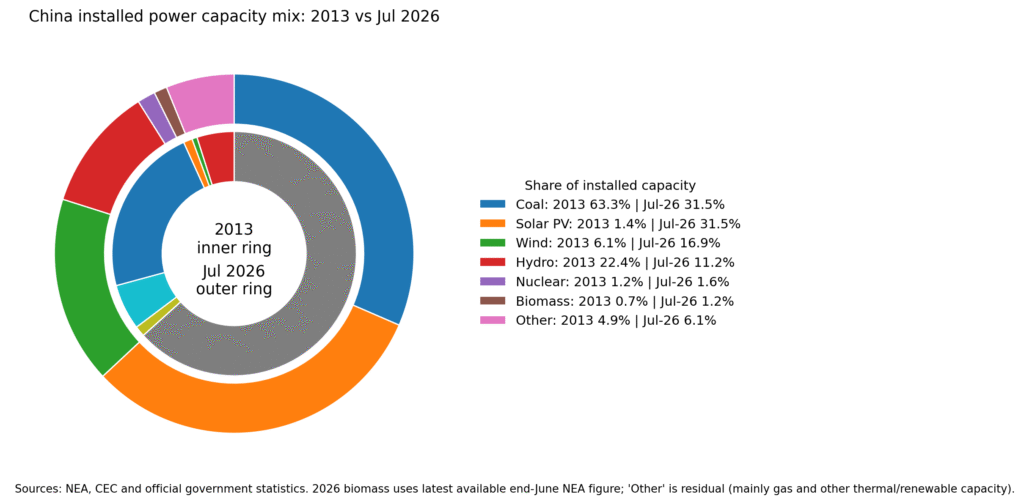
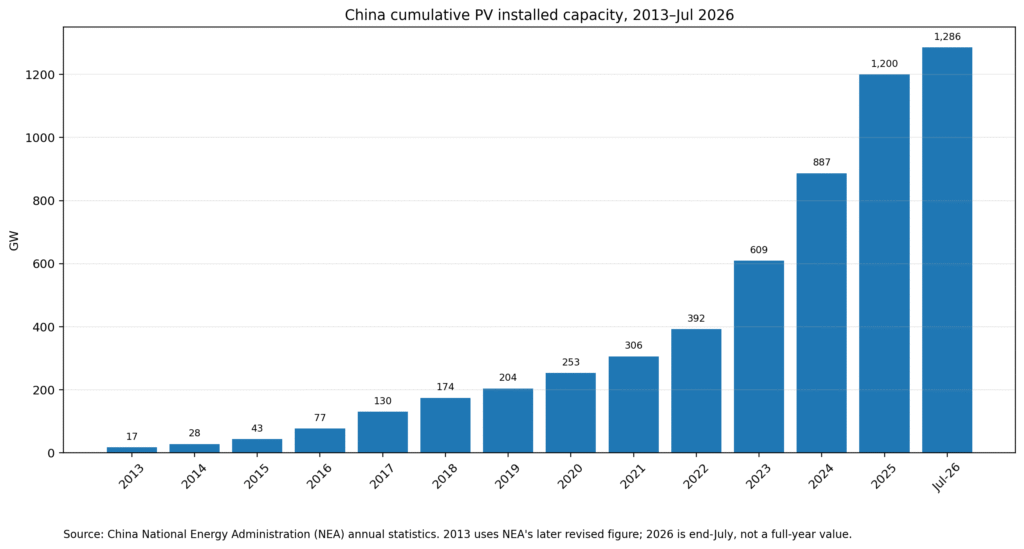
Subsequently revised NEA statistics put cumulative PV capacity at just 17.45 GW at the end of 2013. Coal capacity stood at around 790 GW, representing roughly 63% of the country’s generating fleet, while solar accounted for only around 1.4%. Hydropower stood at approximately 280 GW, wind at 75.5 GW and nuclear at 14.6 GW.
China’s PV fleet has therefore expanded almost 74-fold since 2013. Capacity reached 77.4 GW in 2016, passed 130 GW in 2017 and exceeded 250 GW in 2020, before accelerating sharply following China’s 2020 carbon-neutrality pledge. It climbed from 392 GW in 2022 to 609 GW in 2023 and 887 GW in 2024, reaching around 1.2 TW by the end of 2025.

The expansion also has global significance. The International Renewable Energy Agency (IRENA) estimates that worldwide solar capacity reached around 2.4 TW at the end of 2025, meaning China’s 1.2 TW fleet represented approximately half of global installed solar capacity. Solar accounted for about three-quarters of all new renewable capacity added worldwide in 2025.
Yet China’s domestic PV industry is reaching the milestone while undergoing one of its deepest corrections in years.
China installed about 71.8 GW of PV in the first half of 2026, down from 212.2 GW in the same period of 2025, a decline of roughly 66%. Last year’s figure was inflated by a rush to complete projects ahead of the shift toward market-based renewable electricity pricing, but developers are also facing tighter grid-connection conditions and weaker project economics.
Grid integration is becoming another constraint. China’s average PV utilization rate fell to 91.4% in the first half of 2026, from 94% a year earlier, increasing pressure for additional transmission and storage capacity, more flexible generation, and improved electricity market mechanisms.
Manufacturers are simultaneously struggling with excess capacity and weak prices. China Photovoltaic Industry Association data show that polysilicon production fell 9.8% year on year in the first half, while module output declined 35.1%. Wang Bohua, former secretary-general of the association, described the sector as undergoing a “deep adjustment,” but said the slower pace of installations represented a return toward more sustainable growth following the exceptional surge in 2025.
The next stage of China’s solar transition will therefore be less about how many additional gigawatts can be installed than how reliably that capacity can supply electricity when the system needs it. CEC officials have argued that wind and solar have yet to effectively replace conventional generation during critical periods, making storage, grid-forming technologies, stronger transmission networks and more flexible power markets increasingly important.
Solar’s move past coal is consequently both a historic milestone and the beginning of a more difficult phase: converting unprecedented renewable energy capacity into dependable electricity supply.
This content is protected by copyright and may not be reused. If you want to cooperate with us and would like to reuse some of our content, please contact: [email protected].


