






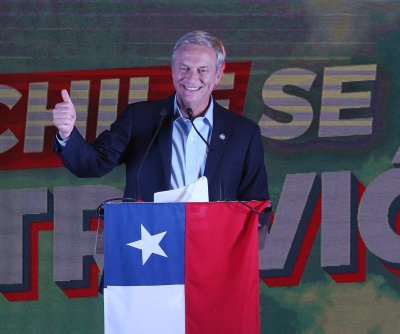
Chilean President José Antonio Kast’s government is walking a tightrope between the influences of the United States and China. File Photo by Elvis Gonzalez/EPA
April 1 (UPI) — When Chilean Foreign Minister Francisco Pérez Mackenna posted a photograph on social media last month, the message was hard to miss.
The image showed him shaking hands with U.S. Ambassador Brandon Judd and, in a second nearly identical shot, with Chinese Ambassador Niu Qingbao. His posture and attire were the same in both.
The symmetry appeared deliberate. It also captured the central challenge facing President José Antonio Kast, who took office March 11.
Kast is one of Latin America’s most openly pro-Washington leaders, and his government has moved quickly to align Chile with U.S. positions on Venezuela, Taiwan and some regional security questions.
Yet, China’s place in Chile’s economy is so large that any sharp break with Beijing would carry serious costs. Officials, business leaders and investors in Santiago understand that well.
I spent the week of March 22 to Saturday in Chile, giving presentations and speaking with business leaders, security officials and academics about China’s role in the country. What I found was a government trying to manage a strategic tension that has no simple resolution.
Security friction
That tension became visible almost as soon as Kast took office. In February, the outgoing Boric administration was drawn into controversy over U.S. sanctions on three officials involved in approving the “Chile-China Express,” a Chinese fiber-optic cable project between Valparaíso and Hong Kong that U.S. officials reportedly viewed as a potential security concern.
Ambassador Niu responded publicly, accusing Washington of trying to undermine the sovereignty of other nations.
Around the same time, a Chinese oceanographic vessel, seen by some outside analysts as having possible intelligence significance, carried out activities in Chilean waters that Beijing described as scientific research.
A People’s Liberation Army hospital ship also made port calls in Antofagasta and Valparaíso, prompting questions in some Chilean circles about the broader purpose of the visit. The Kast government had already halted construction of a Chinese space facility in the Atacama Desert amid concerns that it could have dual-use value.
China’s military presence also extended beyond maritime activity. When I addressed the opening session of the academic year at Chile’s National War College, a three-person People’s Liberation Army delegation, including the military attaché and his deputy, attended the event. Chilean colleagues told me that such visibility in that setting was unusual.
Even so, the long-term contest is unlikely to be decided primarily in the security sphere. It is more likely to be decided in the economy, where China’s position is much stronger.
Economic dependence
China receives roughly half of Chile’s copper exports and 71% of its lithium, two minerals central to both Chile’s economy and the global energy transition. Chinese companies reportedly control about two-thirds of Chile’s electricity distribution network. China also purchases about 90% of Chile’s cherry exports and is an important market for grapes, wine and other agricultural goods.
Chinese automakers now account for about 40% of Chile’s vehicle market, while Chinese electric buses operate in Santiago and other cities. Huawei runs at least three data centers in Chile. Two Chinese state-linked firms are among the finalists competing to expand the Port of San Antonio, Chile’s most important deepwater facility.
During my visit, Chilean contacts also pointed to early commitments linked to a possible Chinese port project in Tierra del Fuego. If such a project advances, its significance would extend well beyond southern Chile. At a minimum, it would deepen China’s presence near maritime routes of growing strategic importance.
This is the dilemma confronting Kast. Chile does not face only a diplomatic choice between Washington and Beijing. It also faces the practical question of how far it can distance itself from China without damaging sectors vital to growth, exports and investment.
Washington’s challenge
One senior Chilean businessman put the matter bluntly: With 38% of Chile’s total exports going to China, more than twice the share going to the United States, Chile would be unwise to provoke Beijing without a compelling reason.
He pointed to China’s economic retaliation against Australia after Canberra called for an independent COVID-19 inquiry, an episode that remains fresh in many Latin American business circles.
There is an additional irony that Kast may not welcome. His signature economic agenda centers on rolling back regulatory barriers that slowed investment under the previous Boric government. That may help growth and improve the business climate. It may also create new openings for Chinese firms that are already well positioned in key sectors of the Chilean economy.
Washington has pushed back where it can. Judd has spoken publicly about Chilean engagements he sees as risky, and the sanctions linked to the fiber-optic cable sent a clear political signal.
But pressure without credible alternatives can accomplish only so much. The United States has moved more slowly than many in Chile would like in offering financing, technology partnerships and market access on a scale that could give Chilean officials and businesses a practical reason to reduce their exposure to China.
Kast will likely continue to speak Washington’s language on the issues that matter most to the Trump administration. He will probably keep some distance from Beijing in the security realm and avoid the most politically sensitive forms of Chinese engagement. What he is far less likely to do, because no Chilean government could do so easily, is unwind the economic relationship that ties Chile to China.
Whether Washington recognizes that constraint and adjusts its expectations accordingly may go a long way toward determining how productive its relationship with Chile’s new government becomes. Pérez Mackenna’s carefully balanced handshake photograph was not merely a gesture. It was a concise expression of the policy tightrope Chile is now trying to walk.
R. Evan Ellis is a senior non-resident associate at the Center for Strategic and International Studies. His latest book, China Engages Latin America: Distorting Development and Democracy, is published by Palgrave Macmillan. The views and opinions expressed in this commentary are solely those of the author.


