


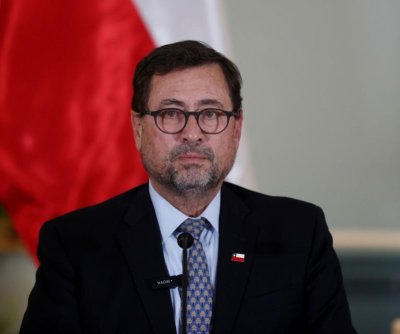
Speaking about the upcoming regional crime and border security summit, Chilean Minister of Foreign Affairs Francisco Perez Mackenna said, “I believe governments in the region understand that to confront the scourge of organized crime we must work together, share information and coordinate efforts.” Photo by Luis Gandarillas/EPA
SANTIAGO, Chile, May 20 (UPI) — Chile has invited Peru, Bolivia, Argentina and Ecuador to attend the first “Secure Border” summit May 28 to coordinate a regional response to organized crime and border security threats.
Chilean Foreign Minister Francisco Pérez Mackenna said foreign ministers and security officials from the participating countries are expected to attend the meeting.
“I believe governments in the region understand that to confront the scourge of organized crime we must work together, share information and coordinate efforts. All invited countries quickly agreed to join this summit,” Pérez Mackenna told UPI.
He said it was especially significant that Bolivia and Peru rapidly joined the initiative because it reflects a shared interest in addressing common security challenges.
“We face similar problems and want to fight them together. This summit is the first step in a joint regional effort against transnational crime,” he said.
Officials hope the meeting will produce agreements for coordinated action against organized criminal networks.
The summit comes amid closer political alignment among several South American governments and growing pressure to contain rising crime rates across the region.
“The political affinity and strong diplomatic relations certainly facilitate these types of agreements because they create conditions of trust and strategic alignment between governments and their institutions,” Patricio Santos, a retired general from Chile’s national police force, Carabineros, and deputy director of the Comprehensive Security Center at Universidad Finis Terrae, told UPI.
Santos said trust between countries is especially important in security matters because cooperation often requires intelligence sharing, police coordination and joint efforts in border areas.
Although Latin America has historically maintained bilateral and multilateral security cooperation mechanisms, Santos said these meetings have become increasingly important due to the continued rise of transnational organized crime, including drug trafficking, human trafficking, smuggling, arms trafficking and irregular migration facilitated by criminal groups.
International indicators such as the Global Organized Crime Index show that between 2021 and 2025, Argentina, Bolivia, Chile, Ecuador and Peru experienced rising levels of organized criminal activity, while also showing declines in institutional resilience.
“That is especially relevant because resilience measures the ability of states to contain corruption, strengthen institutions and effectively confront criminal threats,” Santos said.
Alfonso Kaiser, a professor of military strategy at Universidad de los Andes, told UPI that transnational criminal organizations exploit legal loopholes across different countries.
“There is a lot of imitation in all of this. It is not necessarily coordinated between criminal organizations, but countries face common challenges such as identifying money routes, which requires prior intelligence work,” Kaiser said.
Santos said criminal organizations’ ability to adapt requires increasing levels of international cooperation, intelligence sharing and permanent operational coordination.
“The real challenge is not only signing agreements, but sustaining real coordination capacities, institutional trust and permanent evaluation of results over time,” he said.
He added that while summits are important as a starting point, their practical legitimacy will depend on whether they lead to concrete and measurable actions on the ground.
Kaiser said achieving results and advancing joint protocols will be essential, including measures such as mechanisms to return migrants to their countries of origin.
“It is a first step, but there is still a long road ahead,” he said.