



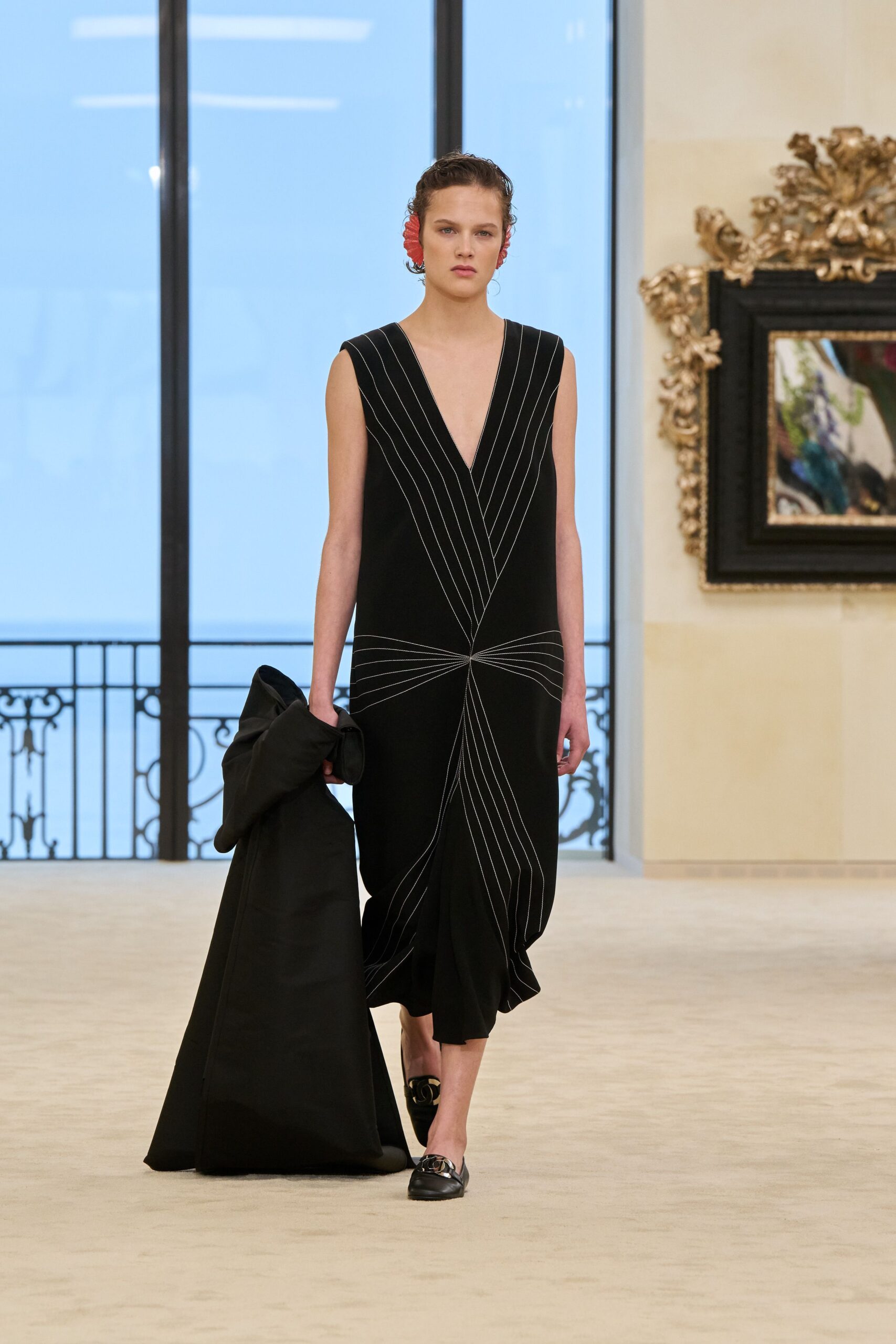
Matthieu Blazy used to play on the beach at Biarritz as a boy. “My father’s family were up in the Pyrenees, so we came down to swim here in the summer.” Who’d have thought at that stage in the life of a French-Belgian boy that he’d be back here playing with Chanel’s seaside legacy, overlooking the same beach?
But that’s what just took place at Blazy’s first Chanel cruise show: a beige carpet made to look like sand and a collection walking on it that refracted both the past of the house and the joyful new energy he’s bringing to it. Seashells as earrings. Coral, starfish, and sea anemone-fronds turned into braiding, and an aquarium of embroidery. Beach umbrella skirts, striped-towel Chanel suits, and giant straw baskets. All of this washed in on a tide of the kind of lightweight-yet-serious clothes that have caused editors, influencers, stylists, and customers to storm Chanel boutiques recently.
The legend of Biarritz is a cornerstone of the house’s history. Coco Chanel was young herself when she landed in the French Atlantic coastal resort with her British lover Arthur ‘Boy’ Capel in the summer of 1915. A stone’s throw from the Spanish border, Biarritz had become an escape for intellectuals, artists, aristocrats, and wealthy émigrés during World War I. Before the show, Blazy related how he was inspired by that heady social mix and by what Chanel did by radically infusing sportiness and local Basque workwear into high fashion. “In 1914, all these kind of intelligentsia, creative people, the artists, they all started to come down to Biarritz to flee what was happening in Paris, and this is where she had the idea together with Boy to create her own fashion house.”
Blazy had boards full of research. Alongside pictures of Deco posters, Picasso, Dali, and even of Winston Churchill at play on the beach, there was a photo of a young woman in a fancy-dress costume made out of newspapers. (More on that one in a minute.) “And this, I think,” he said, pointing to a 1926 sketch of what American Vogue named Chanel’s ‘Little Black Dress,’ is really her first Revenge Dress.”
The show opened with his own LBD version, a shift cut into a deep V, its drop-waist shape emphasized by lines of white geometric stitching. Blazy had discovered an original in the Met’s Costume Institute, and was surprised to find it had a large bow at the back. He swiftly converted it into a tiny clutch sunk into a ginormous bow. Chanel’s introduction of simple-chic black dresses, which she’d borrowed from observing maid’s uniforms, is a clothing revolution enjoying its 100th anniversary this year. Blazy pointed out the audaciousness of a young woman couturier absorbing the uniforms of the working classes (of her own origins) and then presenting it back as high fashion which then suddenly became all the rage. “A revenge from her old social condition.” Which soon turned into a democratic style for everywoman.
There’s a lot of that spirit in the way Blazy makes ultra-luxurious fashion look so easy to wear. Part of it is the Chanel-for-everyday idea he implanted in his Métiers d’art New York subway show. This time it manifested in ticking-stripe overshirts and worn-in cotton drill khaki skirts suits with bags to match. Casual Chanel. Not afraid of showing something as generic as a striped sweater with a quarter-zip. After all, it was Chanel herself who copied it from the sailors, or was it (as Blazy suspects) from Pablo Picasso, who was also hanging out in Biarritz wearing his marinère sweaters at the same time? “There was always this idea of borrowing.”
The other part of the easiness in Blazy’s design is just how supple and uncomplicated to wear he makes the most formal clothes look. Getting a modern, elegant slouch into a notional Chanel tweed suit; establishing the proportions of a trouser suit with a slightly cropped jacket that everyone wants; making arrays of evening outfits to suit all kinds of characters and occasions are all accomplishments he’s been pulling off at record pace.
In a room drenched in light, his 1920s swimwear and swim caps, and mermaid and silk scarf dresses raised smiles and spirts. Everywhere there was something to see: lattice lace in the shape of Biarritz trees covering a suit, a gold-fringed fish-scale coat, gilded sandals that were actually only heels, leaving the rest of the foot naked. In a preview, he pulled out the latest lattice-work iteration of a quilted Chanel bag made of sea-blue resin: “It’s waterproof. You can swim in it!”
And as for the newspaper prints and the ball dress that popped up somewhere near the end? Blazy acknowledged the long list of precedents for that idea. “The first to do this kind of dress with newspaper were the suffragettes. Then, of course, Schiaparelli, John Galliano, one of my favorites Per Spook, and Jean Paul Gaultier,” he said. “But the thing that made me want to do it was a beautiful quote by Gabrielle Chanel. She said ‘I love to read newspapers, like men’.”