








Global, Headlines, Health, Population, TerraViva United Nations


The question of who should be responsible for meeting the rapidly growing need and expenses for elderly care remains a contentious issue in many countries. Credit: Shutterstock.
PORTLAND, USA, Apr 15 2026 (IPS) – Who should be responsible for providing care and covering expenses for the elderly? Should it be governments, the elderly themselves, their families, a combination of the three, or a new societal arrangement?
As populations age and more elderly individuals live longer lives, there are relatively fewer workers and less tax revenue, causing governments to struggle with the challenge of providing care for the elderly. This struggle is particularly notable in the provision of nursing care and health services.
The challenge is mainly driven by the growing demand for care, workforce shortages, and rapidly rising costs. These issues are expected to become increasingly difficult to sustain in the upcoming years.
Furthermore, this challenge is complicated by age discrimination towards elderly individuals. This discrimination is increasingly prevalent and has a negative impact on older people’s physical and mental well-being. It is associated with earlier death, poorer physical and mental health, and slower recovery from disability in older age.
The proportion of the world’s population aged 65 years or older has doubled from 5% in 1950 to 10% today and is expected to reach 16% by 2050. Most of the world’s elderly are below the age of 75, with 41% in the age group 65 to 69 and 29% in the age group 70 to 74 (Figure 1).
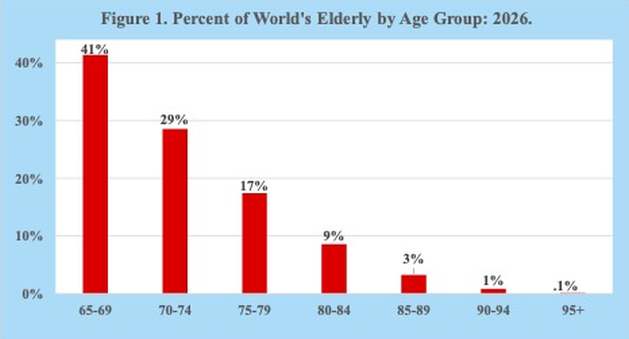

Source: United Nations.
The increase in the proportion of elderly individuals is significantly greater in many countries. For example, in Japan, the proportion of elderly has increased six-fold since 1950. Similarly in Italy and China, the proportion of elderly has tripled since 1950. By 2050, it is projected that approximately one-third of the populations of Japan, Italy, and China will be elderly (Figure 2).
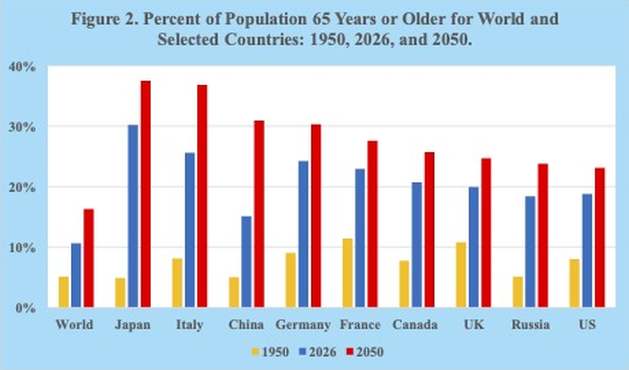

Source: United Nations.
In addition to population ageing, life expectancy at birth for the world’s population has increased from 46 years in 1950 to 74 years in 2026. It is projected that by 2070, the global life expectancy at birth will nearly reach 80 years, with many countries, such as France, Japan, Italy, Norway, Spain, Sweden, and Switzerland, expected to reach life expectancies at birth of around 90 years.
Elderly individuals in need of care are more likely to be women, 80-years-old and older, and live in single households. Many of them experience social isolation while living at home, which negatively impacts their mental and physical health. Additionally, these individuals typically have lower incomes than the country’s average.
The cost of providing care for elderly individuals varies drastically across countries. Costs for care are mainly driven by labor costs, healthcare infrastructure, and government subsidies.
Governments, especially those leaning towards political conservatism, are hesitant to cover the increasing expenses associated with care for the growing numbers of elderly. In the United States, for example, the president recently announced that it’s not possible for the federal government to fund Medicare, Medicaid, and child care costs. Instead, he argued that the one thing the federal government must take care of is the country’s military spending
Many high-income countries rely on migrant workers with irregular work contracts, to fill labor gaps, often operating with limited legal protections and standardized training. The situation is further complicated by poor working conditions, comparatively low salaries, and a lack of recognition making recruiting and retaining care workers difficult.
High-income countries have relatively high annual costs for care, while low-to-middle-income countries typically rely on family members to provide assisted care for the elderly.
For example, in the United States, the average annual cost in an assisted living community is approximately $75,000. Care in Switzerland is also expensive, with nursing home costs averaging over 100,000 Swiss francs annually. Similarly in Germany, the average annual cost for nursing home care is roughly between 36,000 to over 48,000 Euros.
Among OECD countries, publicly funded elder care systems still leave nearly half of older people with care needs at risk of poverty, especially those with severe care needs and low income. Out-of-pocket costs represent, on average, 70% of an older person’s median income across OECD countries.
Governments, especially those leaning towards political conservatism, are hesitant to cover the increasing expenses associated with care for the growing numbers of elderly.
In the United States, for example, the president recently announced that it’s not possible for the federal government to fund Medicare, Medicaid, and child care costs. Instead, he argued that the one thing the federal government must take care of is the country’s military spending.
Conservative and authoritarian governments typically do not see much economic benefit from government spending on elderly care, as they perceive the elderly as a societal burden. They argue that health care costs for the elderly is negatively correlated with economic growth and tend to oppose publicly funded efforts for life extension, advocating for limited government spending in these areas.
Furthermore, these conservatives and government officials often stress the importance of individual responsibility and solutions from the private sector. They believe that the costs of caring for the elderly should be borne by the elderly and their families.
However, the total cost of care for the elderly is often unaffordable for most families. In many OECD countries, elderly individuals risk falling into poverty without substantial financial assistance from their governments.
Some countries, such as Germany, Japan, South Korea, and the Netherlands, have implemented mandatory enrolment in elder care insurance. These programs are typically funded through mandatory payroll contributions.
In many countries, however, informal care for the elderly is still provided by family members, with the majority being women. This informal care is facing increasing strain due to factors such as urbanization, declining fertility rates, dual-career families, workforce mobility, and rising financial costs, all of which are putting pressure on the capacity of families to care for elderly relatives.
Although the need for elder care is rapidly increasing worldwide, the ability of existing systems to respond to current and rising needs remains limited in many countries. Most individuals in need of care rely on families and informal caregivers for support, while care services remain expensive, unstable, and difficult to access. These circumstances place significant strains on families, caregivers, and health care systems.
Further complicating care systems is the fact that elderly individuals often suffer from chronic health conditions. Some common health issues experienced by the elderly include Alzheimer’s disease, arthritis, asthma, back and neck pain, cancer, cataracts, chronic obstructive pulmonary disease (COPD), dementia, diabetes, frailty, falls and injuries, heart disease, hearing loss, high blood pressure, high cholesterol, osteoarthritis, stroke, and urinary incontinence. Furthermore, as individuals age, they are more likely to experience multiple health conditions simultaneously (Table 1).
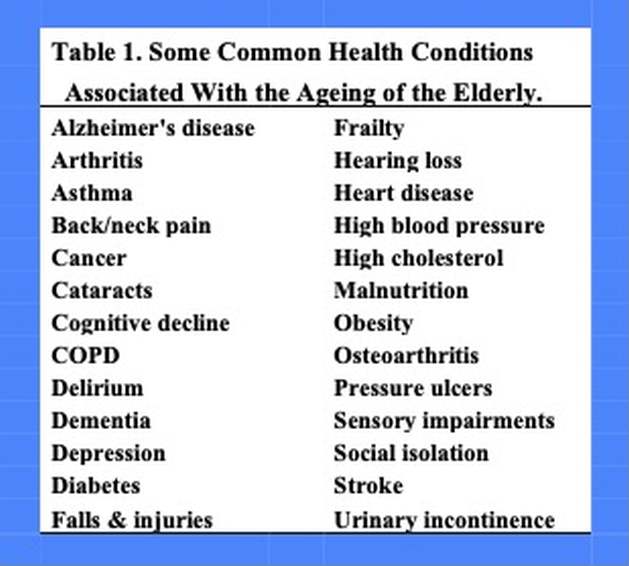

Source: World Health Organization.
In conclusion, as a result of population ageing and increased longevity, countries are facing the challenge of providing care for their elderly citizens. The question of who should be responsible for meeting the rapidly growing need and expenses for elderly care remains a contentious issue in many countries.
The general public believes that the government should take on the responsibility of providing care for the elderly. In contrast, many governments, concerned about the escalating fiscal burden, prefer that the elderly and their families themselves provide the necessary care and be responsible for the expenses. Still, others believe that a new societal arrangement is needed to provide care for the elderly.
Joseph Chamie is a consulting demographer, a former director of the United Nations Population Division, and author of many publications on population issues.


