
The Bank of England (BoE) will deliver its first monetary policy decision of 2026 on Thursday.
Most analysts think the ‘Old Lady’ will sit tight, keeping the base rate at 3.75% after the cut delivered back on December 18. Alongside the decision, the bank will also release the Minutes, which should shed a bit more light on how policymakers weighed the arguments around the table.
Markets are firmly priced for no move this time. However, the case for further easing hasn’t gone away, even if the BoE chooses to stay patient for now, as the UK economy struggles to gain any real traction and the fiscal backdrop continues to darken.
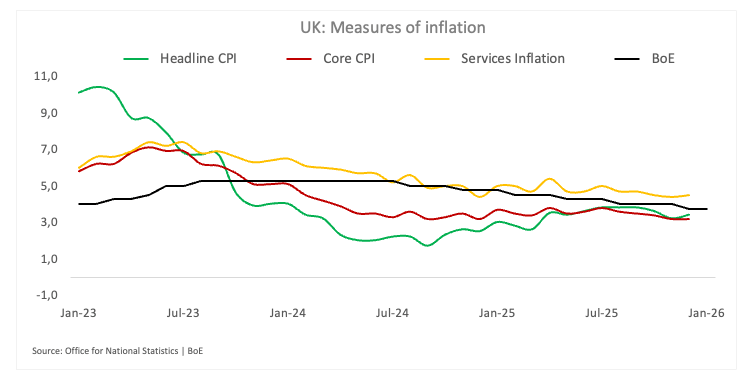
Inflation keeps running hot
The BoE’s December rate cut was a close-run thing. The 25 basis point move, which took the bank rate down to 3.75%, was carried by a narrow 5–4 vote. Indeed, members Breeden, Dhingra, Ramsden and Taylor all backed a cut, but it was Governor Bailey’s switch that proved decisive, underlining just how finely balanced the debate around further easing has become.
The message from the guidance was still cautiously dovish but noticeably more conditional. Policymakers stuck with the idea that rates are likely to move lower over time, describing a “gradual downward path”, while making it clear that each additional cut will be harder to justify. As policy drifts closer to neutral, the room for manoeuvre is shrinking, and the judgement calls are getting tougher.
The macro backdrop allows for further easing, but not with haste. Growth momentum has faded, with the economy expected to flatline in Q4, and inflation is projected to fall back more quickly in the near term, moving closer to the target by mid-2026. At the same time, lingering inflation bumps and a labour market that is only cooling slowly argue against flagging an aggressive cut cycle.
All told, December looks less like the start of a rush to ease and more like a careful recalibration. The Bank is still edging in an easier direction, but with rising caution as rates approach neutral and decisions become ever more dependent on incoming data.

According to the BoE’s Decision Maker Panel (DMP) published on January 8, businesses are growing a touch less punchy on pay, as firms now expect wages to rise by 3.7% over the 12 months from the final quarter of 2025, a shade lower than the pace they were expecting just a month earlier.
Additionally, companies are reducing their expectations for price increases in the upcoming year, which resulted in a 0.1 percentage point decrease to 3.6% in the three months to December.
And it’s not just wages and prices. Firms have also become slightly more cautious on hiring, with expectations for employment growth over the next year softening a little, according to the survey.
How will the BoE interest rate decision impact GBP/USD?
Many people expect the BoE will keep the reference rate at 3.75% when it makes its announcement on Thursday at 12:00 GMT.
The real focus will be on how the MPC votes, since a hold is already fully priced in. If the British Pound (GBP) moves in a way that isn’t expected, it could be because it suggests a change in how policymakers are getting ready for future decisions.
Pablo Piovano, Senior Analyst at FXStreet, notes that GBP/USD has come under fresh downside pressure soon after hitting yearly peaks near 1.3870 in late January, an area last traded in September 2021.
“Once Cable clears this level, it could then attempt a move to the September 2021 high at 1.3913 (September 14) ahead of the July 2021 peak at 1.3983 (July 30)”, Piovano adds.
On the other hand, Piovano says that “the critical 200-day SMA at 1.3421 emerges as the immediate contention in case sellers regain the upper hand prior to the 2026 floor at 1.3338 (January 19).”
“Meanwhile, the Relative Strength Index (RSI) near 61 suggests further gains remain in the pipeline in the near term, while the Average Directional Index (ADX) near 30 indicates a pretty strong trend,” he concludes.
Pound Sterling FAQs
The Pound Sterling (GBP) is the oldest currency in the world (886 AD) and the official currency of the United Kingdom. It is the fourth most traded unit for foreign exchange (FX) in the world, accounting for 12% of all transactions, averaging $630 billion a day, according to 2022 data.
Its key trading pairs are GBP/USD, also known as ‘Cable’, which accounts for 11% of FX, GBP/JPY, or the ‘Dragon’ as it is known by traders (3%), and EUR/GBP (2%). The Pound Sterling is issued by the Bank of England (BoE).
The single most important factor influencing the value of the Pound Sterling is monetary policy decided by the Bank of England. The BoE bases its decisions on whether it has achieved its primary goal of “price stability” – a steady inflation rate of around 2%. Its primary tool for achieving this is the adjustment of interest rates.
When inflation is too high, the BoE will try to rein it in by raising interest rates, making it more expensive for people and businesses to access credit. This is generally positive for GBP, as higher interest rates make the UK a more attractive place for global investors to park their money.
When inflation falls too low it is a sign economic growth is slowing. In this scenario, the BoE will consider lowering interest rates to cheapen credit so businesses will borrow more to invest in growth-generating projects.
Data releases gauge the health of the economy and can impact the value of the Pound Sterling. Indicators such as GDP, Manufacturing and Services PMIs, and employment can all influence the direction of the GBP.
A strong economy is good for Sterling. Not only does it attract more foreign investment but it may encourage the BoE to put up interest rates, which will directly strengthen GBP. Otherwise, if economic data is weak, the Pound Sterling is likely to fall.
Another significant data release for the Pound Sterling is the Trade Balance. This indicator measures the difference between what a country earns from its exports and what it spends on imports over a given period.
If a country produces highly sought-after exports, its currency will benefit purely from the extra demand created from foreign buyers seeking to purchase these goods. Therefore, a positive net Trade Balance strengthens a currency and vice versa for a negative balance.
Economic Indicator
BoE Minutes
The minutes of the Bank of England (BoE) Monetary Policy Committee (MPC) meetings are published alongside the committee decision. The minutes give a full account of the policy discussion, including differences of view among members. They also record the votes of each member of the MPC. Generally speaking, if the BoE is hawkish about the inflationary outlook for the economy, then the markets see a higher possibility of a rate increase, and that is positive for the GBP.
Read more.
Last release:
Thu Dec 18, 2025 12:00
Frequency:
Irregular
Actual:
–
Consensus:
–
Previous:
–
Source:
Bank of England