







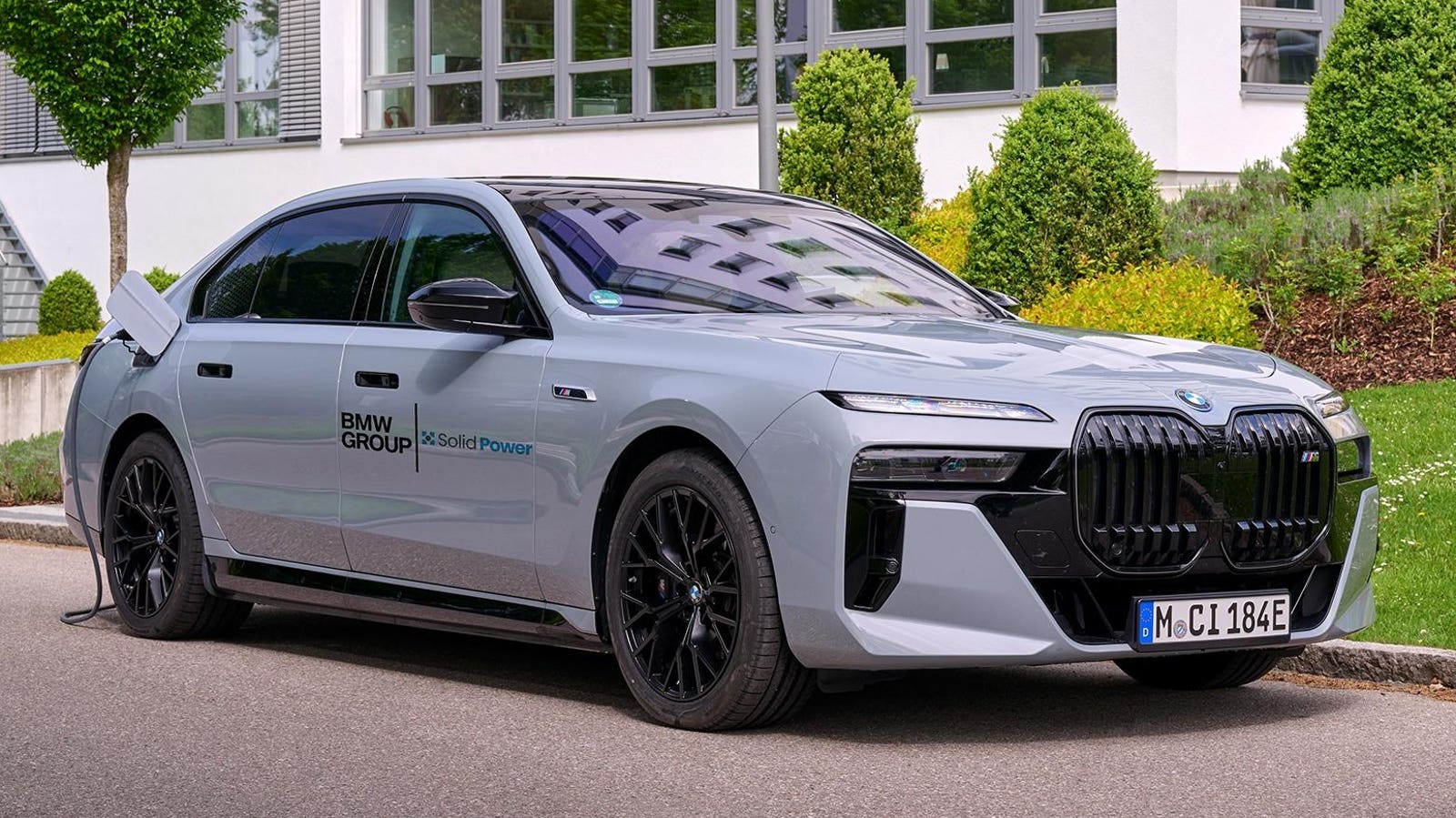
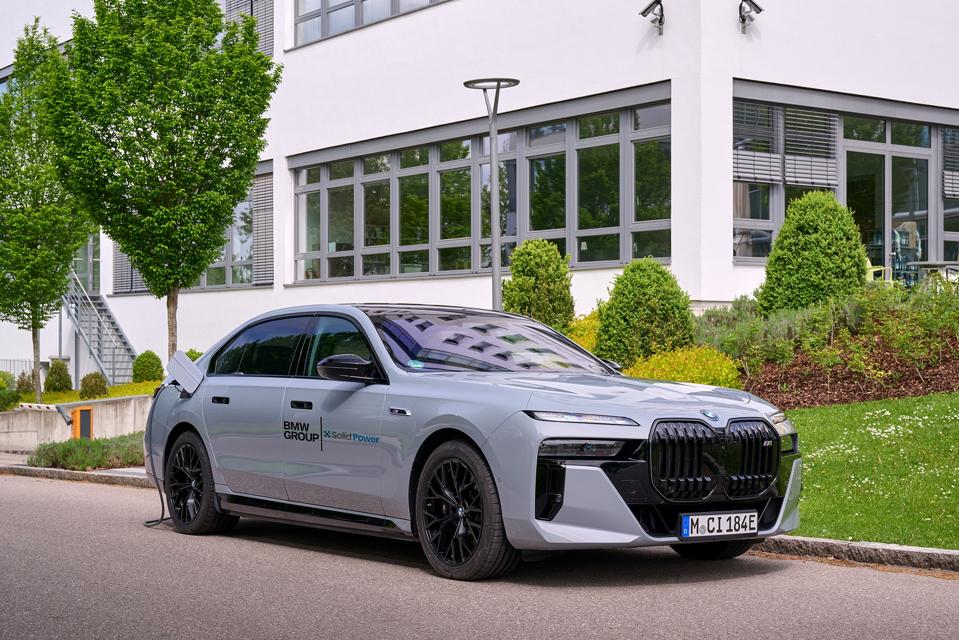

BMW is already trialling solid state batteries.
Tom Kirkpatrick/BMW AG
European car manufacturing is facing a pincer maneuver of threats. From the East, China’s automotive industry is stretching its wings across the global market. To the West, the lucrative American economy has become both unpredictable and less easily accessible. But BMW is confident it has the right strategy to combat the challenges. I talked to BMW Board Member Ilka Horstmeier about how the company plans to cope with current automotive uncertainties.
BMW’s Bet On Electrification Is More Of A Hedge
BMW’s launch of the first Neue Klasse cars would imply that it’s focusing on battery electric vehicles (BEVs) just as US ambivalence towards electrification is growing. Indeed, the company ceased making internal combustion engines (ICE) at its oldest, flagship plant in Munich in November 2023, moving production to Steyr in Austria and Hams Hall in the UK. Instead, Munich will exclusively make BEVs, and BMW has simultaneously been retooling the plant for the Neue Klasse sedan while continuing to manufacture up to 1,000 cars a day.
However, the official BMW strategy, as explained to me recently by Chairman Oliver Zipse, is to keep its options open. As the US market for EVs softens while Europe and China press ahead, BMW’s global production footprint provides some resilience, and the ability to vary its plans by region. “We didn’t need to adjust our strategy overall,” says Horstmeier. “Even three years ago, we were saying that we don’t put all our eggs in one basket, because times are volatile. Even in Europe, the prerequisites for 100% electric are not there and will not be there until the 2030s. Either it’s charging infrastructure or affordable green energy.”
BMW will be building the new all-electric i3 at its revamped Munich plant.
James Morris
BMW’s philosophy has long been that there is more to sustainable automaking than just switching to battery electric vehicles. “We remain technology open, while at the same time reducing the CO2 footprint of the whole value chain,” says Horstmeier. “This is what counts for climate change and not what the drivetrain of a car is. We don’t need to fundamentally change our strategy. We’re adjusting volumes and what type of car we produce in which plant.” This strategy not only addresses the uneven transition to electro mobility, but also the tariff fluctuations that have buffeted the year so far. “You never know what’s happening the next day. But the genetic code of our production network and system is flexibility. That’s the reason why we can react better to changes than others. Most of our plants can produce all the drivetrains in their production system.”
BMW Facing Chip Challenges, But Batteries Remain Problematic
One change that BMW has been having to react to recently has been the chip supply issues caused by the Dutch government’s takeover of Nexperia and China’s reaction of limiting exports. “We have shown in the chip environment we had in 2021-22 that we are very adaptive with regard to these types of volatility,” argues Horstmeier, referring to a previous chip shortage that shocked the automotive market. “We are watching what is happening. We are in close contact with our suppliers regarding what they can supply daily. And we make decisions as late as possible, because that was the differentiator in 21-22 with that chip shortage. We always use our own flexibility instruments.” At the time of writing, the Nexperia chip challenge was showing signs of receding.
However, as the European market moves inexorably towards EVs, despite US reticence, a more fundamental weakness is evident: the lack of local battery production. “An electric car needs a battery, that’s for sure,” says Horstmeier. This threat is accentuated by hard targets of ending internal combustion engine sales by 2035 in the EU and UK, which makes the lack of local battery supply a strategic threat to European automakers. “Every car manufacturer in that situation must look for resilience in their supply chain. But there are not that many options that we have. We use all suppliers. In the short term, the game has been played. But in the long term the biggest task for the European Union is to really think about how to allocate European battery production in Europe. I’m not talking about Chinese suppliers coming to Europe. I’m talking about really building up European battery manufacturing. This generation of batteries is done. We must look for the next generation and the whole supply chain, because it’s not only battery and cell production, but also about all the raw materials you need. A strategic plan now in Europe to look for the next generation of batteries, and what we can do there, would be helpful. That’s what we are talking about with the European Commission.”
BMW has been building up its battery knowledge at its Competency Centre in Munich.
Tom Kirkpatrick/BMW AG
Horstmeier isn’t implying that Europe has been caught doing nothing but argues that greater unity of purpose is required. She compares the situation to charging infrastructure, where manufacturers joined forces to create the necessary high-speed charging network for long-distance EV driving. BMW is part of the consortium behind IONITY, alongside Ford, Hyundai Motor Group, Mercedes-Benz and Volkswagen Group. “We have a lot of discussions in Europe about how to allocate battery production here,” she explains. But the first point is that we don’t only need battery production. If we look at resilient supply chains, we need raw materials. We need all the prerequisites for battery cell production. Then we must look for the production sites. It’s a joint effort. In the next years, we must see whether we are all together and really move the needle in a different direction.”
From BMW Circularity To Solid State
Obtaining the necessary minerals for local European battery production is one reason why BMW sees its push towards recycling and a circular material economy as so crucial. With a circular recycling ecosystem, the minerals in existing batteries can be extracted to create new ones. That way, even if the batteries were originally imported, their minerals stay in Europe when built into new European vehicles.
BMW is betting strongly on EVs like the iX3 Neue Klasse, but it’s still keeping its drivetrain options open.
Fabian Kirchbauer Photography
That still leaves the issue of manufacturing. Europe has had obvious problems building up strong local battery cell production. Northvolt filed for bankruptcy earlier this year, and the UK’s Britishvolt failed before even constructing a factory. “You need a couple of prerequisites,” says Horstmeier. “You need the raw materials. You need to understand where to get them from and how to secure them. You need the competency to build up cells efficiently.” Horstemeier argues that BMW is in a good position here because it has invested in a battery competence center, based in Munich, which opened in 2019. The company also has local high-voltage assembly plants in Woodruff, South Carolina (USA), Irlbach-Straßkirchen, Lower Bavaria (Germany), Debrecen (Hungary), Shenyang (China) and San Luis Potosí (Mexico). “We know what a battery looks like, but the industrialization and scaling are tricky tasks, even for experienced cell manufacturers. Whenever battery technology changes, it’s quite a while until production runs stable.”
However, while Horstmeier concedes that European automakers have lost the battery chemistry battle for current generation cells, she argues that solid state technology offers an opportunity to get ahead again. Indeed, BMW has been showing off the results of its collaboration with America’s Solid Power Inc in an i7 test mule. “In the past, we thought that just industrialization would be necessary, and this doesn’t work,” concludes Horstmeier. “I’m optimistic that there is a chance to become more independent in the future with new technology coming up, but we must join forces now. That’s a tricky point in Europe for many issues we are facing, including defense. We must join forces now, together with the European Commission and with the countries in Europe, and with the industry as well.”


