

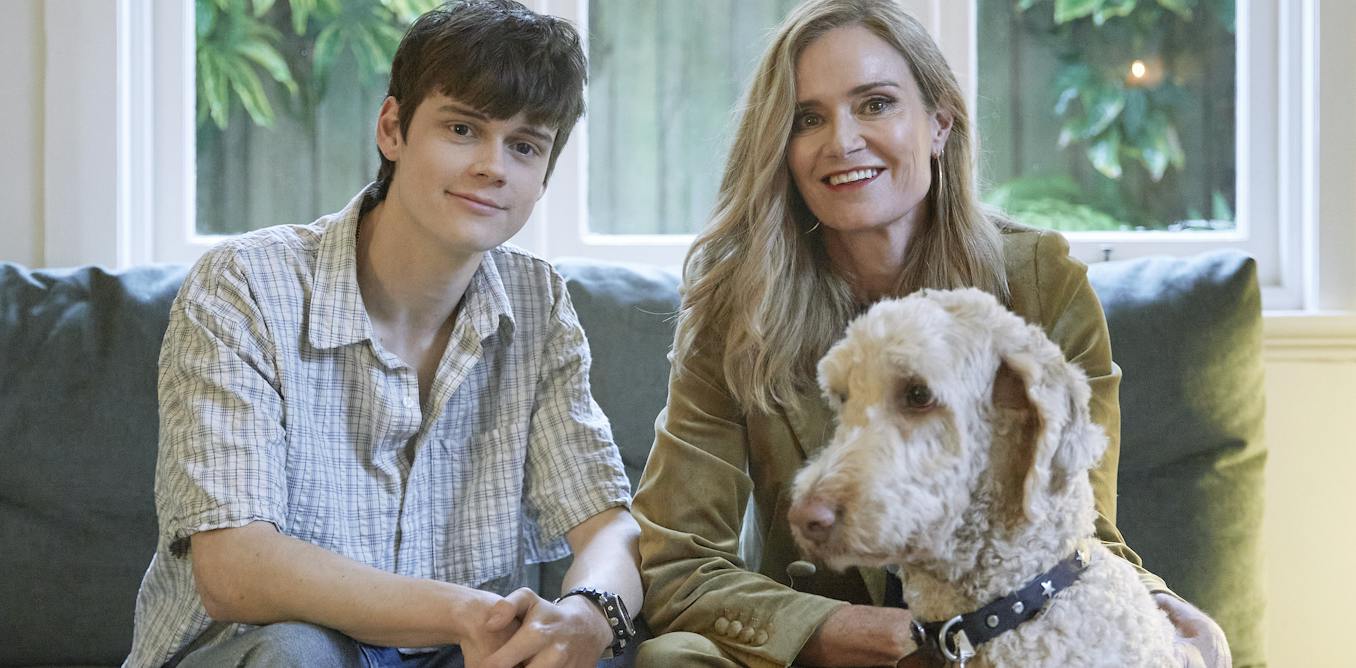
On her son Sam’s 16th birthday, journalist Julia Baird asked a group of men – family and friends – to write him letters about what it means to be a good bloke. The idea was to help him navigate the current atmosphere, where talk about the manosphere and toxic masculinity dominates. The letters were so moving, they decided to take the concept and turn it into a book.
In this way, Becoming a Man, edited by a mother and her son, was born. Their book adds to a broader public conversation, addressed to young boys, about what it means to be a man. Actor Stephen Graham, who played the father in Netflix’s Adolescence, recently released a similar book, Letters To Our Sons.
Review: Becoming a Man edited by Julia Baird and Sam Baird Sparks (Fourth Estate)
Becoming a Man contains some beautiful pieces. These letters offer a mix of inspiration, joy, sadness, contemplation and wonder. I didn’t love them all, but there was some genuinely good advice.
Much of it goes beyond the usual tips, such as “be sensitive” and “it’s okay to cry”. Tim Minchin, for example, provides a hodgepodge of tips for living a good life, such as get into cooking, treat your body kindly and smile. Jonty Claypole, CEO of Red Room Poetry, writes about the value of keeping a diary.
Composer Richard Tognetti eloquently talks about art and why we should get off our computers and go to choir practice. And award-winning Indigenous novelist Tony Birch talks about the value of slowing down, taking things in, clearing your head and replacing the clatter of noise with contemplative quietness.
Despite this, I still had an unease reading the book. My concern is not about the contents, but the premise – and what is missing from it.

Dan Himbrechts/AAP
Do we need more advice just for boys?
Becoming A Man exists because of an increasingly dominant discourse that boys are in trouble, and need help and advice. It’s a challenging time to be a boy. Yet, despite having dedicated years to researching the manosphere, I struggle to believe the issues they face are theirs alone.
Girls, and people of other genders, have it tough too. They also face challenges with social media, the rise of influencers, body image pressures and discrimination. And all young people are facing the existential threats of climate change, AI and economic insecurity. As more books, shows and other media are pumped out about boys, I increasingly worry that girls are being ignored in these conversations.
Before the men’s rights activists jump on me, I am not suggesting we direct attention away from boys to girls. But why do we keep splitting kids via their gender, rather than addressing these issues together, as human beings?

This is where I question this book’s premise: it assumes, even in its title, that the traits you need to become a “good man” are inherently different from the traits needed to become a “good woman”. This is a dominant idea within the manosphere itself – that the “two genders” are fundamentally different and should have different roles in society.
Becoming a Man is coming from a good place, but I worry it subtly reinforces this binary, which limits the ability of boys (and girls) to imagine what their lives could look like beyond notions of masculinity and femininity.
Some authors challenged this in their letters: like resilience author and podcaster Hugh van Cuylenburg and Andrew Denton. Former rugby league player, now reading influencer Luke Bateman argues “the danger in focusing on what it means to be a man is that you lose sight of the very thing that you were born to be: human.” In one of my favourite letters, Amar Singh, founder of Sikh-led charity Turbans 4 Australia, which specialises in disaster relief, begins:
First of all, we have to be human beings, no matter what our sex or preferences are in life. Being human means understanding each other, whether it’s your friends, partner or work colleagues.
This is why the question I wish the book had asked – what does it mean to be a good human? – is so important. Thinking about a common humanity, rather than a separate “masculinity” and “femininity”, allows us to better understand each other. The essays I most enjoyed often thought about things in a less gendered way, rather than trying to awkwardly fit traits into masculine moulds.
Would it be a better book if it was Becoming A Human?

Sarah Wilson/AAP
Where were the women?
Apart from Julia Baird’s introduction, alongside a discussion between quadriplegic disabilities scholar Shane Clifton and his daughter Jemma, a trans woman who works for LGBTIQ+ Health Australia, there are no women in this book. The contributors are mostly cis men – some gay, but mostly straight.
Women have often been expected to “fix men” and have borne the brunt of fighting against male violence. So, I’m not suggesting the Bairds should have asked women to write letters about the impact of domestic violence and why men shouldn’t do it – making women do all the work again. But the lack of women contributors plays into the narrative men can only learn from men (and vice versa).
Julia Baird’s clearly powerful relationship with her son shows that women can, and often do, become mentors and role models for men.
Manosphere men often complain about boys not having enough male role models, often blaming mothers for the crisis of masculinity among young men. Even Louis Theroux made this claim in his documentary, noting that most of the influencers he met were raised by single mums, a subtle way of blaming them. This enters political debate too, like when Matt Canavan suggested boys are turning to the manosphere because we don’t have enough male teachers.
While well meaning, a book that only includes men subtly reinforces these ideas. Boys can’t learn from women, or look up to them. The only way they relate to women, this kind of segregation suggests, is as people they’re related or married to, or want to have sex with.
Some male contributors tried to address this, particularly in the section about friendships. Darcy Moore, captain of Collingwood Football Club, says “platonic friendships with women are healthy; they can help to broaden your perspective, especially if you’re a young guy”. Actor and TV host Rob Mills talked about the value of having relationships with “the opposite sex”, saying he is so grateful for those friends: “because of it, we learned about consent and respect very early on”.
Even here, though, suggestions men should have more female friends were often shoehorned in awkwardly, framed through the lens that women can “provide” something different to men – not that we should be friends with women because, well … women are awesome. Instead, I’d love to see something more expansive – where women and men can be anything and everything to each other.
This works the other way around, too. Men can and should (obviously, in an appropriate way) be role models for girls.

James Rossl/AAP
A different approach is needed
One of the best ways to deal with the separate pressures faced by boys and girls is to stop separating them – and instead address them together. Groups like the manosphere claim girls are like a different species – and we can only relate to our own gender. It’s time to start resisting that framework.
I understand how and why this book has come about: mother and son discussed it beautifully in their introductions. Sam describes being struck by “how, even when discussing the same concept, the letters could have entirely different meanings shaped by how the author lived their life”. He continues, eloquently,
it was a bit like looking at a portrait and realising that while I could list the colours used, how they took form and shape to create the work – in this case, a man people can trust and rely on – was and still is beyond me.
It’s no wonder he and his mother wanted to share his gift with everyone.
In today’s world, advice from men, to men looks like the best way to help young boys. In context, this book makes total sense. So, I don’t discourage people from giving this book to their sons – much of its advice is truly excellent.
My criticism is not of Julia and Sam Baird, but of our cultural context. While I enjoyed Becoming A Man and learnt a lot from it, I also wanted something different – and feel like we need it.
