




Asia-Pacific, Crime & Justice, Development & Aid, Editors’ Choice, Featured, Headlines, Human Rights, Humanitarian Emergencies, International Justice, Migration & Refugees, Religion, TerraViva United Nations | Analysis


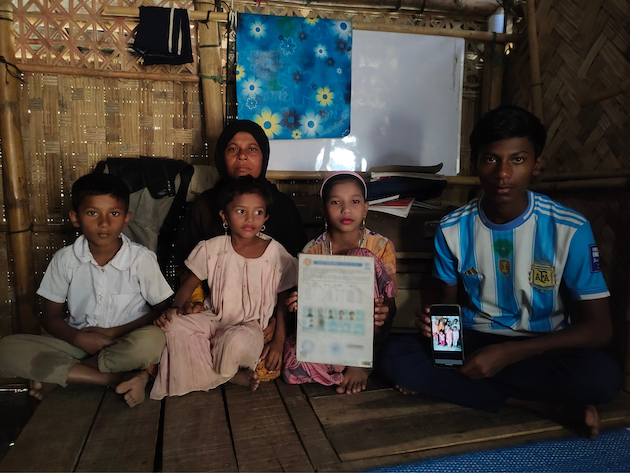
Mon Bahar’s family poses with a photo taken before her husband Rahmot Ullah and daughter Shamsun Nahar, both Rohingya refugees, tried to leave Cox’s Bazar for a better life in Malaysia. Credit: Mohammed Zonaid/IPS
COX’S BAZAR, Bangladesh, Feb 13 2026 (IPS) – Dawn is breaking and the world’s biggest refugee camp stirs to life. Smoke rises from small cooking fires among rows of bamboo and tarpaulin shelters as children line up for food.
For 38-year-old Mon Bahar, one of over 1.1 million Rohingya refugees in a sprawling network of camps that make up Cox’s Bazar in Bangladesh, this is the most unbearable moment of the day when she feels the absence of her husband and eldest daughter most acutely.


The family before the father and daughter’s attempt to take a boat to Malaysia. Courtesy: Mon Bahar
“We were seven,” she says quietly. “My husband, me, three daughters and two sons.” Now they are five.
After living in the camp for eight years with few opportunities to make a living and virtually no hope left, Mon Bahar’s husband, Rahmot Ullah, made the fateful decision to follow the thousands of Rohingya who had gone before him and attempt the highly dangerous sea journey to Malaysia in the hands of traffickers.
There he hoped to at least scrape an income and send support back to his family. Shamsun Nahar, their 15-year-old daughter, insisted on going too.
She was just a small girl when the family from Inndin village in Maungdaw Township fled the 2017 onslaught by the Myanmar military against the Muslim Rohingya community in Rakhine State. Aided by Buddhist nationalist mobs and militia, the military forced over 700,000 Rohingya across the border into Bangladesh. The UN estimates at least 10,000 people were killed in what it said amounted to ethnic cleansing.
As her daughter grew, Mon Bahar explained how their worries mounted for her safety in Camp 1 West, where sexual violence against women is common, and for the looming cost of arranging her marriage and dowry.
“She said that if she reached Malaysia, she could get married without paying a dowry,” Mon Bahar recalls. “We cried and tried to stop her, but she refused.”
The family agreed to pay traffickers 350,000 taka (about USD 2,850) per person after arrival. Such “pay-after-arrival” deals are common, according to activists, making even the poorest families vulnerable to smugglers’ promises.
On 26 October last year, Rahmot Ullah and Shamsun Nahar left the camp.
Eleven days later, Mon Bahar received a call. Her husband was crying. Their boat had broken down and they had been drifting at sea for five days before being rescued by Malaysian authorities and NGOs.
“He told me he was alive,” she says. “But he was separated from my daughter. He didn’t know where she was.”
They were among 303 people who began their journey by boat on 29 October. After reaching Malaysian waters, the passengers were transferred to three smaller boats. One later capsized.
According to Malaysian government sources, rescue operations recovered 29 bodies: 15 men, nine women, three girls and two boys. There were 14 survivors: 12 men and two women. Rahmot Ullah survived and was taken into detention by the Malaysian authorities.
Since then Mon Bahar has heard nothing about Shamsun Nahar. The family later saw a news video of Rohingya men under investigation. After that, all communication stopped.


Bangladesh hosts about a million Rohingya refugees in Cox’s Bazar. The refugee population has been growing since 2017, when thousands of Rohingya escaped persecution in Myanmar. Credit: Mohammed Zonaid/IPS
Mon Bahar is left caring for her underage children with no income. She has no information about her missing daughter or husband. “I went to the camp help desk. I asked UN agencies. No one can tell me anything,” she says. “We are helpless.”
The family’s tragic experiences reflect what UNHCR calls one of the world’s most complex and protracted humanitarian crises, exacerbated by the 2021 military coup that triggered unrest and civil war across Myanmar.
The UN refugee agency estimates the number of internally displaced people across Myanmar at over 3.68 million. Over 1.5 million refugees are outside the country, most in Bangladesh. In addition, neighbouring Thailand hosts several million Myanmar migrants, many working illegally.
Those taking boats from Bangladesh and Myanmar are mostly stateless Rohingya, estimated to total some 23,400 in the four years from 2022 to end-2025. Nearly 10 percent were reported dead or missing at sea.
An estimated 6,200 attempted the perilous sea journey on 153 boats in 2025. Women and children accounted for 60 percent. Of the total, 892 people were reported dead or missing, according to UN data. Activists say the 2025 figures may be higher, as some cases remain undocumented.
Bangladeshi, Myanmar and Malaysian naval forces have intercepted many boats, detaining suspected members of trafficking syndicates, as well as the refugees on board.
Main destinations are Malaysia and Indonesia but also Myanmar, where some refugees attempt to move along the coast and then cross by land to Thailand or elsewhere. Trafficking routes grow increasingly complex and dangerous, as seen in the surge of the ratio of dead and missing in 2025.


Mon Bahar’s husband, Rahmot Ullah, after his rescue by the Malaysian government. Her daughter hasn’t been found. Courtesy: Mon Bahar
“Nearly 1 out of 5 people attempting perilous sea movements in this region have been reported as dead or missing so far in 2025, making the Andaman Sea and Bay of Bengal waters amongst the deadliest in the world,” UNHCR said last May following reports that 427 Rohingya had died in two boat tragedies at the onset of the dangerous monsoon season.
Lilianne Fan, an ASEAN advisor on the Myanmar crisis and Rohingya expert, argues that the tragedy repeats every sailing season because of political failure, not lack of knowledge.
“For more than a decade, Rohingya families—including women and children—have risked their lives at sea because they see no other pathway to safety or dignity,” she says.
Southeast Asia lacks a binding refugee protection framework. Responses to boats are inconsistent and often focused on deterrence rather than protection. Without predictable disembarkation and shared responsibility among states, people are pushed back into danger or left drifting at sea.
At the same time, humanitarian responses have focused on containment—keeping refugees in camps without rights, livelihoods, or long-term prospects. “This deepens despair and fuels onward movement,” Fan says.
She stresses that saving lives at sea must go hand in hand with political solutions in Myanmar: restoring citizenship, ensuring accountability, and creating conditions for safe, voluntary return. Long-term education and skills programmes are also essential so Rohingya can rebuild their lives wherever they are.
Eighteen-year-old Mohammed Suhail knows the dangers of the sea full well, but he is still tempted to take the risk in search of a better life.
Suhail fled his home in Shidar village in Maungdaw Township during the 2017 military operations. He was 10 and studying in Grade 4. Eight years later he feels stuck.
“My life is very restricted,” he says. “No higher education. No job. No freedom of movement. No hope to get back to Myanmar.”
Each day feels identical to the one before: limited schooling, no sports facilities, and few constructive activities for young people. “It creates depression,” he says. “Sometimes I feel like I’m living in hell.”
Suhail’s dreams of becoming a leader and helping his community feel out of reach, with no clear path to education or employment. Informal learning centres exist, but many are closing or scaling back due to funding shortages. Food rations, health care, and other services have also been cut.
“I can’t imagine my future,” he says. “I can’t plan.”
Like many Rohingya youth, Suhail has watched friends attempt the sea journey to Malaysia. Some arrived, two are still missing, others were detained in Malaysia and Myanmar.
Only his family is holding him back. “My youngest family members don’t allow me to leave,” he says. “If I go to Malaysia, maybe I can earn, study, and send money to my family. Here I see nothing.”
If conditions improved in the camps, he says he would not consider leaving. Ultimately, like most Rohingya, he wants to return to Myanmar safely and with dignity. “But until then,” he asks, “what option do we have?”
Aung Myaing, a humanitarian and human rights activist working in the camps, says such stories are not the exception.
“Rohingya have been fleeing Myanmar by boat and other pathways since at least 2012 for Malaysia, Thailand or other places,” he explains, citing long-standing discrimination, denial of citizenship, and restrictions on movement. The situation worsened dramatically after 2017.
Crucially, refugees in Bangladesh have no legal right to work. With the current funding crisis, daily survival has become even harder. Those who try to work outside the camps risk arrest, exploitation, or kidnapping.
Traffickers exploit this desperation.
“They are everywhere,” Aung Myaing says. “Inside and outside the camps.” Networks include local brokers, transporters and middlemen who connect families to larger smuggling routes stretching through coastal Bangladesh, Rakhine State, and onwards to southeast Asia.
Bangladeshi authorities periodically announce arrests of traffickers, but details are often limited, and networks quickly adapt. “Arresting a few people does not stop the system,” he says. “Because the root causes remain.”
Worsening conflict in Rakhine State over the past two years between the Myanmar military and the insurgent Arakan Army (AA), and sometimes involving Rohingya militants, has made the prospect of repatriation even more distant for refugees across the border in Cox’s Bazar.
The AA, which is predominantly ethnic Rakhine and rooted in Buddhism, now controls over 80 percent of Rakhine State. The military is isolated in the state capital Sittwe and areas to the south, where a sea terminal feeds twin pipelines conveying oil and gas across Myanmar to China.
A UK government statement last month noted the AA had taken control of northern Rakhine, including IDP camps, and that both the military and the insurgents had forcibly recruited Rohingya to fight.
“…The Rohingya continue to face discrimination, restrictions on movement, including the need to pay bribes for permission to travel, arbitrary arrests and detention. Human rights abuses against Rohingya in Rakhine State by the AA also include killings, targeted drone and mortar attacks, burning of villages, enforced disappearances, denial of humanitarian access, torture and sexual violence,” the UK assessment stated.
In Camp 1 West, Mon Bahar sits outside her shelter as evening falls. Other families are preparing food, and children play in narrow alleys.
Her plea is simple: improve camp conditions so families are not pushed into taking such perilous journeys. “And stop the dowry system,” she adds. “If there were no worries about dowry and safety, maybe my daughter would still be here.”
“We don’t want to die at sea. “We want to live with dignity,” she says.
IPS UN Bureau Report