







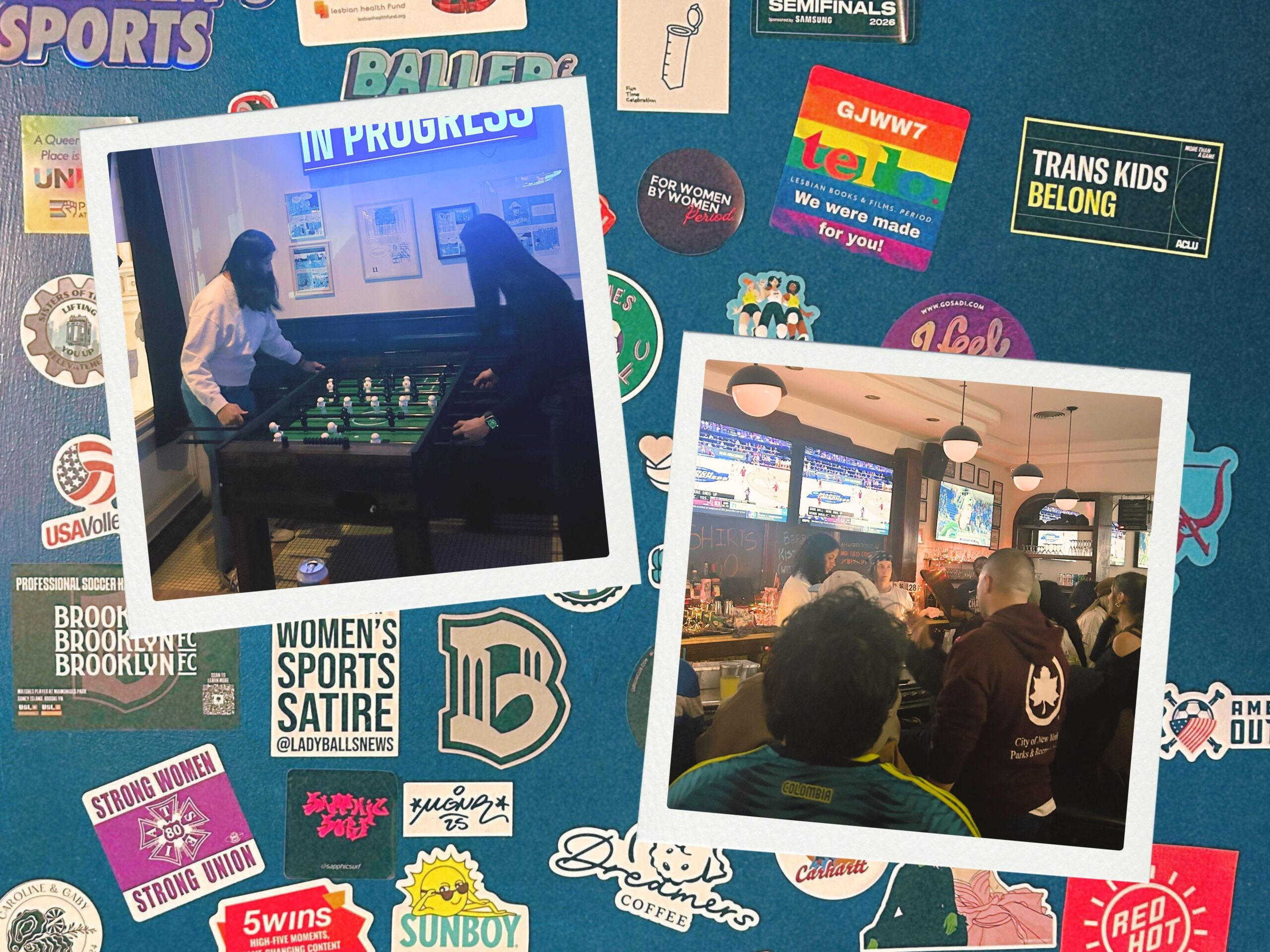
If you asked five people anywhere in the US to picture a sports bar, they’d probably all envision pretty much the same scene: a dark, sweat-perfumed hole in the wall populated by raucous men watching either an NBA or an NFL matchup. Historically, sports bars have been dominated by those of the XY-chromosome persuasion, both in terms of their athletic broadcasts and patrons. You’d be hard-pressed to find a single establishment that aired women’s sports (and even if you found one willing to, the channel change might spark a mutiny among your fellow patrons.)
But a new crop of establishments is putting a more female-friendly spin on the traditional business model. Women’s sports bars—as in, those dedicated to highlighting women’s sports—are on the rise in tandem with women’s sports themselves. Women’s basketball is by far the biggest success story thus far. For several seasons in a row now, the WNBA has seen rapid growth in both viewership and attendance. Last summer, WNBA officials even announced the 2025 season had set an all-time attendance record: More than 2.5 million fans had attended games as of August 20, 2025. (For context, the previous record was set in 2002, when the league contained three more teams and held 30 more games in the season.) Star players like Angel Reese, Caitlin Clark, and Paige Bueckers, all former NCAA standouts, have become true celebrity athletes since they made their WNBA debut as first-round draft picks, attending VIP events, scoring lucrative brand deals, and attracting several metric tons of media coverage.
Watching the attitude toward women’s sports shift, it became apparent to Lauren McKenna, a cofounder and co-owner of the New York City women’s sports bar Wilka’s, that there needed to be more places to watch women’s professional games. “You’re kind of fighting for space in a traditional sports bar—[space] to be seen,” McKenna, a fan of the Brooklyn-based WNBA team the New York Liberty, tells SELF. “No one’s willing to hear out a woman or see what they’re interested in, watch what they want to watch, whatever that may be.”
Not your average sports bar
Women’s sports bars—which are often framed by proprietors as a passion project as much as a commercial enterprise—neatly meet that growing demand. Last March, an NBC News analysis found that the number of women’s sports bars in the US was on track to quadruple by the end of the year, increasing from six to around 24 across 16 US states. Several women’s sports bars have opened in New York City alone in recent months, including Athena Keke’s and Blazers in Brooklyn—and, of course, Wilka’s, which is located in Lower Manhattan and first threw open its doors in August.
On a Friday evening in late March, Wika’s was filled with people—mostly women, but some men and nonbinary individuals too—fixated on a row of TVs along the wall broadcasting the NCAA Tournament’s Sweet 16 faceoff between the University of Minnesota’s Golden Gophers and the UCLA Bruins. Most were clustered around the center of the bar for the best possible view. “Everyone watches women’s sports,” the shirt of a passing server proclaimed.
While Wilka’s looks and functions like your average sports bar in many respects (minus the sticky floors, persistent odor, and cramped atmosphere—it’s refreshingly spacious!), the women’s-sports-centric decor choices are probably the most obvious feature setting it apart: framed New York Liberty jerseys in the franchise’s iconic black, white, and seafoam green colors; a Liberty-branded candle on a bookshelf; and bobblehead dolls of hockey player Micah Zandee-Hart and basketball legend Lauren Jackson stationed like sentries in front of colorful spines on that same bookshelf. Two titles written by WNBA legends immediately jump out: “The Can-Do Mindset: How to Cultivate Resilience, Follow Your Heart, and Fight for Your Passions” by retired two-time WNBA MVP Candace Parker and “Dear Black Girls: How to Be True to You” by the Las Vegas Aces’ A’ja Wilson.
In the bathroom, there were stickers plastered on the wall promoting not only the Liberty, but also the New York Sirens, a women’s hockey team; Gotham FC, a New York-area women’s soccer team; and Unrivaled, a Miami-based women’s basketball league that boasts Reese and Bueckers on its 2026 roster. “Love who you want and watch women’s sports,” another sticker read.
McKenna was one of the bartenders working during the NCAA tournament that night, frantically mixing drinks to keep up with the demand. With Wilka’s, “we’re proving and showing every day that women’s sports matters, even from an economic standpoint,” she said. And the economics matter more than ever, especially for the athletes. Women’s basketball players—the most successful female athletes in team sports—command a mere fraction of what their male counterparts make, a disparity that Reese, Clark, Bueckers, and other players have all spoken out about. Change may be slow, but it’s hard to deny that the energy around women’s sports “is just so good,” one customer, Sam Hankins, 43, an Upper Manhattan resident who uses they/them pronouns, said. “How can you not be into it?”
No need to change the channel
Beyond the main bar area, Katlyn Hallock-Palmatier, 27, another New York City resident, was playing a card game with two friends at a long table. Working in the male-dominated field of law, she said, she knew the importance of representation firsthand. “We need to uplift and empower women in spaces where there hasn’t been, historically, chairs pulled out for women,” she said, recalling how she had no other option than to follow the MLB as a childhood baseball player because there wasn’t a women’s league. Today, by contrast, young girls with athletic aspirations “can see themselves on the big screens and realize that their dreams can come true.”
Sitting at the far end of the bar near the windows, three 22-year-old women watching the NCAA tournament rooted for Minnesota over cocktails and bar bites. Compared to a regular sports bar, one of the Minnesota fans, Emmy Wolf, 22, another New Yorker, said, there are “just safer vibes.” “I feel like I could go to the bathroom and not cover my drink,” she elaborated. Shay Valentin, 32, a Brooklyn resident, agreed: “It’s great to be somewhere where you don’t have to think about guys just bumping up against you or being a predominant gender in the space.”
For many, the women’s-sports-bar experience—and the more “welcoming environment” that results, as both Hallock-Palmatier and Hankins put it—is worth a longer commute. Hankins had traveled all the way from their 110th Street home to Wilka’s. Even though the Liberty and Unrivaled fan has found that regular sports bars are typically willing to accommodate requests for women’s sports, asking still feels nerve-wracking—a factor in their decision to seek out a friendlier spot where you can always watch the women’s game. At Wilka’s, they said, “you don’t have to feel uncomfortable when you come here—it’s already on before you even have to ask.”
Related:
- JuJu Watkins Hasn’t Stopped Putting in the Work
- Why Are So Many Women Athletes Tearing Their ACLs Now?
- The Very Best Way to Ease Muscle Soreness, According to a WNBA Trainer
Get more of SELF’s great women’s sports coverage delivered right to your inbox—for free.


