



When the young founders of Aaru were starting their company, they would woo new customers with a magic trick. They’d run their simulation model—an AI that churns out the opinions of hundreds of thousands of imaginary individuals—on a question the would-be client already knew the answer to. Then they’d compare the report with the answers the company had spent vast sums acquiring from real people. It rarely missed.
These glimpses into Aaru’s crystal ball make the value of its work “so blatantly fucking obvious,” Aaru’s cofounder Ned Koh told me last week, that they’ve helped the two-year-old company win customers like EY, as well as Chanel and Coca-Cola, according to a source familiar with the matter. It’s also raised what PitchBook estimates to be more than $50 million from investors like General Catalyst, Diplo, and Mario Carbone, according to the source, reaching a headline valuation of a billion dollars by late 2025.
Aaru—named for the ancient Egyptian vision of an afterlife as a perfected reflection of one’s life on earth—is one of several buzzy companies in the emerging field of AI “simulation.” The first image that came to mind when I heard of these types of companies was the Black Mirror episode “Hang the DJ,” in which two people send simulated versions of themselves on infinite numbers of dates to test their compatibility. The reality is not all that far off.
Pulling from thousands of data sources, from financial transactions to public records to media consumption habits, Aaru spins up massive, custom-made focus groups for just about any question you can imagine.
A record label recently approached it to evaluate a batch of unknown artists for “star power.” (It selected an artist who had 40,000 streams at the time. Today, his top song has 172 million.) Publishers consult it before selecting book covers; beverage makers ask it which flavor to launch; private equity firms and hedge firms hire it to evaluate potential acquisition targets and stock futures; political parties ask it what candidates to run and which policies to try to write into law. It’s not hard to see why some people worry these companies pose an existential threat to the multibillion-dollar consumer insights industry.
But there’s one thing that differentiates Aaru from its competitors: The founders started the company when they were just 15, 18, and 19.
That was 747 days ago. Keeping this running tally seems to be one of the founders’ many inside jokes. It’s also one of the many signs of just how much fun they are having running this company, unburdened by the cynicism, boredom, and media training that afflicts so many of their older counterparts.


Even as kids, all three cofounders showed an entrepreneurial streak, from a six-employee lemonade stand to playground equipment rentals.
Photographer Will Pippin
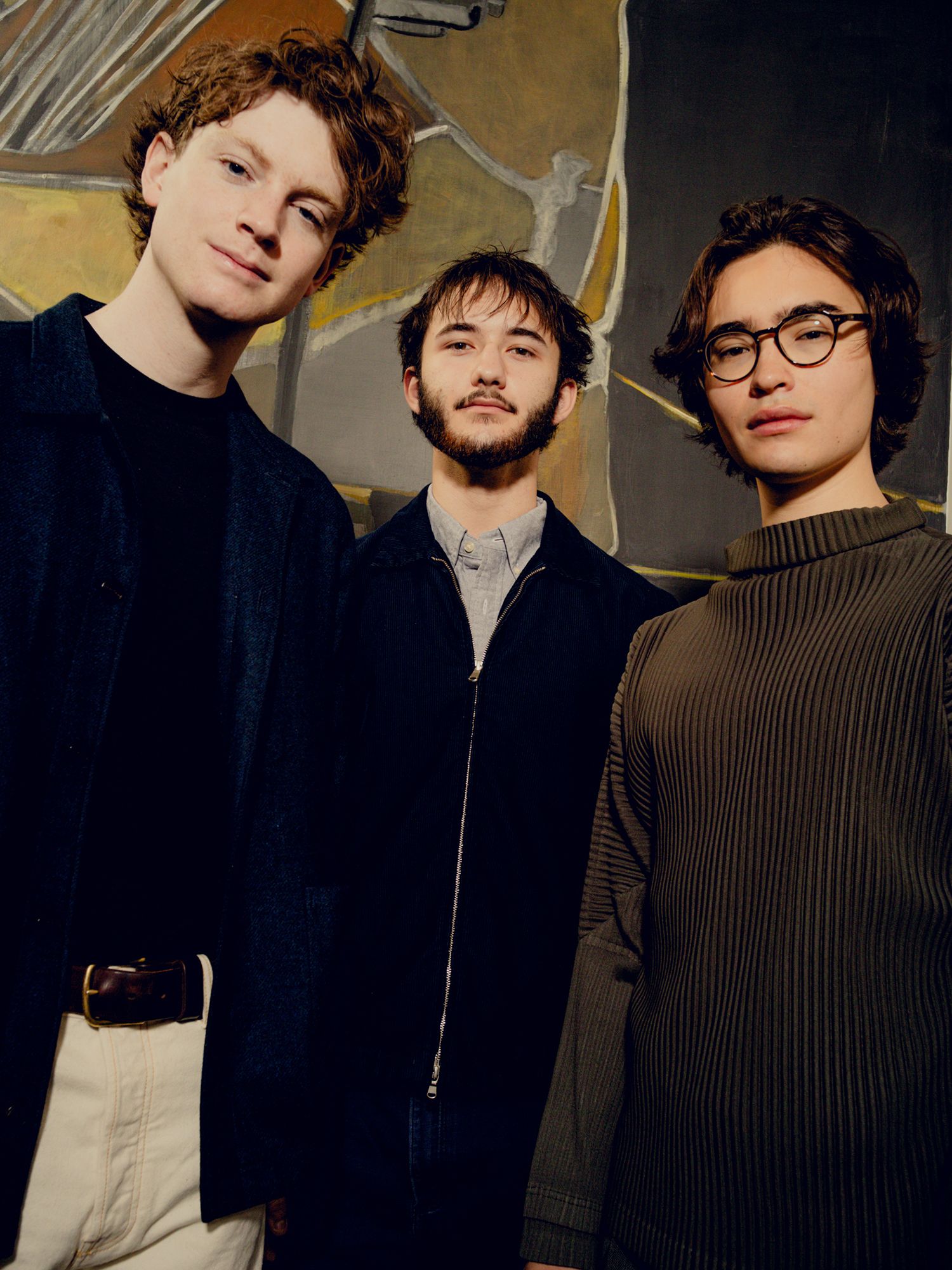
I met the three cofounders for lunch on Friday in the inner sanctum of Jeff Klein’s San Vicente, the members-only club in the West Village. (The club is generally restricted to guests 18 and older, but seems to have made an exception for the now 17-year-old cofounder and chief technology officer John Kessler.)
Koh, the 21-year-old president of the company, is the most brash and outspoken member of the trio. He compares starting a business to “gladiatorial combat” and genuinely believes that if someone were to say he had to join the NBA in order to save his mother’s life, “I would be on the fucking All-Star team next year.”
Cam Fink, 20, with an elusive accent acquired in the 17 different cities where he spent his childhood, is Koh’s more reserved and erudite counterpart. He reminisces about his teenage years, when he had time to read 100 books a year; fluently cites philosophers like Jean-Paul Sartre; and even name-drops several deep cuts from the Vanity Fair archive, like Brian McNally’s 2008 “Letter From Saigon” and Bethany McLean’s 2009 column on imploding hedge funds.
Lest you think they’re new to this whole entrepreneurship thing, they’ll tell you they’ve been at it for years. When Kessler was eight, his father asked him to clean the yard for $5 per hour. He found another kid to do the work for three bucks and kept the margin. Fink found a way to counterfeit his teacher Mr. Darcy’s “Darcy Dollars,” which were supposed to be earned as extra credit and redeemed for classroom perks, and sell them to classmates. As a kid, Koh bought a “really nice basketball” and charged other kids to use it on the playground.
Fink and Koh met in their freshman year of high school, bonding over hacking projects and boredom with their schoolwork. During a gap year before college (that is, the two weeks Koh spent at Harvard and the one night Fink spent at Dartmouth before dropping out), they came up with the idea for Aaru and quickly raised $7.5 million. They brought Kessler on as a cofounder after meeting him on Zoom. Fink and Koh often refer to him as the smartest person they’ve ever met.
The young savant mostly kept to himself at lunch, interjecting only occasionally to sprinkle the conversation with facts and figures, like the Korean birth rate, the population of China, or the deal size of the recent Blue Bottle Coffee acquisition. Just when I started to forget I was talking to a teenager, he would blurt out something like, “Once, I only ate chicken wings for a week straight!”
Today, the trio manages 27 employees out of a six-story former architect’s office in Tribeca. The space, which features a towering Cubist mural and a shelf of ancient artifacts, is littered with empty cans of Celsius (mostly Kessler’s, I am told), snacks from Meadow Lane, and carpet samples in rich ’70s hues. They’re picking out designs for the artist’s loft in SoHo that they are relocating to next month to accommodate their growing staff, which they expect to more than double this year.
Not everyone is so enthusiastic about their rise. Last week, a New York Times op-ed titled “This Is What Will Ruin Public Opinion Polling for Good” decried the practice it called “silicon sampling,” arguing that it will contribute to a broken information ecosystem.
As long as predictive analytics have been around, humans have recoiled at the notion that our feelings and behaviors can be reduced to a mathematically deduced probability. In 2022, New Yorker writer Kyle Chayka helped popularize the term “algorithmic anxiety” to describe the sensation that comes with realizing that our tastes and behaviors have been selected for us by a machine.
It’s not hard to see how these tools could be used to optimize just about any industry. (Aaru, run a simulation on which cover star will drive the most subscriptions!) You can also start to see how it could strip the fun and human creativity out of the work that you do.
The founders of Aaru insisted that their tech is actually there to empower people to go with their gut. Decision-makers have always craved data, Koh told me. “So we have to give them numbers that are better and more accurate and allow them to take those risks. It’s almost a moral mission.”
Besides, they argued, traditional polling methods are broken—and more often than not yield junk data, as once gold-standard pollsters like Nate Cohn to Ann Selzer have learned the hard way. (It’s a fair point: When was the last time you said yes to a random caller asking for your opinions?) This especially applies to sensitive or potentially shameful topics.
In 2024, Aaru ran a model predicting that cigarettes would make a comeback among its Gen Z cohort. Another recent contrarian finding: It has predicted that while GLP-1s will lead to a short-term dip in alcohol consumption, they will create a long-term uptick as users lose weight, gain confidence, and start going out more.

After our photo shoot, the 17-year-old Kessler excused himself to go deliver a talk at a quantitative trading firm.
Photographer Will Pippin
“To predict human behavior is to predict the future,” Fink argued. And “if you can predict the future, you can shape it.”
One of its biggest competitors, Simile, has so far decided not to get involved in politics. But if there is one thing to know about the founders of Aaru, it is that politics is their absolute lifeblood. “We love board games,” Koh said. Politics is “the biggest one on the planet.” (Aaru successfully called the New York mayoral race, and plans to get involved in midterm campaigns that inspire it.)
The phrase “With great power comes great responsibility” comes to mind. So far they have worked on shaping narrative strategies on issues like nuclear power, reproductive rights, and school choice.
“We are nonpartisan,” Fink told me, and “have very strict ethical rules. We do not work for people who promote violence, create violence, or who are violent themselves. And as a result, we exclude a whole world of people.”

Koh compares starting a business to “gladiatorial combat.”
Photographer Will Pippin
Of course, all this talk still sent a cynic like myself spinning out with worst-case scenarios in which their technology falls into the wrong hands: What sets them apart from Cambridge Analytica, I asked, which weaponized populations’ data to manipulate them into making choices against their own interests?
“There are certain companies that do it in ethical ways, and there are certain companies that don’t,” Koh said. “If the Cambridge Analytica approach worked, more people would do it, right?” I told them that I hope for their sakes—and perhaps all of ours—that they remain true to their ideals. After all, this is only the beginning.
“I’ll be working here for the next 80 years,” Fink told me. Koh nodded vigorously. “‘Let’s go to the moon. Let’s go to Mars,’” he said, listing off the things his misguided peers find worthwhile. “No. I think those are boring compared to what we do.”
-
Why We Had to Wait So Long for a New Season of Euphoria
-
How Titaníque Sailed From a Grocery Store Basement to Broadway
-
Lorne Michaels Is Ready for His Close-Up—but That Doesn’t Mean He Has to Like It
-
Everything to Know About Cannes 2026 (So Far)