






To view this video please enable JavaScript, and consider upgrading to a web
browser that
supports HTML5
video
Artemis II astronauts have landed safely back on Earth after making their awaited splashdown into the Pacific Ocean.
The four-strong NASA crew completed the 10-day trip around the moon, travelling furthest from the Earth than anyone ever has.
Then it was time for their hair-raising return journey inside the minivan-sized Orion capsule before splashing into the Pacific Ocean off the California coast overnight.
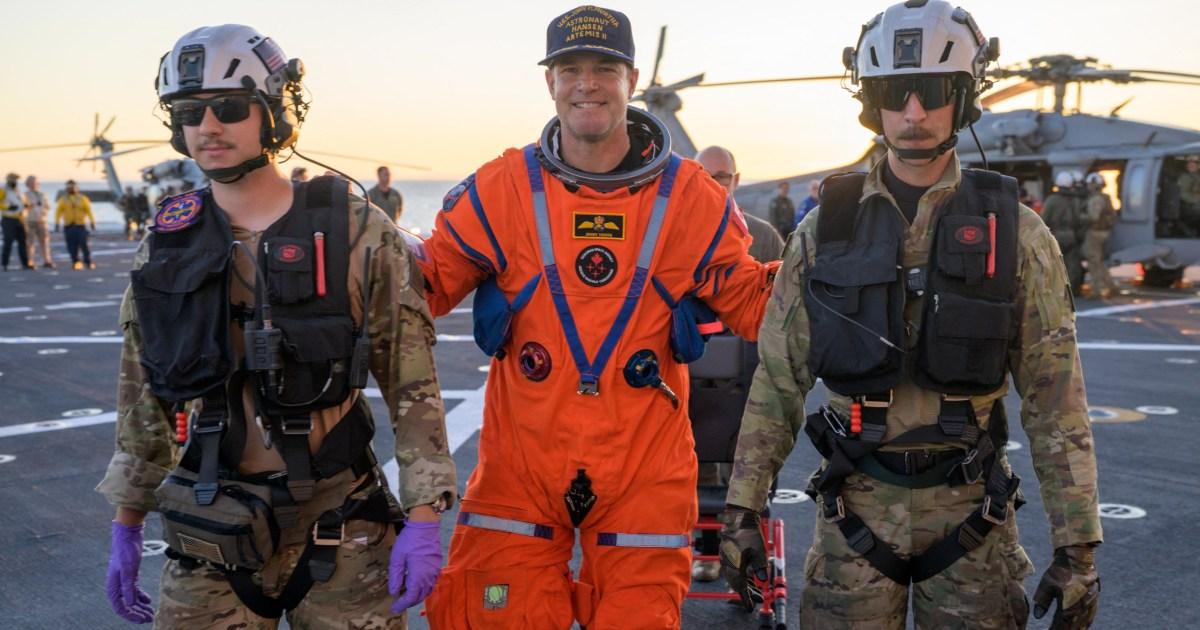
Reid Wiseman, Victor Glover, Christina Koch and Jeremy Hansen were escorted from a helicopter onto the deck of USS John P Murtha, with some of the astronauts needing support to walk after the gruelling impact of living without gravity for 10 days.
To view this video please enable JavaScript, and consider upgrading to a web
browser that
supports HTML5
video


The four were taken on board the warship for their mandatory medical checks after the two-week mission, which could have had an impact on their muscles and bones.
They were met by US military choppers and soldiers who lifted them from an inflatable raft next to Orion.
Wiseman, the Artemis commander, shared the first glimpse of what was going through the astronauts’ minds after their feet touched Earth again.


He posted a picture of a view of the setting sun over the ocean taken from on board one of the choppers with caption: ‘On the helicopter leaving the ship right now. This planet is impossibly beautiful from every altitude I’ve seen it…surface to 250,000 miles.’
NASA’s control room erupted into cheers when the crew touched down safely.


The space agency described the landing as a ‘textbook touchdown.’
Their families were watching the nerve-racking approach to the ocean as the spacecraft slowed down from 300mph to just 20mph thanks to 11 parachutes.
NASA administrator Jared Isaacman said: ‘These were the ambassadors from humanity to the stars that we sent out there right now, and I can’t imagine a better crew.’


The most dangerous part of the landing happened when the shuttle smashed into the atmosphere.
The Orion spacecraft sustained speeds of up to over 23,000 miles per hour when it hit Earth’s atmosphere – 35 times the speed of sound – at 400,000 ft above the ground.
The air beneath it gets so hot that it turns into fiery plasma, which makes radio communication difficult, meaning the crew were in a blackout for around six minutes.


You can read more about the riskiest minutes of the mission here.
NASA is already planning the next trip to the moon – and inspiring the future generation of astronauts.
Eight-year-old Lucas Ye designed the Artemis II mascot – Rise – which the crew carried on board and used as their zero gravity indicator.


Young Lucas’s plush toy was selected from 2,600 global entries.
He warmed everyone’s hearts after writing ‘Carroll crater’ on the side of the mascot – the name of one of the moon’s new craters given after Wiseman’s late wife, who died of cancer in 2020.
Artemis II wasn’t designed to land on the moon. Instead, the crews made scientific observations from the far side of the moon, including a total solar eclipse.


While the mission went smoothly overall, there were some technical glitches on board, including most famously with the Orion’s cosmic toilets.
The astronauts will be undergoing medical checks before being reunited with their families.
As expected, a trip around the moon to the limits of human endurance is not a walk in the park, although the four are said to be healthy after the journey.
Risks from venturing into space include high levels of space radiation as the Earth’s usual atmosphere is no longer protecting them.
This could lead to DNA damage, higher cancer risk and cardiovascular issues, experts have warned.
While it might seem fun to float around the spacecraft without gravity, the force that keeps as on the ground also plays a crucial role in many bodily functions.

Lacking gravity can have negative impacts in the long run like loss of bone mass density, weakening bones.
An astronaut’s muscles can also become thinner in space due to a lack of gravity.
Next, the Orion crew will go through a strict post-space mission physical training to rehabilitate them following the harsh conditions, including muscle and bone rebuilding and hydrotherapy.
Got a story? Get in touch with our news team by emailing us at webnews@metro.co.uk. Or you can submit your videos and pictures here.
For more stories like this, check our news page.
Follow Metro.co.uk on Twitter and Facebook for the latest news updates. You can now also get Metro.co.uk articles sent straight to your device. Sign up for our daily push alerts here.
MORE: Artemis II crew hug before they enter the most dangerous part of the mission
MORE: Houston, we don’t have lift-off — what happens to your penis in space
MORE: Donald Trump claims ‘Space Force’ is watching Iran in latest rambling post
News Updates
Stay on top of the headlines with daily email updates.


