


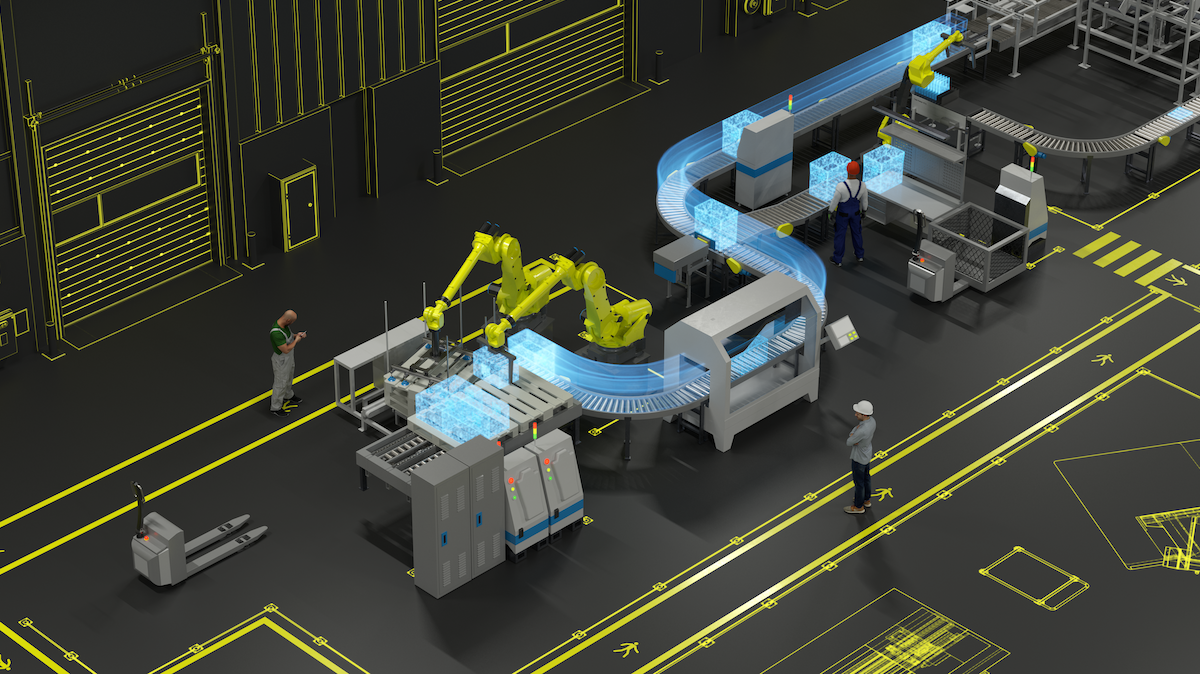


For global manufacturing in the era of artificial intelligence (AI) transformation, the digital factory model pairs an ideal of greater throughput, supply chain efficiency, and resilience with reduced waste and machine downtime, all built to withstand macroeconomic and regulatory pressures.
But manufacturing transformation depends on a company’s digital maturity: Its ability to execute on business priorities directly correlates to how connected and digitized its systems are. And many organizations with low digital maturity struggle to overcome operational chaos. Their roadblocks might include legacy operations and infrastructure handling siloed data, uncoordinated teams, and manual processes that inhibit growth.
An upgrade to connected data platforms—supported by specialized expertise across the design and manufacturing global landscape—can help manufacturers connect workflows at the plan, design, build, and operate stages.
By linking their engineering, construction, and manufacturing operations on one platform, these digital factories can now achieve returns on their high digital maturity, sharing data, automating operations, eliminating bottlenecks, and helping their workforces achieve stronger outcomes.
The Cost of Disconnected Data
The cost of data silos shows up in awkward handoffs. Teams using traditional platforms and processes must reconcile conflicting files, rebuild models, and make decisions based on information that may already be out of date.
Digital transformation succeeds when connected data removes the friction that slows decisions, handoffs, and execution.
For Eaton, a global power management company, the challenge was to optimize its building operations and maintenance before beginning production. To do this, the company upgraded its energy management software to support building digital twins so it could analyze and predict facility performance.
Transforming its fragmented data into usable information helped Eaton create intelligent, interactive 3D replicas of factory environments. Putting that data to work through visualization and predictive analysis now enables Eaton to help its customers monitor assets, plan maintenance, reduce operational risk, and improve building performance.
Optimizing the Factory Lifecycle
A shared platform can eliminate data bottlenecks and create a continuous digital thread across engineering, construction, and manufacturing operations. That continuity is critical, because manufacturing development projects often generate much more data than they use: 95% of data generated during factory construction goes unused, underscoring how easily valuable knowledge can be lost along the way.
A connected data environment helps manufacturers use that information for layout planning, simulation, building of digital twins, and real-time operational analysis.
When Porsche planned to build its Taycan electric vehicle factory on a constrained urban site in Stuttgart, Germany, the automaker needed to keep complex project data connected from early planning through production.
Porsche wanted to build a zero-impact facility that reflected the sustainable principles of the Taycan and introduced design, engineering, and building information modeling (BIM) workflows to coordinate the facility, production systems, and construction process within tight space, speed, and performance requirements. The new workflows helped the company reduce construction risk, increase flexibility, and optimize the value of the facility.
“In the model, all designers, planners, and suppliers speak the same language,” says Till Moczarski, Porsche Taycan Factory Project Manager. “It’s like a kind of symphony where people meet and everything comes together.”
Compressing Time to Market
Rapid deployment was a high priority for Viessmann, a global heating, ventilation, and air conditioning (HVAC) manufacturer, when it planned to build a heat pump plant in Legnica, Poland. To begin production on the factory within two years of starting initial planning, Viessmann needed to build quickly without letting disconnected handoffs and lost data undermine coordination across building trades teams.
Viessman used an AI-powered 3D planning model to create a single source of truth, which let project partners access real-time plans and coordinate workflows, integrating architecture, construction, assembly, and logistics into one planning process.
“The speed with which we were able to build was a great success,” says Norbert Schmidt, Digital Factory Expert, Viessmann Climate Solutions. “But even greater than that was the fact that the most diverse groups—from architecture to building services to factory planning to production management—could work together intensively.”
Navigating the Maturity Journey
AI can help companies move beyond outdated systems toward connected, integrated, and automated operations.
Bridgestone, the world’s largest tire and rubber company, was an early adopter of automation and AI for streamlining manufacturing operations. The company expanded a six-month automation initiative to become its ongoing digital transformation effort.
That shift to a broader operating model has helped the company reduce waste and rework while making factory improvements easier to scale. With a common data foundation, its factory transformation has become cumulative, helping manufacturers adapt as its products, capacity needs, and supply chain pressures evolve.
Factory Data for Operational Advantage
Fragmented systems limit AI’s value by making it harder for organizations to transform their raw data into reliable predictive insights. Bringing design, construction, asset, and performance data together can create an operational advantage. Connecting data can help a manufacturer build a live digital twin for better visibility into equipment health, production bottlenecks, facility conditions, and maintenance needs before problems become downtime.
For leaders seeking to transform their manufacturing operations into digital factories, establishing higher digital maturity is mission-critical. To lead change, they must identify where factory data is reentered, translated, or lost across planning, design, build, and operations. Closing those gaps is the first step toward building a more connected, adaptable, and resilient manufacturing enterprise.
The first step to building a more connected, adaptable, and resilient manufacturing enterprise starts with understanding where gaps are today. Let’s work together to enhance digital maturity across your organization—from planning, to design, to build, to operations.