







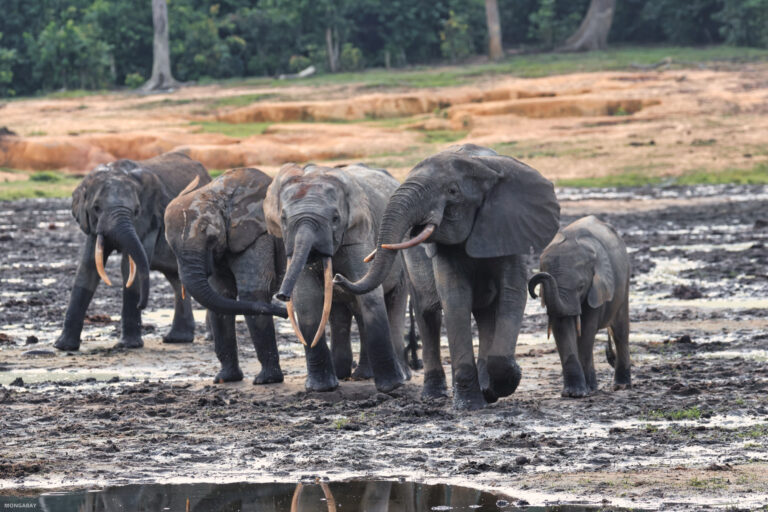
- Dzanga Bai is an exceptional forest clearing where hundreds of elusive forest elephants gather, offering scientists and visitors opportunities to observe their behavior, social interactions and family dynamics in the open.
- Mineral-rich soil and shallow pools draw elephants and other wildlife like bongos and forest buffalo, making the clearing a unique ecological hotspot and a valuable site for long-term research on a little-understood species.
- Dzanga Bai is a growing tourism spot for the Central African Republic, but growth remains limited by difficult access, infrastructure constraints and perceptions of insecurity.
BAYANGA, Central African Republic — Throughout most of Central Africa, it’s difficult to spot herds of forest elephants all at once. They move through dense rainforest, remaining elusive, their lives obscured by thick vegetation and distance. For tourists and even researchers, direct encounters are largely a matter of chance.
But Dzanga Bai is different. Often called the “village of elephants,” this mineral-rich clearing in Dzanga-Sangha National Park in southwestern Central African Republic draws large numbers of forest elephants (Loxodonta cyclotis) out of the dense forest. Here, in the Congo Basin, they gather in the open, dozens at a time, sometimes hundreds, feeding, interacting and returning again and again to a place where elephants can be seen in the open.
“The Dzanga Bai is the only known clearing where you get hundreds of forest elephants,” said Yvonne Kienast, a behavioral biologist with the Elephant Listening Project at Cornell University, U.S., who has been working in Dzanga-Sangha since 2021. “You have other clearings where, if you’re lucky, the maximum number of elephants you can see will be 40 or 50. But here, the minimum is 40 or 50.”


At peak instances, the numbers climb higher still. “Two hundred and eleven was the count last year in December,” Kienast said. “And that’s just at one [instance].”
The forest elephants emerge from the forest edge, stepping cautiously into the open. Some wade knee-deep into pools, drawing up trunkfuls of mud. Others linger at the margins, watchful. Calves stay close to their mothers. Bulls move slowly, asserting presence without confrontation.
In addition to forest elephants, the clearing supports bongos (Tragelaphus eurycerus), red forest buffalo (Syncerus caffer nanus) and giant forest hogs (Hylochoerus meinertzhageni). The sitatungas (Tragelaphus spekii) used to show up as well but have not done so for a while, according to park officials.
For Kienast, whose research work revolves primarily around the site, the clearing is more than a spectacle. It is a window into a species that is otherwise difficult to study.

“This is one of the very few places in the world where you can observe forest elephants in such numbers and with such consistency,” she said. “For most of their lives, these elephants are invisible to us, hidden by the forest. But here, they come out into the open.”
This also gives researchers a chance to study the pachyderms in real time, with little filter.
“When I started, I thought we knew everything about forest elephants from the literature,” she said. “The more time I spend here, the more I realize we don’t.”
Researchers identify individuals by ear patterns, tusk shapes and other features, tracking them over time to build long-term datasets. But beyond the data, the clearing reveals the species’ social complexity.
“They have a greeting ceremony; they say hi, get super excited, spend time together, and then go back into the forest and split up again,” Kienast explained. “There is a huge social component, but the primary factor is the minerals.”
The attraction is below the surface. The soil and water at Dzanga Bai contain essential minerals, salt, magnesium and zinc, which are scarce in the surrounding forest. Elephants dig, drink and return, sometimes over decades.

For mothers and calves, the bai (a marshy forest clearing in the Sango language) offers something else as well. “For the mothers and the small ones, it becomes a sort of playground and a very safe place,” Kienast said. “The water is shallow.” In a landscape where visibility is limited and risks are harder to detect, the clearing provides both nourishment and a measure of security for the elephants.
A growing attraction
For those working in and around the park, Dzanga Bai is also the reason visitors come.
“They love nature here in Dzanga Bai,” said Léonce Madomi, a guide who has worked in the park for more than 16 years. “They have never seen elephants gathered like this, in groups, as families.” He paused, then added, “In other countries, they are more scattered. You might see 10, 15, maybe 20. But here, if it’s the right time, you can see 140, even 150 elephants in one day.”
That reliability is unusual in dense forest ecosystems and may be why there’s been a growth in tourism, suggests Gervais Pamongui, deputy director of the Dzanga-Sangha Protected Areas (DSPA). But the relative sense of stability in this part of the Central African Republic could also be a factor, he told Mongabay.
“For tourism to develop, a country needs stability so that visitors feel safe,” he said.


In 2025, the park recorded about 800 tourists, according to officials, still modest by global standards, but a noticeable increase. Researchers and guides say many more pass through from neighboring Cameroon and the Republic of Congo, drawn specifically by the bai.
Yet the growth is constrained by realities beyond the clearing itself. Reaching Bayanga can take days by road from the capital city of Bangui, depending on conditions. Infrastructure is limited.
“It’s not a lot, but consider how difficult it is to get here,” Kienast said. “You can’t bring 50 people at once.” Visitor numbers are intentionally capped, and the model remains “low impact” by design to support conservation.
Perception matters as well.
“The problem is that the CAR is often classified as a ‘Do Not Travel’ country,” said Luiz Aranz, who has spent more than 47 years working in parks in the Congo Basin. “People are told they’ll get killed if they come here. There is a lot of misinformation.”
That perception persists even as those on the ground describe a more nuanced reality.

“People used to hear about the Central African Republic — killings and insecurity,” Madomi said. “But those who came didn’t see those problems.”
Local participation and the protection of Indigenous peoples’ rights in conservation efforts remain a work in progress in Central Africa, as in many parts of the world. Mongabay observed that WWF, which co-manages the park with the Central African Republic’s Ministry of Forest, supports a grievance mechanism through the Bayanga Human Rights Center, where local Indigenous groups, including the Ba’aka, can raise complaints related to park management. However, it was less clear how Indigenous knowledge is being integrated into forest elephant monitoring.
Asked how traditional science informs her work, Kienast acknowledged that while it was challenging in forest elephant monitoring, it was more prevalent in forest-related research, given the deep knowledge of plant species and the landscape by local people. For her, particularly as a European-Argentinian working in the region, an important part of the effort is sharing scientific knowledge and building local capacity to support long-term, locally led conservation.
What is at stake, she said, goes beyond tourism or conservation outcomes. “It is also about knowledge — and who produces it.”
Securing local ownership and support among Central Africans is critical to the long-term sustainability of Dzanga Bai, said sources. For Kienast, what is at stake goes beyond tourism and conservation outcomes. “It is also about knowledge — and who produces it,” she said.

“One of the main focuses of our project is to create a hub for capacity building and training Central African researchers,” she added. “I’ve made it my mission to share what I know so that local experts can take ownership of a place that belongs to their country and culture.”
Around the bai, that shift is taking shape in the work of local trackers, in young researchers learning to observe and document the rhythms of the clearing, and in the gradual growth of expertise rooted in the landscape itself.
As the day fades, the light over Dzanga Bai softens. Some of the elephants begin to retreat into the dense forest, while others stay on. In a region where forest elephant populations have declined significantly, Dzanga Bai stands as a stronghold. But its future, like that of the forest around it, is not guaranteed.
“It is a privilege,” Kienast said. “The more time I spend here, I realize what we don’t know.”
For now, the elephants continue to gather, interact, feed and disperse, as they always have.
Additional reporting by Rhett Butler.
Banner image: “For mothers and young elephants, Dzanga Bai becomes something of a playground and a very safe place,” says Yvonne Kienast, project manager and head researcher of the Dzanga Forest Elephant Project. Image by Rhett A. Butler/Mongabay.
Forest elephants are the ‘glue’ holding Congo rainforests together
Latest podcast episode: ‘We will not know what we lost’: Conservation fallout a year after USAID shutdown. Listen here:
Citations:
Verahrami, A., Swider, C., Bambi, F. B., Malonga, P. J. F., Samba, O. J., Hedwig, D., & Bombaci, S. (2025). Forest elephants modulate their behaviour to adapt to sounds of danger. Philosophical Transactions of the Royal Society B Biological Sciences, 380(1928), 20240051. doi:10.1098/rstb.2024.0051
Turkalo, A. K., Wrege, P. H., & Wittemyer, G. (2013). Long-Term Monitoring of Dzanga Bai Forest Elephants: Forest Clearing use Patterns. PLoS ONE, 8(12), e85154. doi:10.1371/journal.pone.0085154
Goldenberg, S. Z., Turkalo, A. K., Wrege, P. H., Hedwig, D., & Wittemyer, G. (2020). Entry and aggregation at a Central African bai reveal social patterns in the elusive forest elephant Loxodonta cyclotis. Animal Behaviour, 171, 77–85. doi:10.1016/j.anbehav.2020.11.008
Feedback: Use this form to send a message to the author of this post. If you want to post a public comment, you can do that at the bottom of the page.


