






Our product picks are editor-tested, expert-approved. We may earn a commission through links on our site. Why Trust Us?


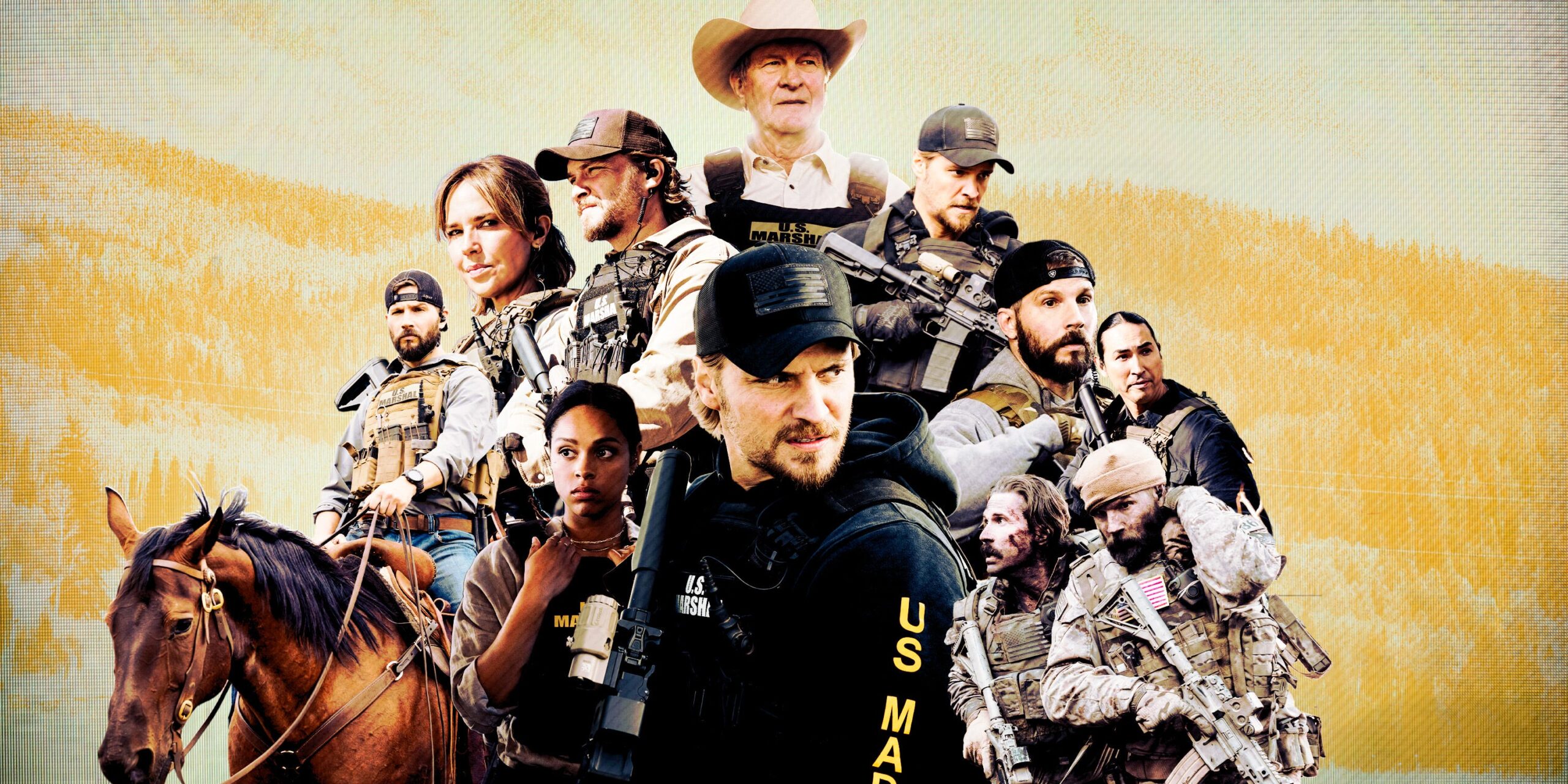
WHILE THE LATEST massive hit series from CBS, Marshals—the most-watched new TV series of 2026 so far—is technically a spin-off of the ever-expanding Yellowstoneuniverse, it’s a crime procedural at its core. We follow Dutton son Kayce as he joins the U.S. Marshals of Montana, and are quickly thrown into a high-octane action environment, complete with explosions and shootouts and all. However thrilling it might be, the escalating body count and questionable ethics of Special Deputy U.S. Marshal Kayce Dutton (Luke Grimes) begs the question: What does a U.S. Marshal do, exactly?
To answer our nagging questions and fact-check some oddities in Marshals, we went straight to the source: retired Chief Deputy U.S. Marshal Larry Homenick, 77, who had an illustrious career in the Marshals Service—the country’s oldest federal law enforcement agency. That goes all the way back to 1789, when it was established as the enforcement arm of the federal courts. From his start in 1972 to his retirement in 2000 (28 years of service), Homenick worked for the agency in different capacities and in different offices, from Washington, DC, to Los Angeles, to Denver, to Houston, to the El Paso Intelligence Center (EPIC), and back to Denver.
Early in his career, he was tasked with sequestering the so-called White House “plumbers”who broke into Watergate during the Nixon era, keeping them confined in military barracks alongside “the heroin smugglers of fame from The French Connection,” Homenick says. He recaptured Christopher Boyce, the American spy convicted for selling government secrets to the Soviet Union(watch The Falcon and the Snowmanif you haven’t) after he had escaped prison. He also once caught an American fugitive featured on America’s Most Wanted in Belize. Homenick spent many hours with Oklahoma City bomber Timothy McVeigh, transporting him from jail to the courthouse (“Actually, he really was a nice young man,” Homenick says of McVeigh). Which is all to say: When it comes to all things U.S. Marshals, Larry Homenick is in the know.
He also feels strongly about Marshals. “I haven’t missed an episode,”Homenick says. But he does have notes.
“I don’t want to disappoint you,” he says. “But as someone who was in that line of work for 28 years, and worked at the highest levels in the agency, I find it to be just a fantasy.”
“I Give Them a Pass on That”
“Fantasy” is not exactly a surprising description for a CBS crime series. So, it might be easier to start with what in the show is accurate to the real-life Marshals service. Kayce is initially recruited by his old Navy SEALs pal Cal (Logan Marshall-Green). In an uncanny connection, Homenick himself was brought into the job by a friend and fellow Army veteran from his time as a military policeman in Vietnam.
“He called me one day and he said, ‘Hey, do you want to be a U.S. Marshal?” Homenick recalls. “I said, ‘What is a U.S. Marshal?’”
Kayce has a similar fish-out-of-water experience as he’s quickly introduced to the Montana Marshals office run by Cal.


What else feels realistic? Marshals do, in fact, have an enormous amount of leeway in their law enforcement. “We have more statute authority” than any other federal agency, Homenick notes. Per 28 U.S. Code § 564, “Powers as sheriff,” Marshals can exercise the same powers as a state sheriff when executing federal laws within a state.
The main work of most Marshals, however, is actually quite boring. New Marshals will generally work in courts and jails, transporting prisoners in federal custody. If they’re lucky enough to advance and specialize, as Homenick did, they might capture fugitives both in the U.S. and abroad.
The plainclothes style of the Marshals depicted in the series is true enough. In much of his work, Homenick stuck to a suit. But in rural Montana, the cowboy hats “can be justified, because they’re in that environment.”
Also, the horses are not simply a Yellowstone ranch holdover. Marshals riding on horseback is plausible, Homenick confirms.
“The one thing that gives any semblance of reality is where they’re located,” he says. “There are suboffices that might be 200 miles from the main office. And they pretty much operate on their own. But they don’t operate to the extent of what that show is. Many times you’re scouting in very dense and desolate places. And so it’s practical to have a horse. I give them a pass on that.”
“It’s So Unrealistic That in Every Episode, They Kill Multiple People”
Homenick considers the way Kayce becomes a Marshal (a quick chat with Cal, who immediately hands him a badge—done deal) and his trigger-happy firearm habits to be among a number of major inaccuracies in Marshals.
The on-the-spot issuing of a Marshal badge? That does not fly with Homenick. “No background investigation. And he’s out shooting up people with no real legal authority. He was not sworn in,” he says. “That just galls me.”
The outrageous number of bullets flying? Not quite true to real life.
“In 28 years, I arrested hundreds of dangerous fugitives throughout the L.A. area and other places around the United States,” Homenick says. “I never shot my weapon once.” A partner of his did once shoot at a fleeing fugitive, he says. “Thankfully, he didn’t hit him, but we captured him later that evening on the roof of a church.”

The gun was a necessity. But shooting is rare. “If I had any uncertainty about the person I was looking for or going to arrest, I always did it with my gun in my hand.”
The over-the-top weekly body count also doesn’t ring true to Homenick’s experience.
“It’s so unrealistic that in every episode, they kill multiple people,” Homenick says. “If you discharge a firearm, you have to write a report. And, of course, that’s never done [on Marshals]. There’s a lot of relaxation when it comes to protocols.”
Real Marshals may very well help in operations capturing drug dealers and gang members, as seen on Marshals. Except on the show, it can seem like other federal agencies such as the FBI and DEA have disappeared.
“If you’re going out on what you know to be a big drug bust, you’re going to invite and get the DEA to come with you, if not take over, and you provide the backup,” Homenick adds.
There’s also some physical differences as well. Marshals aren’t always quite as hunky and tall as Luke Grimes and Logan Marshall-Green (who are both around 6’0’’), though we’ll chalk that up to smart Hollywood casting.
“I’m a little guy,” Homenick notes. “I’m only five-foot-eight.” .
The frat house vibe of the Marshals office on the TV series, with a punching bag and slouchy sofas, also doesn’t sit well with Homenick.
“In Denver I had a gym for our office, but it was downstairs and it was a standalone gym. You weren’t just hanging on the couch while someone was boxing,” he says.
“That’s an insult to the real Marshals service to see that.”
A Show of Appreciation for the U.S. Marshals
Here Homenick pauses. He softens his perspective on this unprecedented show spotlighting an often overlooked law enforcement agency that has been around almost as long as the nation itself.
“I don’t want to be too hard,” he admits. “I do enjoy watching the show, just because it’s so outrageous.”
What he likes about the show, beyond head-turning twists and gunfire, is that it explores Marshals beyond outdated stereotypes. In the past, Marshals in pop culture were generally depicted as over-the-hill ex-police (Like the Rooster Cogburn character in True Grit), he recalls.
“I just hate that. [Marshals] shows that there’s much more to it than that. There’s been a number of [newer] TV shows based on the Marshals. Justifiedwas all about U.S. Marshals. So we’ve started to get recognition and appreciation and understanding.”
Homenick is nothing if not proud of his service as a U.S. Marshal. That extends to his viewing experience.
“It’s a little over the top, but at least we’re getting known,” he says. “I love the exposure, as do other people I’ve talked to in the Marshals service.”




Paul Schrodt is a freelance writer and editor covering pop culture and the entertainment industry. He has contributed to The New York Times, The Wall Street Journal, GQ, Men’s Health, The Hollywood Reporter, Los Angeles magazine, and others.


