






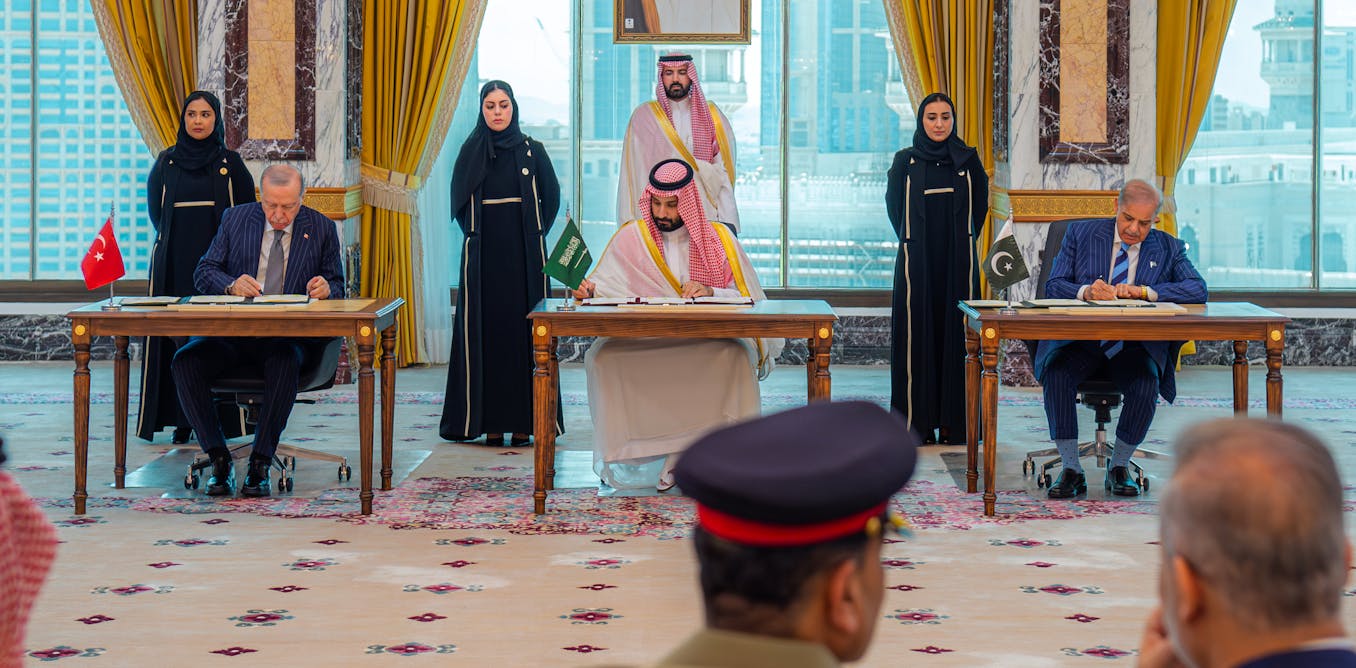
Saudi Arabia, Turkey and Pakistan have signed the Mecca Joint Defence Pact, a new collective defence arrangement that connects the Middle East with South Asia.
Its central promise is striking: an armed attack against any one of the three countries will be treated as an attack against them all. This language has prompted comparisons with NATO, whose members make a similar commitment under Article 5 of the North Atlantic Treaty.
By bringing together a major global oil producer (Saudi Arabia), a NATO member with an expanding defence industry (Turkey) and a nuclear-armed state (Pakistan), this agreement has the potential to reshape security dynamics across the Middle East, South Asia and the Indian Ocean.
It signals a significant shift in how regional powers navigate their security, moving toward strategic self-reliance at a time of deep regional instability.
However, the Mecca agreeement is not a new NATO — at least not yet. It’s better understood as a form of strategic insurance for three governments seeking greater protection and political influence beyond traditional American guarantees.
Whether it matures into a credible military alliance or remains a piece of political symbolism will depend entirely on how these nations resolve deep underlying questions regarding their exact obligations and conflicting regional interests.
Why these three countries?
The agreement brings together three states with different but complementary strengths.
Saudi Arabia contributes financial resources, strategic geography and influence in global energy markets. It also has a strong incentive to protect the infrastructure and investment projects associated with its domestic economic transformation. Repeated attacks and conflicts across the region have demonstrated how quickly instability can threaten those ambitions.
Turkey possesses one of NATO’s largest militaries and an expanding defence industry that produces drones, missiles, armoured vehicles and naval platforms. Participation gives the country a larger role in Gulf security while creating opportunities for arms sales, technology transfer and joint production.
Pakistan brings a large and experienced military, longstanding security ties with Saudi Arabia and close defence relations with Turkey. It’s also the only nuclear-armed member of the new grouping. For Pakistan, the pact may attract investment, support its defence industry and strengthen its diplomatic relevance beyond South Asia.
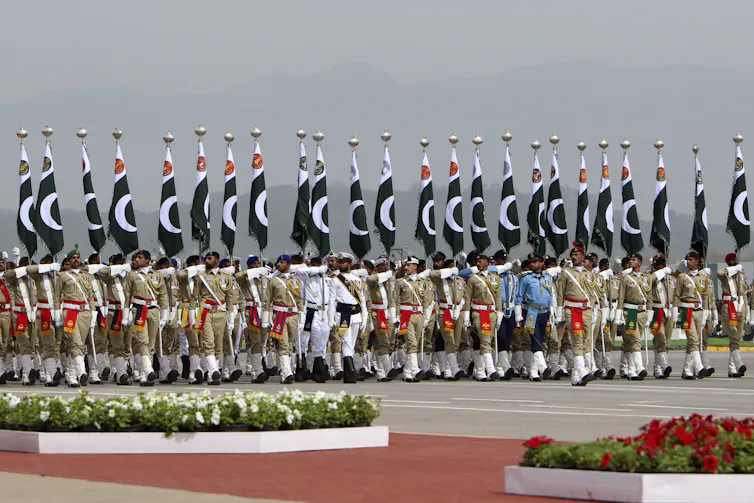

(AP Photo)
The agreement builds on existing relationships rather than creating co-operation from nothing. Pakistan and Saudi Arabia signed a strategic mutual defence agreement in September 2025, while Turkey and Pakistan have expanded military training, electronic warfare and defence industrial co-operation.
Saudi Arabia and Turkey have also been rebuilding relations and deepening defence ties after years of political tension.
Why now?
The pact reflects declining confidence in the existing regional security order. Saudi Arabia and other Persian Gulf states have long relied heavily on the United States for their defence. Yet the war initiated by the U.S. and Israel on Iran has exposed the risks of this dependence.
Although Saudi Arabia and its Persian Gulf neighbours have sought to avoid involvement in the conflict, they have faced Iranian missile and drone attacks, threats against critical energy infrastructure and disruption to regional shipping.
Saudi Arabia has consequently been drawn into a conflict it did not choose, encouraging the kingdom to diversify its security relationships and seek additional protection beyond the U.S.
For Turkey, the pact expands its role in Gulf and Indian Ocean security while creating new opportunities for defence exports, technology transfer and joint weapons production. It also advances the Turkish ambition to act as an autonomous regional power capable of working through NATO while developing security partnerships beyond the western alliance.
For Pakistan, the agreement formalizes longstanding military ties with Saudi Arabia, strengthens its diplomatic relevance beyond South Asia and may create opportunities for Saudi investment, defence co-operation and economic support. It also allows the country to present itself as an important security provider to the Gulf while maintaining its close strategic relationship with China.
This doesn’t mean the three countries are abandoning the U.S. Turkey remains a NATO member, while Saudi Arabia and Pakistan maintain important security relationships with the U.S. Instead, they are adding another layer of protection in case traditional guarantees prove conditional, politically constrained or too slow during a crisis.
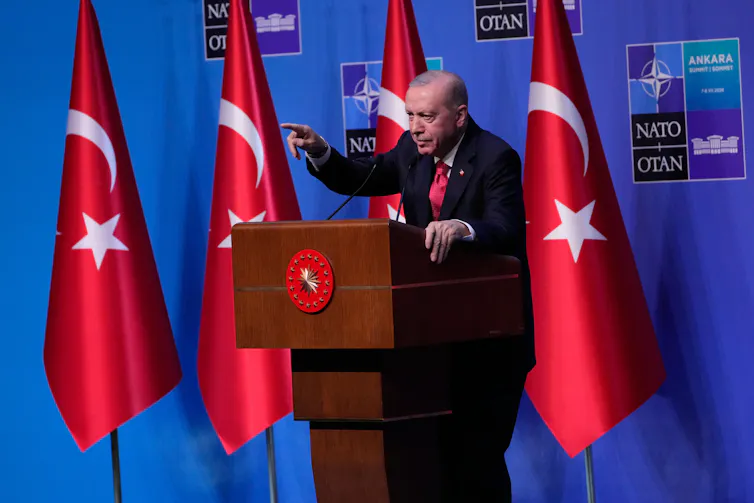
(AP Photo/Hussein Malla)
What about Pakistan’s nuclear arsenal?
Pakistan’s nuclear weapons make the agreement more consequential, but they do not automatically create a nuclear umbrella over Saudi Arabia or Turkey.
Extended nuclear deterrence requires more than a general promise of mutual defence. It normally involves political commitments, consultation procedures, command arrangements and some explanation of the circumstances in which nuclear weapons might be used. No such provisions have been publicly announced.
The signatories have described the pact as defensive and not as a nuclear alliance, but this ambiguity risks triggering dangerous miscalculations by regional rivals rather than creating a true deterrent.
What could prevent the pact from working?
A collective defence promise is credible only when members share threat perceptions and are willing to bear costs for one another. That cannot be assumed here.
Turkey must balance the new agreement with its NATO obligations and its complicated relationships with Iran and Russia. Pakistan will want to avoid being drawn into Middle Eastern wars while managing tensions with India, insecurity along its western border and close ties with China. Saudi Arabia may want additional protection without accepting all the institutional constraints associated with a formal alliance.
A crisis could therefore expose significant divisions. An attack viewed as existential by the Saudis might not receive the same assessment in Turkey or Pakistan. The public statement about the agreement also fails to explain what each country is required to contribute, or whether attacks by armed groups, rather than states, would activate the agreement.
What happens next matters most
The pact’s importance will be determined less by summit language than by implementation. Regular exercises, joint contingency planning, intelligence sharing, logistics agreements and integrated air and missile defence would indicate that it is becoming operational.
A permanent consultation mechanism would help members co-ordinate during crises and reduce the danger of misunderstanding.
Without these measures, the agreement may remain a strong political signal but a weak war-fighting coalition.
The Mecca agreement is therefore best viewed as an experiment in regional self-reliance. Its future will depend on whether Saudi resources, Turkish technology and Pakistani military power can be transformed into co-ordinated defence without creating new sources of insecurity.


