




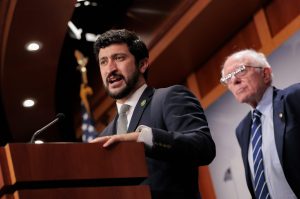
If with AI comes unemployment, this group of lawmakers wants AI companies to foot the tax bill. A new House proposal would impose an excise tax on major AI companies and automatically raise the rate if unemployment climbs, funneling the money into creating jobs in areas from housing construction and infrastructure to child and elder care.
“If Congress does nothing, the rise of AI could create the biggest wealth transfer in history from the bottom to the top,” said Rep. Sara Jacobs (D-Calif.) in a joint press release of the bill. “If AI profits off human work, workers deserve job security and a share of those profits.”
Introduced by Jacobs along with representatives Greg Casar (D-Texas) and Valerie Foushee (D-N.C.) earlier this month, the bill proposes a bifurcated taxation: either tax the value of the tokens—the small data units AI models use to interpret information—or tax revenue from AI services and certain transactions with affiliated companies, whichever yields the higher sum. The rates would start at 2% and 3% respectively when unemployment is 5% or less, and rise as unemployment increases.
Congress pushing to rein in AI companies
The bill is the most recent attempt in a concerted effort from Congress to combat potential job displacement as a result of AI.
Foushee and Casar previously introduced legislation directing the Government Accountability Office to study jobs created, lost, or changed by AI, while Jacobs co-introduced a separate bill requiring large employers and federal agencies to disclose AI-related layoffs to the Department of Labor.
In the Senate, Ron Wyden (D-Ore.) proposed changing the tax treatment of AI data centers and creating a new excise tax, with some of the revenue used to help workers displaced by the technology. Sen. Elizabeth Warren (D-Mass.) has called for taxing AI companies in part based on the energy their data centers consume and investing the proceeds in workers.
Most notably, Sen. Bernie Sanders (I-Vt.) warned AI could eliminate tens of millions of jobs and, as a result, proposed the American AI Sovereign Wealth Fund Act. It would levy a one-time 50% tax on OpenAI, Anthropic, and xAI, and give Americans a portion of those companies through shares.
Even lawmakers who aren’t proposing taxing AI companies directly are preparing for labor disruption.
Senators Jim Banks (R-Ind.), Maggie Hassan (D-N.H.), John Hickenlooper (D-Colo.), and Jon Husted (R-Ohio) introduced the bipartisan AI Workforce PREPARE Act, which would require better federal tracking of layoffs in which AI is a substantial factor, improve Bureau of Labor Statistics automation-related occupational forecasts, and study a rapid retraining program for workers displaced by AI.
Incentives for AI companies to support workers is another potential route some are taking. Representatives Josh Gottheimer (D-N.J.) and Mike Lawler (R-N.Y.) proposed a tax credit covering 30% of qualified AI-training expenses, up to $2,500 per employee each year, for companies that retrain workers in areas like machine learning, prompt engineering, and AI ethics.
Casar, Foushee, Jacobs, Wyden, Warren, and Sanders did not respond to Fortune’s requests for comment. OpenAI and Anthropic also did not respond to questions about whether they support the proposed AI taxes or public-ownership mechanisms.
Tech leaders worry about AI job displacement
The fear of job displacement is shared by leaders in the tech space. Bill Gates recently called for a tax on AI tokens and robots to rebalance the tax system, which he argued currently “nudges you toward replacing people with machines.” He warned “many jobs will disappear forever” and the federal government would need a way to raise revenues if fewer people are working and paying income taxes. Gabriel Weinberg, founder of search company DuckDuckGo, which is investing in AI features, said his company was willing to pay a 10% tax on AI token usage.
Even executives of companies building the very AI systems have acknowledged potential large-scale displacement, which could force governments to consider distributing AI gains.
Anthropic CEO Dario Amodei said AI-driven unemployment could require new sources of tax revenue and mechanisms for equity sharing, and even suggested that the federal government could levy a 3% tax on revenue generated from model usage that gets “redistributed in some way.” While it was not in his economic interest, he said it was a “reasonable solution to the problem.”
OpenAI’s Sam Altman even met with Sanders in June to discuss a public stake in his company to help Americans benefit from the financial windfall of the AI boom. Altman also agreed with Sanders that the public should have a stake in AI companies.