

Your day-ahead look for Aug. 14, 2026
Updated Published

This is an excerpt from CoinDesk newsletter ‘Daybook.’ Sign up here, if you haven’t already.
Scan the news and there are plenty of reasons for worry: continued U.S.-Iran escalation risks, mounting sovereign debt and rising bond yields among them. Crypto carries its own set of concerns, including regulatory disappointments, weak demand and hack risks.
Yet crypto, stocks, bonds and even commodity markets remain sanguine. That is clear from implied-volatility readings across these markets. Implied volatility is a measure of expected price turbulence, and is calculated from the demand for options and other derivatives used to hedge against wild swings and uncertainty.
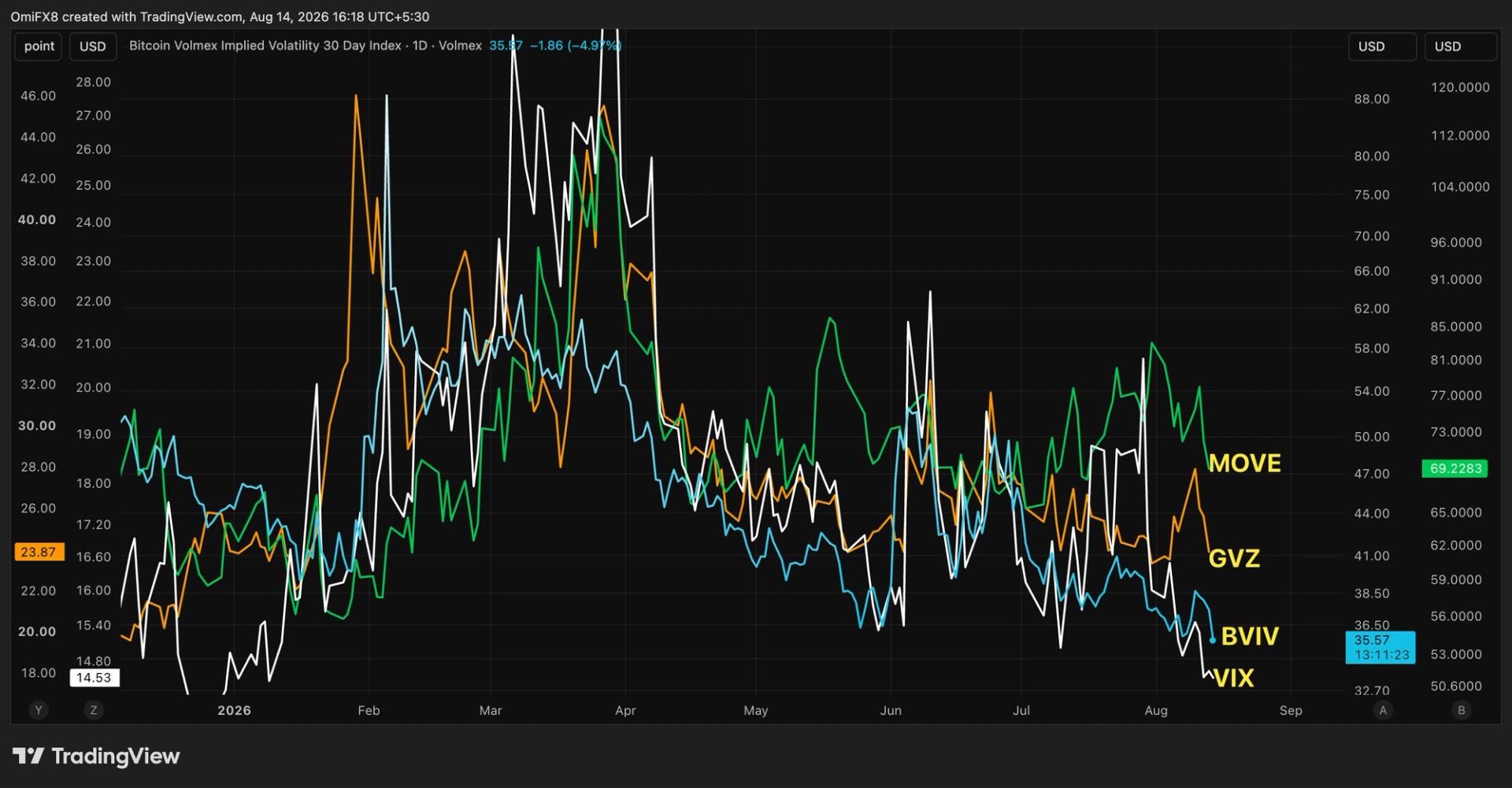
Bitcoin’s 30-day implied volatility index, BVIV, has dropped back to a 2026-low near 36%, reversing the minor pop to nearly 38% earlier this week, according to data source TradingView. The same is true for ether, the second-largest digital asset market value.
Wall Street’s VIX index, often called a “fear gauge” tracking uncertainty and volatility in the S&P 500, has declined to the lowest level since January. The Treasury market equivalent, MOVE, is also under pressure, hovering near the lower end of its multi-month range of 66% to 84%. Even gold and oil volatility indexes are falling.
A believer in the efficient-market hypothesis would argue that markets are always right and the price at any given moment reflects all available information. So, calmness across markets as reflected in the indexes is to be trusted.
To a contrarian trader, this synchronized low-volatility environment is precisely the time to prepare for a major hiccup. The tape will prove who’s right.
For now, the calm prevails. Stay alert!
Read more: For analysis of today’s activity in altcoins and derivatives, see Crypto Markets Today . For a comprehensive list of events this week, see CoinDesk’s “Crypto Week Ahead.”
What’s trending
- SEC cancels long-awaited proposal of Reg Crypto, postponing meeting without new date (CoinDesk): The SEC was on the verge of revealing its first major rulemaking effort for digital assets, but canceled Friday’s “Regulation Crypto” meeting due to a scheduling issue.
- Cluster of headwinds weigh on bitcoin. XRP teeters near $1 (CoinDesk): Bitcoin is under pressure again while XRP (XRP) teeters near $1 amid a cluster of unfriendly developments over the past 24 hours. Regulatory setbacks are leading the charge.
- Treasury yields rise as U.S. threatens Iran with more economic sanctions (CNBC): U.S. Treasury yields rose after the U.S. said its naval blockade of Iranian ports could continue “indefinitely”. The yield on the 10-year bond rose to 4.661%, the two-year to 4.152%, and the 30-year to 5.237%.
- Stocks near record highs; benign US inflation eclipses oil rally (Reuters): Global stocks hovered around record highs, set for a third weekly gain after benign inflation data dented expectations for a U.S. interest-rate increase next month. Faltering talks to end the war in the Middle East sent oil prices higher.
Today’s signal

The chart shows 30-day implied volatility indexes for major markets. BVIV is for bitcoin, while VIX represents the S&P 500. MOVE and GVZ represent U.S. Treasury notes and gold, respectively.
All four of the measures have been falling for months, with BVIV at a year-to-date low and VIX at its lowest since January.
The decline in the MOVE index is particularly noteworthy because Treasury notes underpin global finance. Increased turbulence in this market can cause financial tightening across other asset classes, leading to a broad-based risk aversion.
Building the Zcash Machine: Tachyon and Quantum Readiness

Building the Zcash Machine: Tachyon and Quantum Readiness
Zcash’s Tachyon upgrade aims to scale shielded payments, improve quantum readiness, and test whether its funding, security, and governance can hold.
Zcash’s Tachyon upgrade aims to scale shielded payments, improve quantum readiness, and test whether its funding, security, and governance can hold.
Why it matters:
Zcash’s Tachyon upgrade aims to scale shielded payments, improve quantum readiness, and test whether its funding, security, and governance can hold.
