

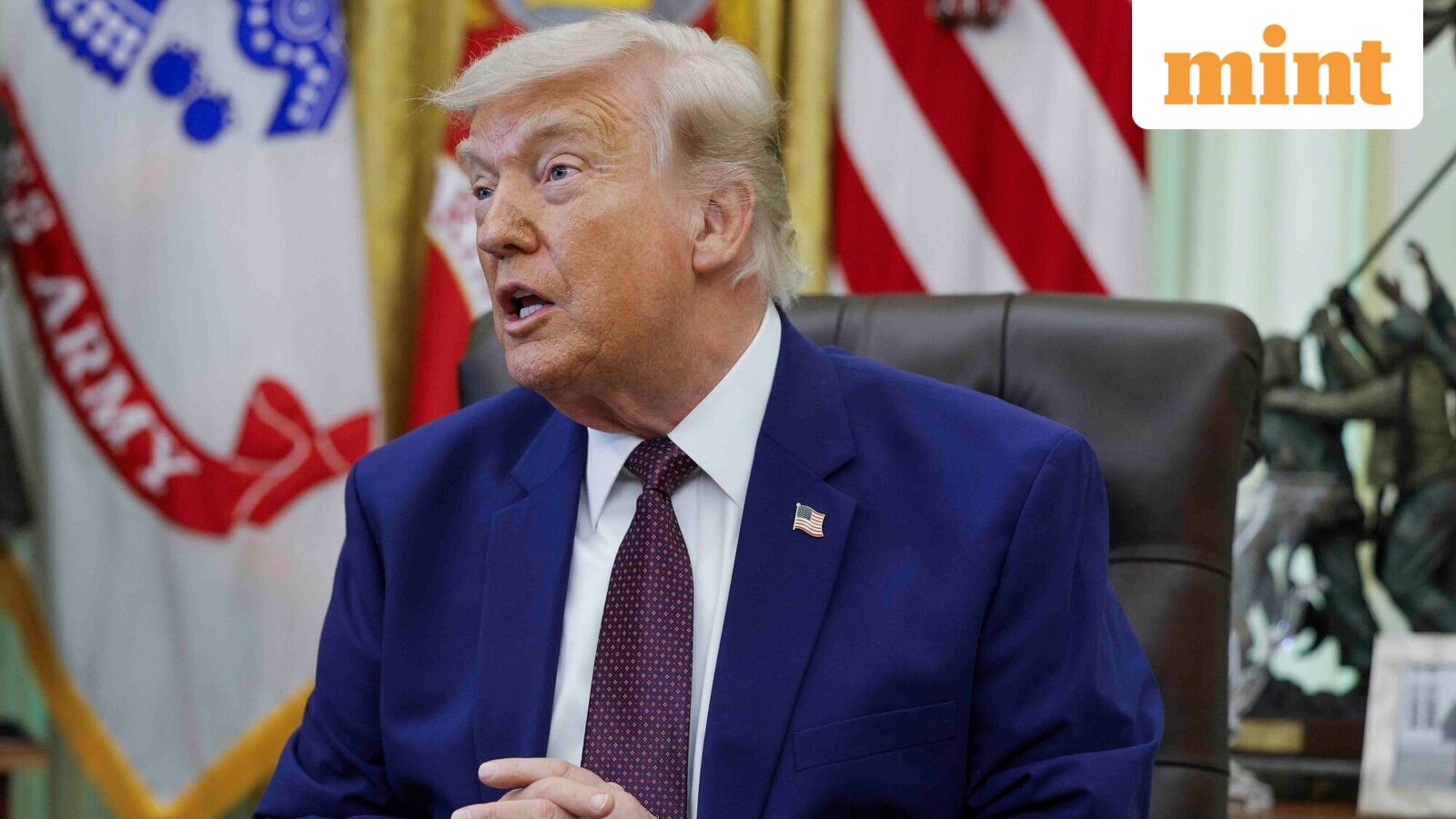
President Trump proposes giving the US public ownership stakes in AI companies like OpenAI and Anthropic. Here’s why he calls it ‘a beautiful thing’ and what it could mean for average Americans.

President Trump has outlined a proposal that would grant the American public a direct ownership stake in artificial intelligence companies, arguing that such an arrangement would transform the relationship between government, citizens and technology firms whilst distributing wealth from trillion-dollar enterprises across the broader population.
The proposal, which Trump revealed aboard Air Force One, represents a significant shift in how policymakers are conceptualising the regulation and governance of artificial intelligence development. Rather than traditional regulatory oversight, Trump’s framework would position ordinary Americans as financial stakeholders in AI’s commercial success.
Trump envisions AI ownership creating partnership between public and private sector
Trump articulated the rationale behind the proposal in direct terms. “There’s something very interesting about it, where it almost becomes a partnership with the American public,” he told reporters. “It’s like you make them partners in this revolution. It would be a beautiful thing. … It would make ’em rich.”
The president elaborated further on the scale and scope of what such an arrangement might entail. “So much money, and it’s so big, that there are concepts where pieces could be given to the American public, where the American public essentially becomes a partner, with the companies,” Trump said, describing the forthcoming stock offerings by Anthropic, SpaceX and OpenAI as the immediate context for these discussions.
How public wealth fund model would function in AI sector
The mechanics of implementing such ownership stakes remain under deliberation within the Trump administration. Industry figures have discussed relatively modest percentages, with discussions centring on stakes ranging from one to five per cent. More ambitious proposals, including one recently revived by Senator Bernie Sanders, would extract substantially larger stakes through taxation mechanisms, with Sanders proposing a one-time fifty per cent tax levied in stock rather than cash.
Trump indicated openness to exploring various implementation strategies. “We’ll look into that. We’re talking about it, where the American people can benefit from the success of AI,” the president said. “And by doing that, they’re gonna like it better. We’re leading China. We’re leading everybody in the world with AI, and we want to keep it that way.”
OpenAI leadership has championed public ownership concept for months
The proposal did not emerge spontaneously from the White House. OpenAI Chief Executive Sam Altman has promoted the concept through multiple channels over the preceding twelve months, first in private conversations with administration officials, subsequently through a proposal framework termed an AI New Deal, and most recently during visits to Capitol Hill where he engaged with both Sanders and bipartisan congressional leadership.
OpenAI’s published framework, titled “Industrial Policy for the Intelligence Age,” which circulated in April, included a “Public Wealth Fund” as one of several provocative governance concepts. The corporation’s advocacy has provided intellectual scaffolding for what Trump is now considering as executive policy.
Public scepticism about AI accelerates industry push for stakes model
The driving force behind enthusiasm for public ownership arrangements stems partly from political necessity. Artificial intelligence remains broadly unpopular across the US population. Technology leaders and Trump administration officials believe that transforming ordinary Americans into financial beneficiaries of AI’s commercial success could fundamentally alter public perception of the technology.
The wealth creation trajectory of AI companies presents a distinctive political challenge. As these enterprises generate extraordinary valuations and shareholder returns, public resentment has grown, particularly given concerns about employment displacement and concentration of technological power. A public ownership structure would address what industry strategists view as a legitimacy problem.
Trump draws unexpected parallel between his economics and Sanders’ democratic socialism
When confronted about embracing a proposal originating from a democratic socialist senator, Trump reframed the conversation through the lens of economic populism. “As far as economics is concerned, we have certain things that aren’t that far apart. People are surprised,” he said.
The statement underscores an emerging consensus across ideological boundaries that AI’s wealth generation requires some form of public participation mechanism. Whether through taxation, direct equity stakes or alternative arrangements, the fundamental principle that citizens should share in AI’s windfall gains has moved from fringe proposal to mainstream policy consideration.
About the Author
Sayantani Biswas
Sayantani Biswas is an assistant editor at Livemint with seven years of experience covering geopolitics, foreign policy, international relations and global power dynamics. She reports on Indian and international politics, including elections worldwide, and specialises in historically grounded analysis of contemporary conflicts and state decisions. She joined Mint in 2021, after covering politics at publications including The Telegraph.
She holds an MPhil in Comparative Literature from Jadavpur University (2019), with a specialisation in postcolonial Latin American literature. Her research examined economic nationalism through Eduardo Galeano’s Open Veins of Latin America. She also writes on political language, cultural memory and the long shadows of conflict.
Biswas grew up in Durgapur, an industrial town in West Bengal shaped by migration, which drew families from across India to the Durgapur Steel Plant. As the only child in a joint family, she spent years listening—almost obsessively—to her grandparents’ testimonies of struggle, fear and loss as they fled Bangladesh during the Partition of 1947. This formative exposure to lived historical memory later converged with her training in Comparative Literature, equipping her to analyse socio-economic structures and their reverberations.
Outside the newsroom, she gravitates towards cultural history and critical theory, returning often to texts such as Paulo Freire’s Pedagogy of the Oppressed. As a journalist, she is committed to accuracy, intellectual rigour and fairness, and believes political reporting demands not only clarity and speed, but historical depth, contextual precision, and a disciplined resistance to spectacle.
