

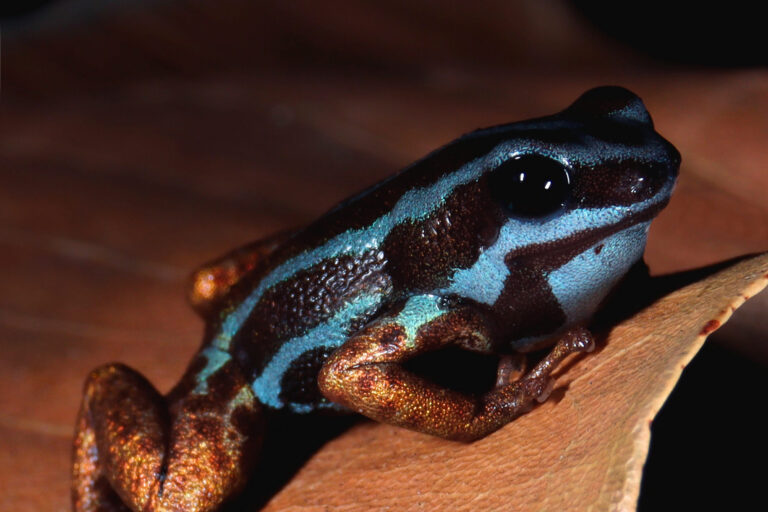
- The Amazon is home to the world’s greatest amphibian diversity, with an estimated 1,525 species, of which only 810 have been formally described by science.
- This megadiversity is under pressure from climate change and human activity, threatening the risk of species going extinct before scientists even get a chance to describe them.
- Recent research indicates that the combination of increased temperature and exposure to pesticides can alter tadpoles’ growth and development in the Amazon.
- Amphibians play a central role in controlling insects, including disease-transmitting mosquitoes, while also contributing to natural control of agricultural pests — a service valued in Brazil at more than a billion dollars annually.
MANAUS, Brazil — Crouched over the leaf litter, where dry leaves accumulate on the forest floor, a researcher tries to capture a distinct croak using a directional microphone. Identifying the sound of a small frog is often one of the conclusive proofs that a new species has been found. It’s nighttime. He wears long clothing as protection against mosquitoes and ants, and boots to keep his feet dry. Finding amphibians in the Amazon doesn’t require high-tech equipment; it actually dates back to explorations by early-20th-century naturalists.
That’s how biologist Igor Kaefer, a professor at the Federal University of Amazonas in Brazil, describes a typical day of fieldwork in search of amphibians in the Amazon. Kaefer was part of a group responsible for describing Amazophrynella bilinguis in 2019. The very description of the little toad gives an idea of how difficult it is to find: females measure about 2 centimeters (less than an inch), and their brown head and back make them “disappear” among the leaves and branches.
Home to an estimated 1,525 species of amphibians, the Amazon Basin is the most diverse ecosystem in the world when it comes to frogs, an order that includes toads and tree frogs. However, occurrence records have been confirmed for only about 810 of those. So going into the field and finding a new-to-science species is not unlikely.
“In almost every inventory conducted in a remote area, you come back with more than one new species for synthesis,” Kaefer says.
But finding a species in the field, analyzing it, and publishing the description takes “at least five,” he adds.
This constant stream of new-to-science discoveries masks another fact: from 2001 to 2010, only 12% of studies on Brazilian amphibians focused on Amazonian species, compared to 60% in the Atlantic Forest. This shows that studies are concentrated in Brazil’s southeast and points out some of the difficulties of conducting research in the world’s largest tropical rainforest, such as limited infrastructure, hard-to-reach areas, and lack of personnel.
“Biologists who know about amphibians are the real threatened species in the Amazon,” Kaefer says.
More than 2,000 amphibian species are threatened worldwide, making them the most vulnerable group of vertebrates on the planet. Of this total, 48% are directly threatened by habitat loss. This adds another layer of complexity to the knowledge gap regarding Amazonian amphibians: we may be losing entire populations before we even know they exist.

Why are there so many species of amphibians in the Amazon?
Viewed from above, the Amazon Rainforest looks like a seamless green block, but it’s composed of a mosaic of distinct habitats: dry land, floodplains, streams, and seasonally flooded areas. This heterogeneity is even more pronounced when it comes to amphibians that are just a few centimeters long. Even in a stretch of forest that seems homogeneous to the human eye, some variations regarding moisture, forest height, soil type, and water type are decisive for amphibians.
“Over millions of years, species have diversified and specialized in these many habitats and in different environmental conditions,” Kaefer says. “This means that they have adapted in very distinct ways to different places. Even within a large group of amphibians, we find species with differences that are very subtle but enough for us to recognize a new one.”
The most significant example of these subtle differences is found in species from the genus Synapturanus, called disc frogs because of their round, flat profiles. These species live underground and have short reproductive periods, which makes them difficult to observe. Lineages that used to be seen as a single species are now only distinguished by approaches that combine genetic examination, vocalization monitoring and bone analysis based on 3D models.

It was precisely this diversity that attracted Kaefer to the Amazon. Originally from the southern state of Rio Grande do Sul, he arrived in Manaus, the capital of Amazonas state, in 2008 to pursue his doctoral studies, accompanied by his friend, Daiani Kochhann, now a professor at the State University of Vale do Acaraú, in Ceará state. While Kochhann’s career was focused on the study of Amazonian fish, she was convinced by her colleague to invest in the little frogs as well — a field where scientists still have much to discover.
Kochhann says Amazonian diversity isn’t defined only by the sheer number of species, but also includes the richness of reproductive behaviors. She cites the case of frogs, which most schoolchildren are taught go through two life stages, first as tadpoles, before metamorphosing into adults.
“In the Amazon, however, some species face very complex variations regarding this pattern, such as parental care, or tadpoles that hatch from the egg and live freely right away,” Kochhann says. “Some lay eggs in water; others in damp soil. And there are species that we only know in their adult phase, whose tadpoles we have never seen.”
These differences also pose a challenge for Kochhann’s research area of physiology: scientists need to know these organisms’ functions and processes, from cells to tissues and organs. Above all, they need to understand how they function in the face of increasing environmental strain, including climate change impacts.
“When we talk about climate change and amphibians, the big questions are which species will survive, which will not, and how this process will occur,” Kochhann says. “In the case of amphibians, the urgency is greater because they have characteristics that make them especially vulnerable to rising temperatures and drier climates, such as cutaneous respiration, which depends on skin moisture. Having little data on the Amazon means not understanding enough about these processes and risks.”
Data from Brazil’s National Council for Scientific and Technological Development (CNPq) indicate that only five groups in the country’s Northern region, which includes much of the Brazilian Amazon, formally study amphibians in their research; three of them are systematically focused on amphibian ecology and physiology.
A search by Mongabay found 9,062 scientific articles on Amazonian amphibians published in the last 10 years, only 3% of which explicitly describe new species. Climate, on the other hand, has been a central topic in the scientific literature: the keyword comes up in 3,411 of the papers, even though a data gap persists regarding amphibians’ tolerance to higher temperatures and their adaptive capacities.

Climate change and pesticides: Emerging extinction risks
Climate change scenarios for the Amazon region include not only hotter days but also more severe periods of drought, as already observed in 2023-2024. Studies indicate that the increase in prolonged drought will cause an increase in habitat loss of up to 33% for frogs.
In addition to this risk, climate change interacts with other factors that also affect amphibians, such as water contamination by pesticides and heavy metals. Biologist Guilherme Azambuja investigates precisely these interactions, which are still little explored in the literature on the Amazon.
“One of the biggest challenges I faced was the lack of studies in this field for tropical environments such as the Amazon,” he says. “We end up resorting to results obtained in Europe or North America, which compromises comparisons with our reality.”

In a paper published in February this year, Azambuja tested the isolated effects of warming and exposure to the insecticide methomyl — an extremely toxic substance used in crops, with high water solubility — on tadpoles from two species, Osteocephalus taurinus and Scinax ruber. In a second phase, exposure to methomyl was tested at two temperatures: 26.5° and 30° Celsius (79.7° and 86° Fahrenheit).
In both species, the higher temperatures reduced the animals’ final mass. “When the temperature increases, their metabolism accelerates, hindering mass gain,” Azambuja says.
With higher temperatures and faster metabolism, tadpole respiration also increases, which may explain their greater susceptibility to absorbing substances present in water in warmer scenarios. In the case of O. taurinus, the link was clear: heat doubled methomyl’s lethal toxicity.
But the results also showed there are no absolutes in nature, with species responding differently to multiple stress factors. In terms of lethality, the tree frog S. ruber proved to be sensitive to methomyl regardless of temperature.
For Azambuja, this variation between species is the central point. It is precisely because species diversity is so high that responses to the same conditions also vary. Therefore, the lack of knowledge about these animals and their lifestyles means we can’t fully understand the impacts of these challenges or which species may be at greater risk.
In any case, Azambuja says, adaptation to temperature or substances takes a toll on amphibians, even the most resistant ones. “Body size decreases, resulting in thinner and smaller animals. While they are resistant, they may have lower sexual fitness and face reproductive challenges. Sometimes an animal tolerates warmer environments but remains at a level of stress that may not be sustainable in the long run, leading to organism collapse,” he says.

What are we about to lose?
Making the case for amphibian conservation can be difficult: considered “disgusting” by society, these little frogs face invisible threats, and their contribution to ecosystems is rarely appreciated. At the Federal University of Ceará, Karoline Ceron is trying to change this reality with a powerful argument: money.
“By proposing research to assign economic value to amphibians in Brazil, we want to work alongside those who influence decision-making in the country, considering agribusiness’s major role in policymaking,” she says. “We want to establish a dialogue between two worlds: that of conservation and that of production.”
Still in progress, her research estimates that amphibians help prevent $1.18 billion in agricultural losses in Brazil, simply by consuming insects that attack crops. In soy plantations in the Cerrado biome, for example, amphibians likely save around half a million dollars a year in pesticides, by eating approximately 300 million invertebrates in those areas.
They also play a role in public health, especially in the tropics. With amphibians’ decline, part of the natural control of disease vectors like mosquitoes, which can transmit malaria and dengue fever, becomes lost. Research conducted across Central America found an increase in malaria cases related to the loss of amphibian populations.
“There is a synergistic risk, therefore,” Ceron says. “Loss of amphibian populations can lead to increased use of pesticides and insecticides in both rural and urban areas, which in turn would create new contamination and environmental poisoning.”
Banner image: Poison dart frog of the species Ranitomeya aetherea, described from the Juruá River Basin, western Amazon, in 2023. Image courtesy of Alexander Mônico.
This story was first published here in Portuguese on April 13, 2026.
Citations:
Kaefer, I. L., Rojas, R. R., Ferrão, M., Farias, I. P. & Lima, A. P. (2019). A new species of Amazophrynella (Anura: Bufonidae) with two distinct advertisement calls. Zootaxa, 4577(2), 316-334. doi:10.11646/zootaxa.4577.2.5
Gonçalves, B. S., Dambros, C. S., & Werneck, F. P. (2025). Exploring blind spots in Amazonian anuran diversity: An assessment of research and conservation needs. Acta Amazonica, 55, e55bc25007. doi:10.1590/1809-4392202500072
Campos, F. S., Brito, D., & Solé, M. (2014). Diversity patterns, research trends and mismatches of the investigative efforts to amphibian conservation in Brazil. Anais Da Academia Brasileira De Ciências, 86(4), 1873-1886. doi:10.1590/0001-3765201420140170
Luedtke, J. A., Chanson, J., Neam, K., Hobin, L., Maciel, A. O., Catenazzi, A., … Stuart, S. N. (2023). Ongoing declines for the world’s amphibians in the face of emerging threats. Nature, 622, 308-314. doi:10.1038/s41586-023-06578-4
Wu, N. C., Bovo, R. P., Enriquez-Urzelai, U., Clusella-Trullas, S., Kearney, M. R., Navas, C. A., & Kong, J. D. (2024). Global exposure risk of frogs to increasing environmental dryness. Nature Climate Change, 14(12), 1314-1322. doi:10.1038/s41558-024-02167-z
Azambuja, G., Silva de Souza, S., Silva, C. B., Kaefer, I. L., Val, A. L., & Kochhann, D. (2026). Combined impacts of warming and methomyl on neurophysiological and behavioral responses in Amazonian frog tadpoles. Ecotoxicology, 35, 44. doi:10.1007/s10646-025-03022-3
Ceron, K., Santana, D. J., & Pires, M. (2024). The economic risk of the losses in pest control as frogs decline. EcoEvoRxiv. doi:10.32942/X2SP79
Springborn, M. R., Weill, J. A., Lips, K. R., Ibáñez, R., & Ghosh, A. (2022). Amphibian collapses increased malaria incidence in Central America. Environmental Research Letters, 17(10), 104012. doi:10.1088/1748-9326/ac8e1
Credits

