

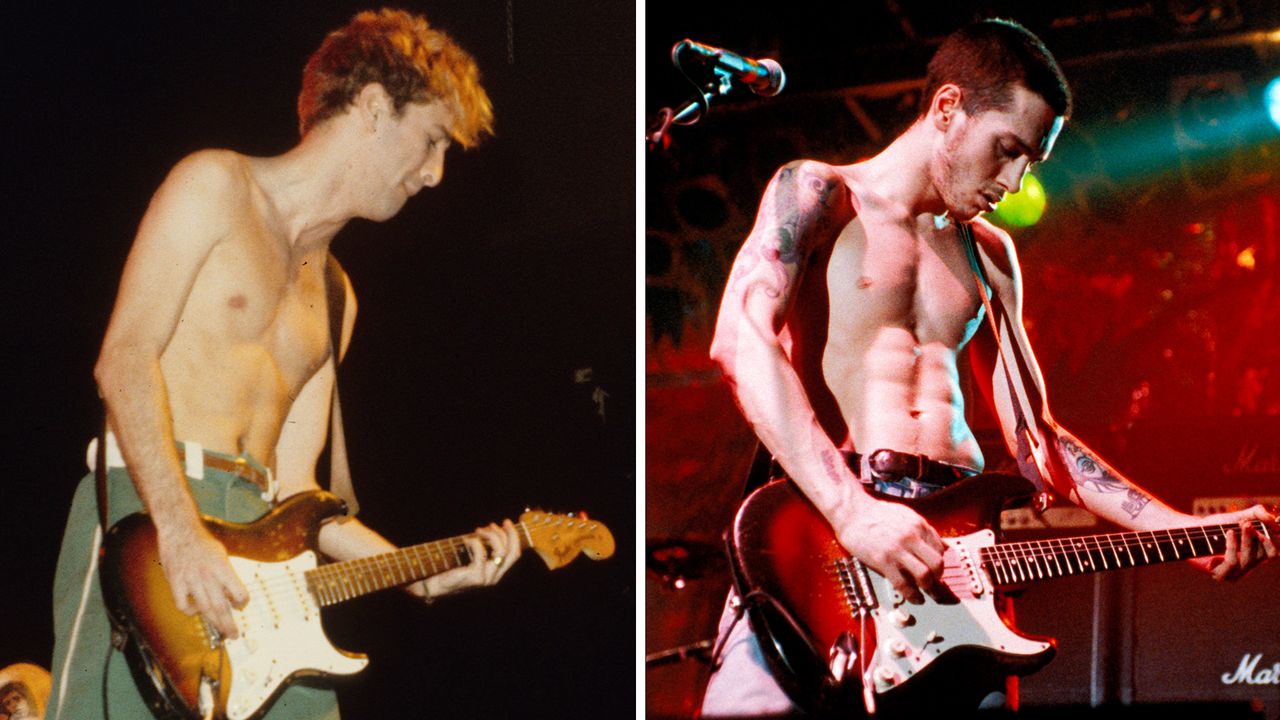
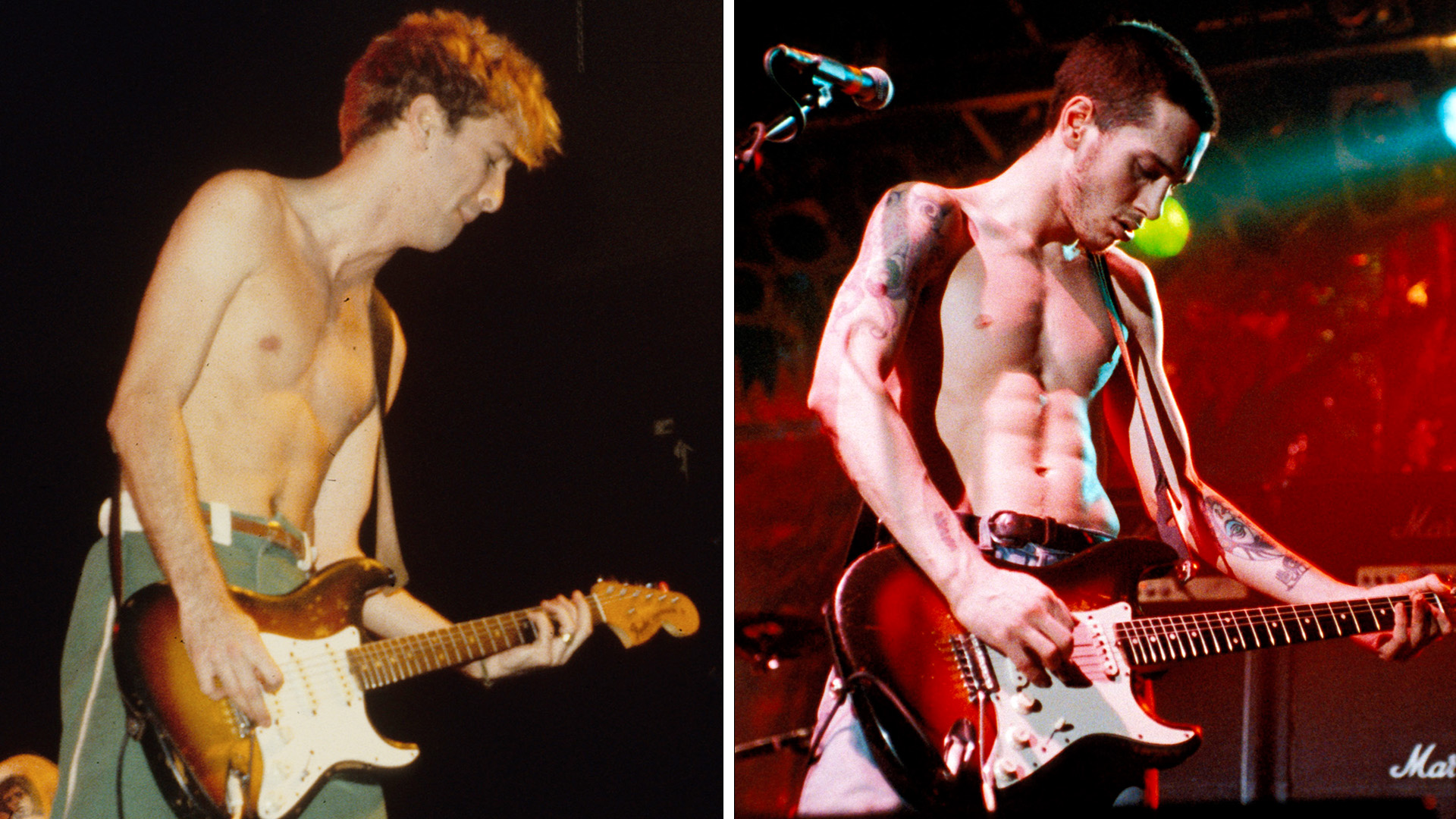
John Frusciante was just 18 when he was offered the guitar slot in the Red Hot Chili Peppers.
By that time, he had spent years honing his skills on the instrument, immersing himself in the playing of Hendrix, Beck and Page; Eddie Van Halen and Randy Rhoads; Steve Howe, Steve Hackett and Steve Vai; Frank Zappa and Robert Fripp and Adrian Belew.
Article continues below
“I went through many phases,” Frusciante says. “Every year I was kind of a different person when I was growing up playing guitar, because as I kept getting better, my tastes kept changing toward something that was a little more difficult to play.”
But for all the music he loved – and he loved a lot of music – Frusciante loved the Red Hot Chili Peppers the most. “They were my favorite band,” he tells Guitar World one afternoon over Zoom. Living in L.A. at the time, he says, “I saw them as often as I could. You went to one of their shows, and there was this magic energy that was happening. It was like being in a dream.”
It would stand to reason, then, that being tapped to become a full-fledged participant in that magic energy would be, well, a guitar player’s dream. When Frusciante officially became a Pepper in 1988, he brought with him, as might be expected, the unbridled energy and enthusiasm of a kid who had just won the rock guitar lottery.
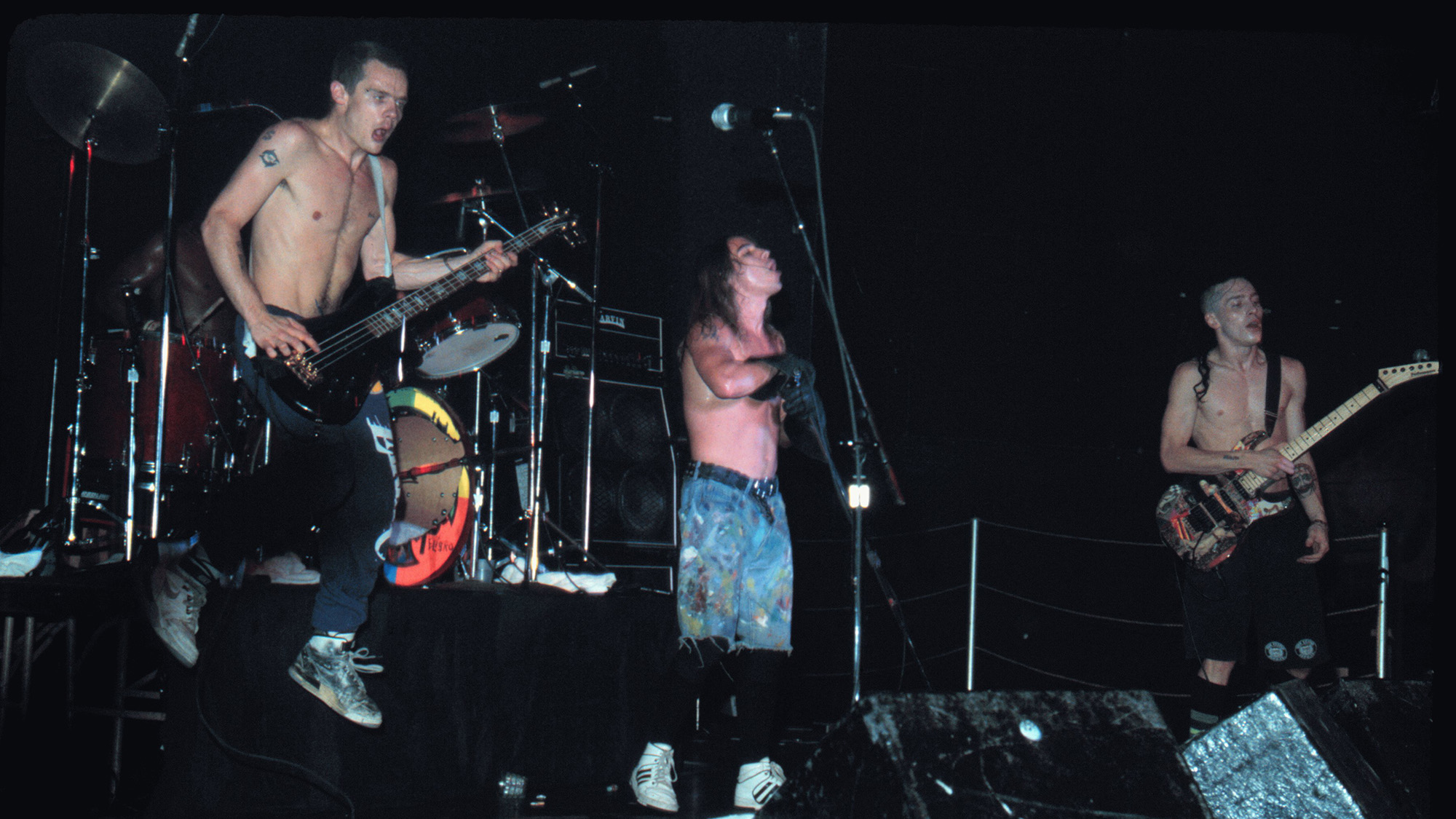
Another thing he brought? Sheer chops, with a high level of technical facility on his instrument (by this time, he says, he could peel off most any Frank Zappa instrumental, as well as all the solos on Alcatrazz’s 1985 metal platter, Disturbing the Peace, which were performed by a then up-and-coming six-stringer named Steve Vai) that enabled the predominantly punk-funk-based act to venture into previously unexplored musical realms.
But still, something was missing. “The first year or so that I was in the band was definitely a struggle,” Frusciante says.
He pauses, then restarts. “I’ve got something to say that I think could probably be good for guitar players. I think that at the beginning of my time in the band, I had my mind too much on trying to impress people, and I wasn’t trusting myself enough.
“I was feeling all these things – ‘I want to be unique,’ ‘I want to show off,’ ‘I want to stand out’ – and everything I was doing felt forced. I didn’t feel free and I didn’t feel like I was saying anything that I wanted to say. I didn’t feel like I was going deep in myself.”
Frusciante’s first album with the Chili Peppers, 1989’s Mother’s Milk, added a hookier, harder-rocking element to their sound, with bigger, thicker riffs and faster, flashier leads. The album was their most successful to date and became their first gold-certified seller.
But, Frusciante says, “by the time we were ending that tour, I got to such a point of unhappiness that I said, ‘I’m just going to throw away all these things I’m trying to do. I’m going to stop trying to grab people’s attention. I’m going to take my ego out of it entirely.’”
Instead, he continues, “I decided I was just going to use my guitar to try to support the other people in my band. So I simplified what I was doing. And at the same time, I was also putting a hundred times the amount of personal expression and soul into it than I had before.”
This change, according to Frusciante, “was the step that, all of a sudden, made people respond strongly to what I was doing. I wasn’t trying to be a Red Hot Chili Pepper in terms of what I thought other people thought that was – I just started being myself. And that honest version of myself is what you’ve had ever since.”
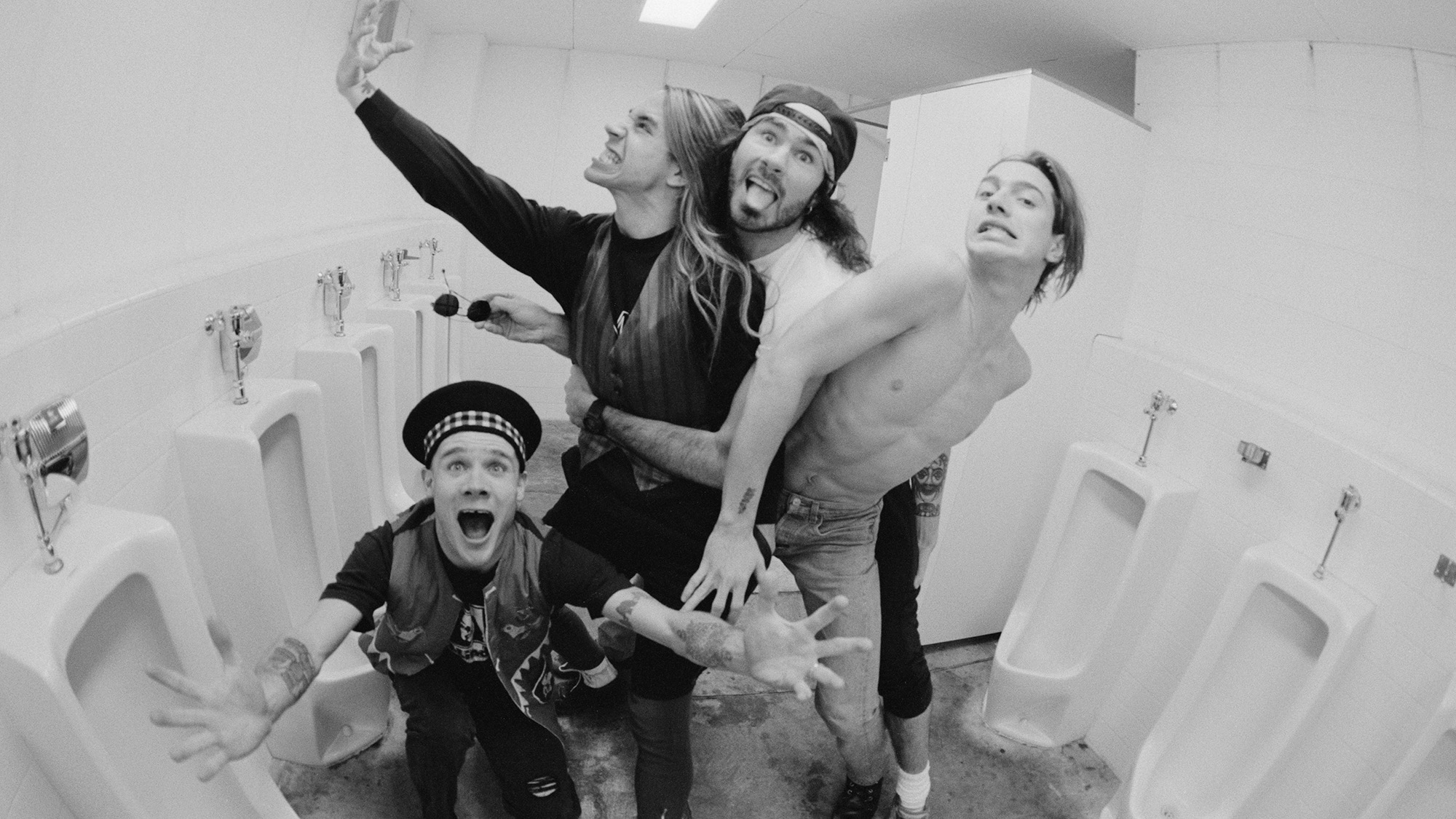
John Frusciante’s time in (and out of) the Red Hot Chili Peppers, and the very high highs and very low lows that have gone along with it, has been well documented. Through it all, he says, there’s a bond that has been forged between the band members that can never be broken.
“We have a special relationship because we went from being a club band to an arena band together,” he says.
“When I was first in the band, we had some bummer shows. Not all the time, but we had shows where nobody showed up, or shows where we were feeling like the audience wasn’t as enthused as they had been before I joined.
“So we had to build our energy together to make something new out of the band. And we pulled that out of each other. That’s a connection we share that nobody else can share with us, because it’s only the four of us that had that experience.”
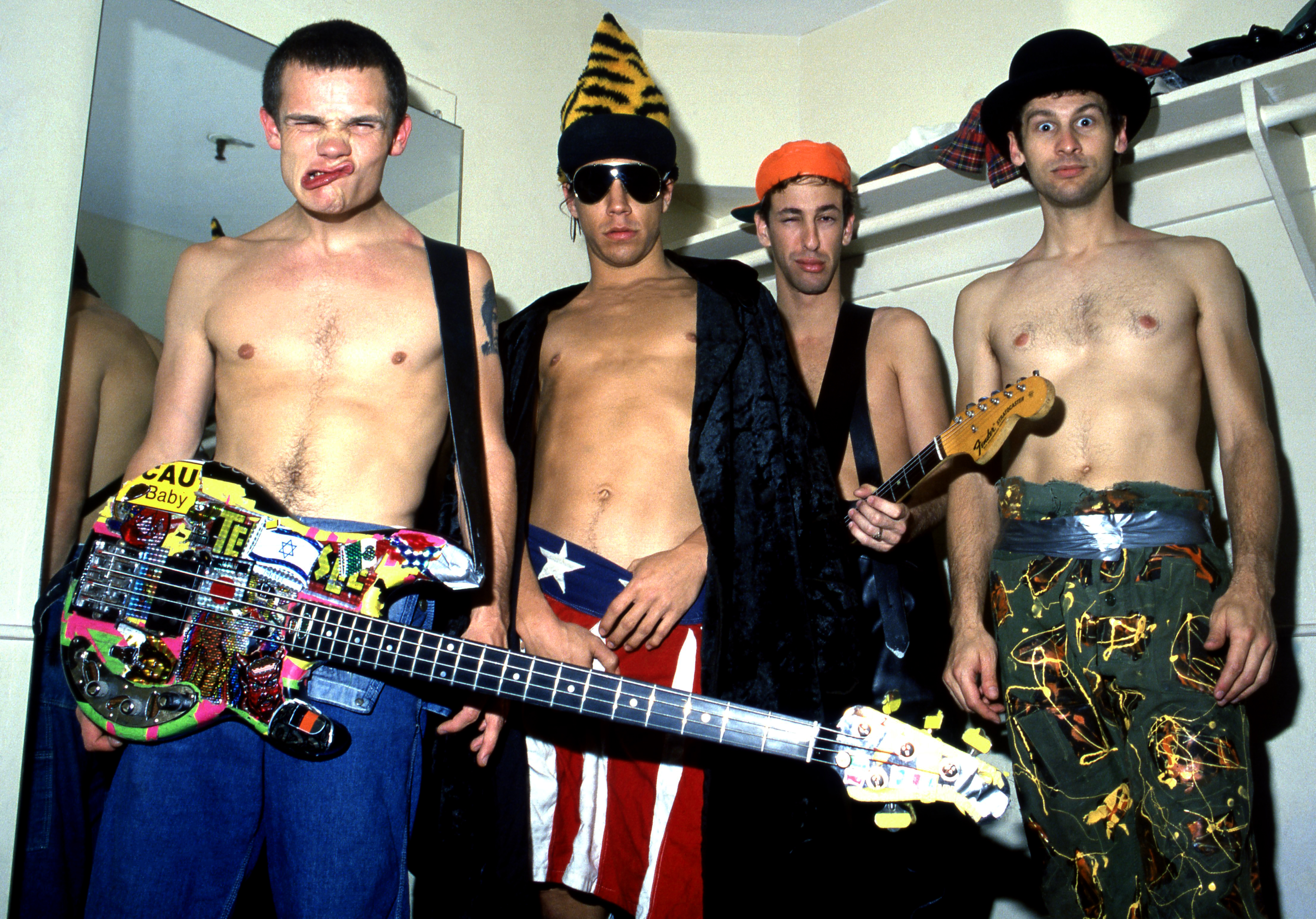
It’s an experience, Frusciante also acknowledges, that is very different from the one that the original version of the band – Flea, Kiedis, guitarist Hillel Slovak and drummer Jack Irons – shared.
“Those guys knew each other in junior high school and high school, and they went from being kind of bummy guys sleeping on people’s floors to realizing, ‘Wow, when we step onstage, we have this energy that makes a whole club of people dance,’ ” Frusciante says. “For me, nothing we’ve ever done touches that lineup in terms of the energy I felt at their shows.”
Frusciante’s reverence for the original Red Hot Chili Peppers lineup runs deep, and it is sincere. So much so that, a week after our interview, he checks back in to further articulate how it felt to join his “favorite band in the world.”
“I just wanted to keep playing in the style they had created with Jack and Hillel,” he says. “I thought I would play like Hillel, but flashier. After about nine months I realized the flashiness wasn’t impressing anyone, and there wasn’t really a place for it in the band chemistry, so for a while after that I just relied on my energy. Those first nine months, I had the impression that a lot of their audience wasn’t into me, but by the time we released Mother’s Milk, I felt pretty accepted.”
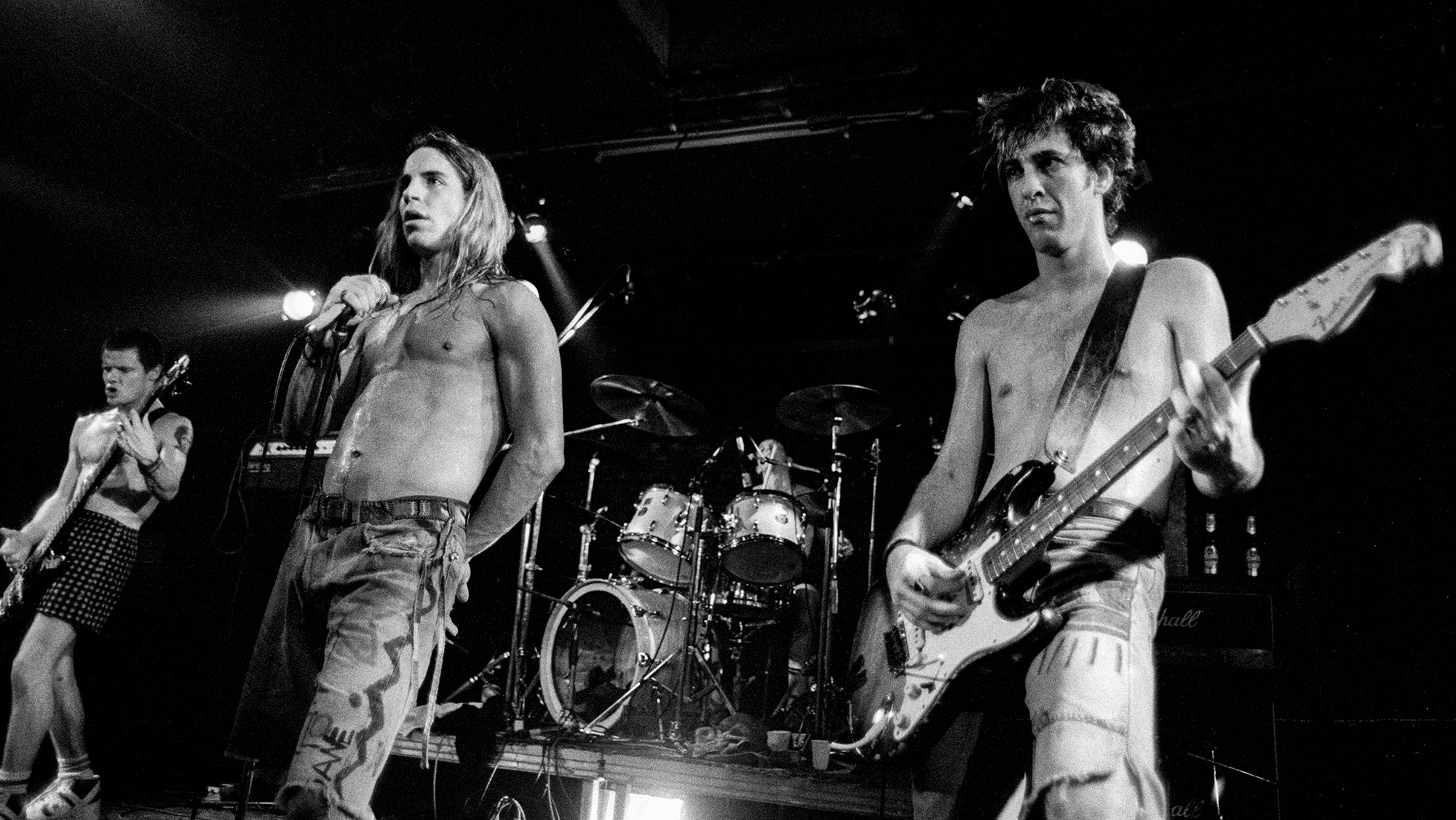
Regarding the particular influence of Slovak, who tragically died of a heroin overdose in 1988 at just 26 years old, Frusciante says, “I’m very lucky to have replaced such a great stylist. The challenge of attempting to appeal to his audience was character-building, and even when my own style appeared, I was still using his style as the basis for what I did.
“And luckily for me, there was some strange confluence of souls, where the more I stayed within the parameters laid out by Hillel, the more I sounded like myself. I wanted to make the band sound good, and I stopped caring about how I might come across. I became content to back up the other guys in the band and, unexpectedly, that made me stand out more, rather than less.
“To this day I see Hillel’s style as the center of my own, where the band is concerned. He was a team player, and he added color and meaning to his bandmates’ contributions, and that’s what I try to do.”
Interestingly, for all of Frusciante’s youthful devotion to the Chili Peppers, he also says that “getting into them was actually a very gradual thing.” He was first turned on to the band when he was 14, when his guitar teacher at the time auditioned for a spot in the then-fledgling act.
“This was at the time when Hillel and Jack had quit [both eventually rejoined the group], and so they were looking for a new guitarist and drummer,” Frusciante says. “They got Cliff Martinez from Captain Beefheart’s band to play drums, and for guitar it was between Jack Sherman and my teacher. He didn’t get the job, but I knew about the band from him telling me that he was auditioning.”
How to watch The Rise of the Red Hot Chili Peppers: Our Brother, Hillel
Release Date: Friday, March 20
Where: Netflix
Watch anywhere: With Nord VPN’s 30-day trial
Not long after that, a friend gave Frusciante a compilation of Chili Peppers music. Frusciante liked what he heard, but, he says, “it wasn’t until I saw them live that they became my favorite band. This was when the original band, with Jack and Hillel, had gotten back together, and I’d never seen anything like it.
“The energy was incredible. I jumped around the entire show, and the whole thing was just this psychedelic blur. Everyone was really happy, and it didn’t feel like the band and the audience were separate. So if you ask what I loved about them, that’s it – that magic energy.”
That magic energy is still alive in the Red Hot Chili Peppers today. But it requires tending to. “I think I loved the band with the Hillel lineup so much that, at the beginning of my time with them, all I could think about was that energy, and trying to match that energy,” Frusciante says. “And I thought that meant being as fiery a guitar player as possible, on every level.”
What it actually meant, as Frusciante returns to, was finding that “honest version” of himself as a guitar player. “Once I stopped forcing it,” he says, “that’s when it started to feel like, ‘Wow, we really do have that same magic energy as the band had with Hillel.’”
Frusciante pauses. “Like, we’re not trying to have it, you know? We just have it.”
This is an abridged version of a feature that first appeared in Guitar World’s June 2022 issue.
” data-join-the-conversation-text=”Join the Conversation”>
You must confirm your public display name before commenting
Please logout and then login again, you will then be prompted to enter your display name.
