

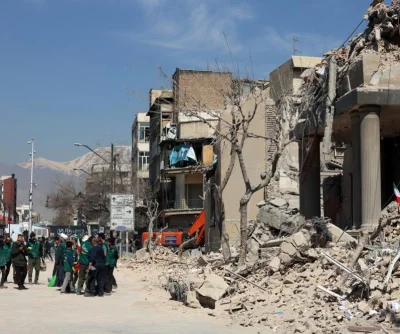
Iranians gather around the damaged police station building in central Tehran on Wednesday A joint Israeli -U.S. military operation continues to target multiple locations across Iran since the early hours of February 28. Photo by Abedin Taherkenareh/EPA
March 4 (UPI) — Five days into this latest war between Israel and its American partner and Iran has raised the most profound and exquisitely unanswerable questions on which success, failure and the nature of much of the future global order will rest.
Assuming the comments made Monday by U.S. Secretary of State Marco Rubio and reaffirmed by House Speaker Mike Johnson were accurate descriptions of the decision for going to war, this was clearly orchestrated by Israel Prime Minister Benyamin Netanyahu.
Both said that because Israel was about to launch a pre-emptive attack on Iran, facing inevitable retaliation from Tehran, the United States had no choice except to join Israel to avoid absorbing a first Iranian strike.
[Rubio later walked back those comments and President Donald Trump said he may have spurred the Israeli attack.]
What an admission by Rubio! If true, the United States had given its proxy to a foreign government to declare war on the part of America. One wonders if Trump was aware of this absurd condition. And one wonders how Republican members of Congress would agree with this decision to outsource declaring and starting a war.
Of the many questions now in play, that posed by retired Gen. David Petraeus is among the most important. Regarding the second Iraq War, he asked “Tell me how this ends?” One must ask Donald Trump, “How does this end?”
Iran has chosen as its strategy economic denial. Closing the Strait of Hormuz through which about 20% of the world’s energy flows would provoke an economic crisis. Stock markets around the world too steep losses Tuesday.
The price of gas and the Dow will be the barometers of success and failure. How then is the strait opened without the consent of Iran? Landing ground forces will be hugely costly, and that still might not force the opening of the strait.
Next, what other arguments will the administration offer to convince the public that attacking Iran was in America’s best interests? As Pentagon briefers informed Congress, Iran was not about to attack America and that it was years away from developing an intercontinental missile capable of reaching the United States. And the briefings completely rejected negotiator Steve Witkoff’s assertion that Iran was a week or two from building a bomb.
Building a nuclear weapon is not something that can be done in a garage. It takes time to reprocess uranium to weapons grade. That material must be shaped to fit into the core. Then, the geometry and timing must be perfect to produce a reaction and explosions. Finally, a test would be required to demonstrate that the device actually worked. Initial North Korean tests fizzled.
And, will this strike cause Iran to conclude that nuclear weapons were essential to assure the survival of the nation and the leadership? The corollary is how will other states, especially in Europe, see the need to have a nuclear capability because each can no longer trust the United States for its security?
Indeed, this may be the most telling consequence of going to war in Iran. Poland already expressed an interest in the nuclear option. French President Emmanuel Macron has just suggested that France may need more warheads.
It is impossible to predict whether greater proliferation will occur. However, it is a far bet that Iran’s leadership under Ali Larijani will seriously consider this option. After all, North Korea has survived because of its nuclear weapons, whie Saddam Hussein and Libyan strongman Muramar Qaddafi did not.
Are China and Russia the big winners in this war? The United States may have become bogged down in the region at the expense of the more strategically important relations with China and Russia. Of course, an oil embargo or cutoff would have serious impact on Russia’s need for foreign exchange and China’s dependence on energy imports.
Finally, what does this mean for war powers and the role of Congress in using force. The contradictions between Article I power to declare war and Article II designation of the president as commander-in-chief remain unresolved. Whether Republicans will choose loyalty to the Constitution over obedience to the president is critical. But if this war lingers and energy and stock markets are in free fall, Republicans will be forced to decide.
For the moment, as in Vietnam, Afghanistan and Iraq, it appears that the Trump team may have followed suit and stumbled into a war it will regret. That these questions have not been answered nor addressed in advance is not the best grounds for optimism.
Harlan Ullman is senior adviser at Washington’s Atlantic Council, chairman of a private company and principal author of the doctrine of shock and awe. His next book, co-written with Field Marshal The Lord David Richards, former U.K. chief of defense, is Who Thinks Best Wins: How Decisive Strategic Thinking Will Prevent Global Chaos. The writer can be reached on X @harlankullman.
