

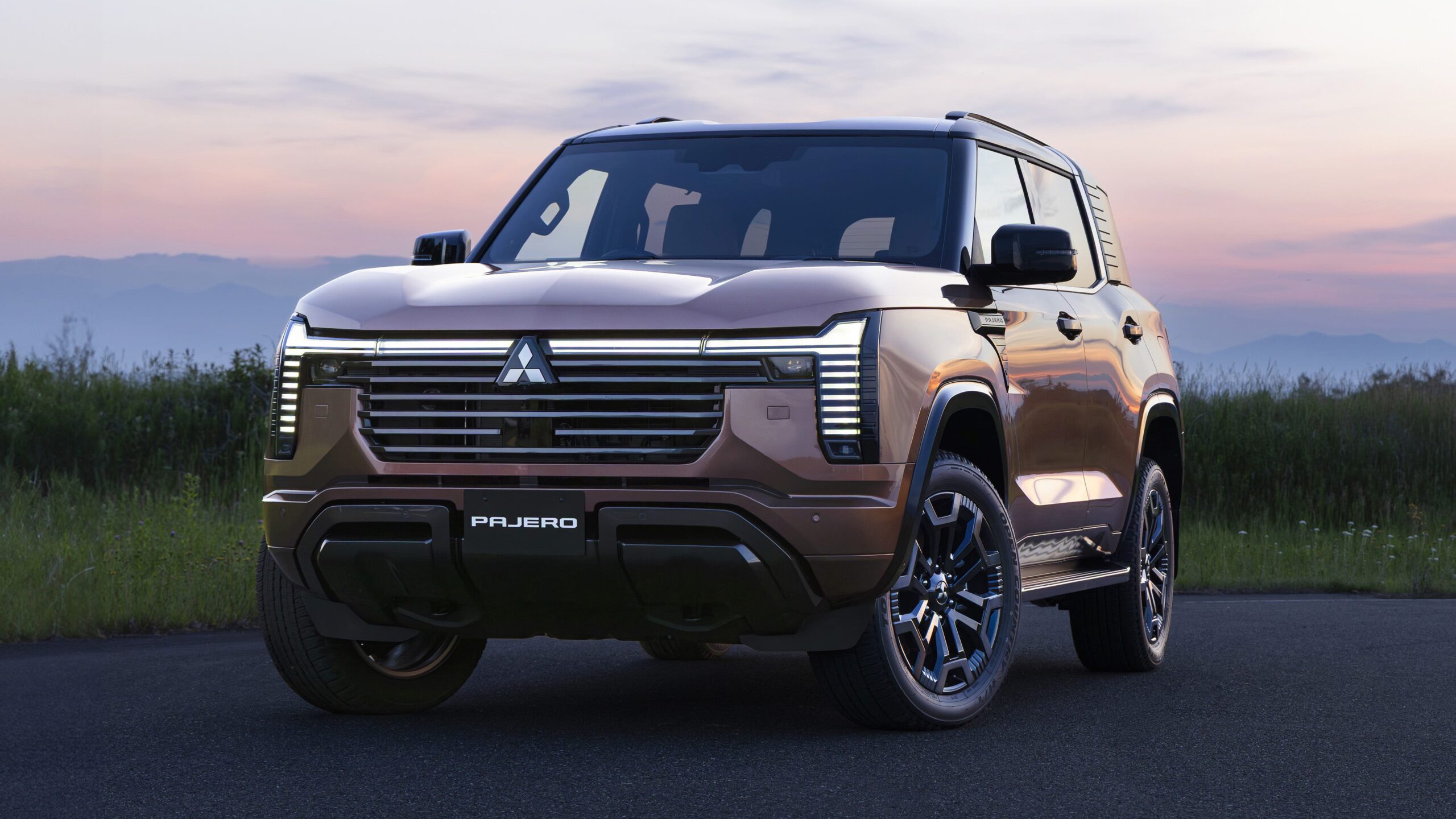
The new Pajero stays true to its legendary roots, but prospects for U.S. sale don’t look very good.
Here’s the new Mitsubishi Pajero or, as we in ’Murica used to know it, the Montero. Before we get into any details, let’s address what most of you are probably thinking: Will we get it in the United States? Mitsubishi teased us in our official inquiry—“no decision has been made regarding a U.S. introduction of our vehicle,” said the Mitsu rep—but the burly new Pajero seems a long way from coming Stateside, even if it will be in Latin America (and Asia and the Middle East).
New Pajero Stays True to its Roots
The new Pajero will be the fifth iteration of this legendary SUV in nearly as many decades. Mitsubishi first introduced this boxy body-on-frame SUV in 1982, and production of the fourth-gen Montero ended in 2021. Happily, the new Pajero isn’t just a high-riding crossover wearing a legendary name (coughPathfindercough).
True to its roots, the new Pajero is a three-row, seven-seat, body-on-frame vehicle with a rear-drive-based powertrain.
While the styling reflects modern trends, the hardware is old-school with a high-tech twist. Size-wise, the new Pajero is about as long as a Toyota 4Runner, but narrower—about the same width as a Ford Bronco—and nearly as tall as a Land Cruiser. The front wheels connect to the ladder frame via a double-wishbone setup, while the live rear axle gets a new five-link coil-spring setup.
Power comes from a 2.4-liter diesel with a variable-geometry turbocharger. Mitsubishi hasn’t published a horsepower figure, but torque is 354 lb-ft. The drivetrain uses a new eight-speed automatic.
Though the drive system wears the S-AWC (Super All-Wheel Control) branding, we’d consider it a proper four-wheel-drive system, as it has a two-speed transfer case and a locking center differential. Drivers can select from two-wheel-drive high range, full-time four-wheel-drive high range, 4WD low range, and 4WD low with the center diff locked. As we’d expect from a modern SUV, there are multiple drive modes for gravel, sand, snow, etc.
The On-Road/Off-Road Compromise
Mitsubishi published some off-road-specific measurements—9.1 inches of ground clearance and respective approach, breakover, and departure angles of 30.4, 22.6, and 25.8 degrees. These numbers indicate good capability, but they fall well short of the more off-road-focused versions of the 4Runner, Bronco, and Land Cruiser. Mitsubishi’s press release talked about a desire to compromise between off-road ability and on-road handling and refinement, and that’s what we see in those numbers: a vehicle that can go off-road, but might not be expected to do so all that often.
Inside, the two-tone baseball-mitt-and-black color scheme should be familiar to anyone who has sat in a nicely-equipped Outlander, but the monolithic screen setup with separate volume and HVAC controls on a panel beneath is a new one on us, and a design we hope will come to other Mitsubishis. As expected, there is no shortage of padded leather on the dash or quilting on the seats. Also as expected, the Pajero will offer a full suite of safety and driver-assistance systems, a comprehensive bird’s-eye parking camera, and a Yamaha sound system. The latter is one of the things that impressed us the most in the latest iteration of the Outlander, and if that sounds like a backhanded complement, well, it is.
Why We Are Skeptical About Montero’s American Return
There are a lot of buyers who, we think, would go nuts for a new U.S.-market Montero. So why, despite Mitsubishi’s official tease, are we skeptical of a Montero coming to the United States, at least as we see it here?
First, the new Pajero is, according to Mitsubishi, based on the L200/Triton pickup, which has not been certified for U.S. sale. (If it was, Mitsubishi might take a crack at selling it here.) The U.S. has very stringent safety standards, and if a given vehicle or platform was not designed with sale here in mind, modifying it can be prohibitively expensive. Second, the turbodiesel engine is, most likely, a no-go for American buyers—even if it could meet emissions standards, it’d be a tough sell even without diesel prices where they are.
We can’t think of a U.S.-market Mitsubishi powerplant that would be suitable for a Montero-sized vehicle. The Outlander PHEV has the torque, but its engine is mounted transversely, not longitudinally as the Pajero uses, and we can’t imagine Mitsubishi going to the reengineering and recertification costs for what would likely be a low-volume vehicle.
Of course, corporate partner Nissan has several engines that would work very well in a vehicle like this, either the twin-turbo 3.5-liter V-6 from the Armada or the hard-working 3.8-liter VQ in the Frontier pickup. Again, though, that’d require expensive recertification. It would make a lot more sense (financially, at least) to slap the Montero badge on a restyled Armada—and based on our experience with the Armada Pro-4X, it would make a pretty decent Montero.
We’re excited about the return of the Pajero, but not overly optimistic for a U.S.-market Montero—but, hey, Mitsubishi didn’t say never.
Stay Ahead of the Curve.
Get the newest car reviews, hottest auto news, and expert analysis of the latest trends delivered straight to your inbox!
