



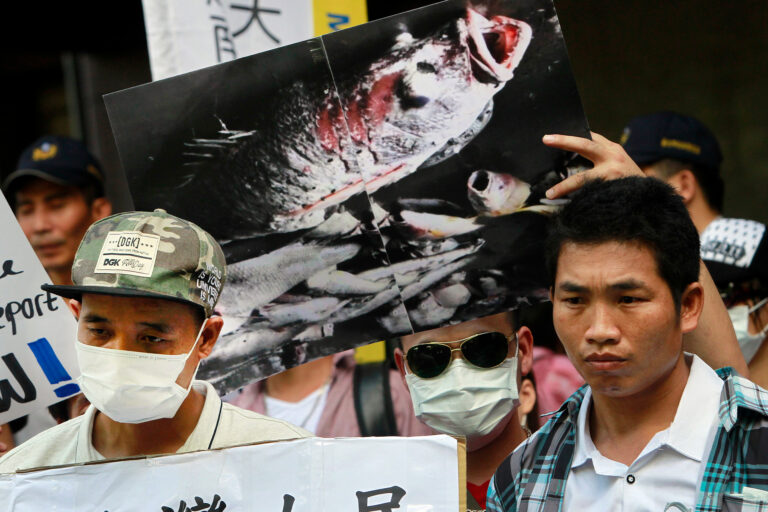
- This month marks the 10th anniversary of a marine disaster in Vietnam, caused by the release of toxic chemicals by the Formosa steel plant off the coast of Hà Tĩnh province.
- At least 100 metric tons of dead fish washed ashore beginning April 6, 2016, sickening thousands of people and shutting down the fishing and tourism industries.
- After widespread public mobilization, the company admitted responsibility and agreed to pay $500 million in compensation.
- Thousands of Formosa victims say they have not been properly compensated; lawsuits against the company are stalled; and victims and their supporters face repression, including imprisonment, inside Vietnam.
In early 2016, a power failure shut down the waste treatment facility at Hưng Nghiệp Formosa Steel Hà Tĩnh (FSH), located off the coast of Vietnam’s Hà Tĩnh province. The power failure caused the facility to illegally release untreated water — contaminated with phenol, cyanide and iron hydroxide — into the sea.
On April 6, 2016, dead fish starting washing up on beaches across four provinces in the North Central region of Vietnam: Hà Tĩnh, Quảng Bình, Quảng Trị and Thừa Thiên Huế. Over the following weeks, at least 100 metric tons of dead fish washed ashore.
Untold numbers of people were sickened by eating contaminated fish, and divers from the region were reported to have died in the affected waters.
In the aftermath of the disaster, thousands more lost their income as waters were closed, fishing operations were suspended and tourism ground to a halt. The government-approved list of victims consists of 510,000 people in 130,000 households across 730 villages and hamlets.
Initially, both FSH and the Vietnamese authorities failed to acknowledge the company’s culpability. Statements from Vietnamese authorities attributed the mass fish deaths to the natural growth of toxic algae blooms.
“No (formally registered) NGO inside the country dared to conduct an investigation on site,” said a Hanoi-based independent human rights activist, speaking on condition of anonymity for fear of government retaliation.
Only after widespread protests across the country, one of Vietnam’s largest civic mobilizations in recent years, did the government name the company as the culprit behind the disaster.
In June 2016, Formosa admitted responsibility, made a public apology, and pledged to pay $500 million in compensation. However, the compensation became a private settlement with the Vietnamese government, leaving decisions about how to allocate funds at the discretion of the one-party state.
A decade later, many of the victims of the disaster say they are still awaiting justice.
Adding to their distress, many of the victims and their supporters have faced repression from the state, winding up in exile or in prison.

State-determined and symbolic compensation
Under the terms of the compensation plan put forth by the Vietnamese government, only those deemed eligible by the local authorities would be compensated. In addition, victims have alleged favoritism in the distribution of compensation toward those who are active members of the Vietnamese Communist Party.
By Oct. 17, 2017, 97.4% of the compensation for damages had reportedly been disbursed. The remaining amount was held back for procedural reasons, such as victims not being available to receive compensation in person while working abroad. Their family members were unable to receive compensation on their behalf.
“There is no monitoring system in place to ensure that the money reaches those affected,” said Nancy Bùi, vice president of external affairs of Justice for Formosa Victims Association (JFFV), a U.S.-based NGO supporting Formosa victims. “Neither the government nor the company have published any publicly accessible report.”
Unhappy with the distribution of damages, various affected communities initially sought justice through local courts, only to be rejected as their lawsuits were deemed to have “insufficient evidence.”
In addition, although several members of the National Assembly put forth proposals to monitor environmental pollution caused by FSH and other foreign investors, these objectives were not included in the assembly’s oversight agenda for 2016-2021 or for the current term.
In November 2022, the spokesperson for the Ministry of Foreign Affairs, Lê Thị Thu Hằng, told reporters: “Currently, the production activities of the company as well as the life of the people in the affected area have been restored and stabilized.”

The quest for justice: A race against the clock
Those who tried to press for justice and accountability within Vietnam often paid a heavy price.
Among the earliest to be arrested was Nguyễn Văn Hóa, a journalist from Hà Tĩnh. In October 2016, he livestreamed drone video of peaceful protests outside the Formosa steel plant, and helped fishing families demand compensation and justice. In 2017, he was secretly arrested and later sentenced to seven years in prison on charges of “propaganda against the socialist state.”
More recently, in 2023, journalist Nguyễn Lân Thắng, who made a documentary about the disaster, was sentenced to six years in prison and two years of probation on charges of “making, storing, spreading or propagating anti-state information, documents, items and publications opposing the Socialist Republic of Vietnam.”
Today, about 20 justice seekers remain behind bars, while others have fled into exile, with many of the latter living in legal limbo in neighboring Thailand.
With avenues for justice appearing closed in Vietnam, the Justice for Formosa Victims Association, with the support of international lawyers, filed two lawsuits against Formosa in 2019. The first was filed in Taiwan, where FHS’s parent company is headquartered. The second was in the United States, targeting Formosa USA, a prominent investor that played a critical role in decision-making for FSH.
Bùi said that only 7,875 victims pursued a lawsuit. “The simple reality is that the Vietnamese Government prohibited the victims from seeking justice,” she said. “Anyone discovered to be involved in legal action risked arrest and imprisonment.” Eventually, Bùi said, more victims reached out wanting to be included, but the filing deadline closed on June 30, 2019.
Peter Nguyễn Văn Hùng, a Catholic priest and human rights activist based in Taiwan, who has supported the victims, said a large number of the people who have filed lawsuits in Taiwanese courts are those who have never been compensated or were given inadequate compensation for their damages. Hùng estimated the number of environmental refugees currently in Taiwan because of the Formosa disaster to be in the thousands, noting that many are undocumented or live in a legal gray zone.
The Taiwan case was initially denied by two lower courts, which reasoned that only Vietnam should have jurisdiction over the suits, and that the victims would have a fair trial there.

In 2020, the Supreme Court of Taiwan reversed the dismissal, opening the path for the case to be heard in Taiwan. Yet the legal obstacles remain daunting. While Vietnamese plaintiffs can sue Taiwanese actors in Taiwan, they are obliged to file paperwork at one of Taipei’s diplomatic missions in Vietnam, which poses a security risk.
Bùi said that in late 2024, about 50 plaintiffs who attempted to travel to Hanoi to authenticate their powers of attorney were stopped by local police and warned they would be arrested if they continued their trip. And in February 2024, a legal assistant based in the region received a police summons requiring her presence at the local station for a “security matter.” According to Bùi, the woman was “subjected to aggressive questioning and threats” and forced to sign a pledge.
In October 2022, members of the U.S. Congress urged the Taiwanese courts to waive the conditions for Vietnamese victims. There has been no progress so far, and the U.S. case is on hold pending the outcome of the trial in Taiwan.
The fear is growing still
Mongabay did not directly contact lawyers and victims involved in the case, for security reasons. However, according to the JFFV’s Bùi, only a few among the nearly 8,000 plaintiffs have withdrawn from the lawsuit over the past decade, primarily due to concerns for their personal safety
Hùng said the delay of justice has demoralized the victims, with many having given up hope.
“The fear is growing,” Hùng said. “Now, at my Taiwanese church, many churchgoers seem uninterested when I mention the Formosa disaster. Many equate raising voice about this to being against the [Vietnamese] state.”
Even taking to the streets in Taiwan is no longer safe for Vietnamese justice seekers. According to Hùng, victims who migrated to Taiwan and joined him in protests to seek justice have faced harassment from Vietnamese authorities in various ways. Either their family members back home experienced harassment, or they themselves were detained upon returning to Vietnam.
For the time being, the Taiwanese courts remain their last resort for justice.
“I hope the NGO communities continue their efforts to put pressure on the government of Taiwan to waive the requirements for the Vietnamese plaintiffs, ” Hùng said. “I hope that the Vietnamese government will release prisoners of conscience.”
Banner image: Vietnamese activists hold a photo of dead fish, allegedly killed with toxic chemicals, during a protest to urge Formosa Plastics Group to take responsibilities for the cleanup in Vietnam, August 2016, in Taipei, Taiwan. Image by AP Photo/Chiang Ying-ying.


