

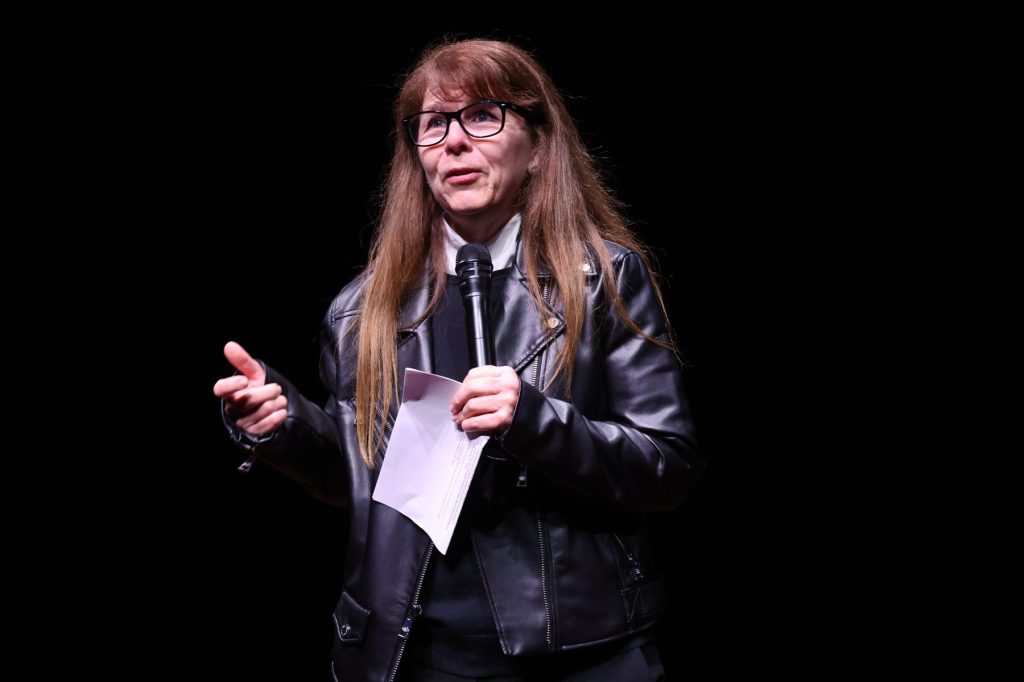
The latest Inclusion in the Recording Studio study shows that women are being consistently shut out of the top charts and awards in music.

Dr. Stacy L. Smith
Phillip Faraone/Getty Images for Proof of Concept
Trending on Billboard
Popular music continues to shut out women artists, producers and songwriters, a new study from Dr. Stacy L. Smith and the USC Annenberg Inclusion Initiative has determined.
The latest iteration of the initiative’s “Inclusion in the Recording Studio” study shows that women artists held 36.1% of spots on the most popular Billboard charts in 2025, coming in slightly behind 2024’s 37.7%. It found that women artists fared better in a band or group — thanks in great part to the success of Huntr/x and K-Pop Demon Hunters — but that representation on the charts dropped for solo female artists, falling from 38.9% in 2024 to 34.5% in 2025. In fact, last year’s percentage is on par with the numbers it reported in 2012 (35.8%), which is the earliest year the report studied.
Related

The report spans 14 years and 1,400 songs from the Billboard Hot 100 Year-End Charts, tabulating the gender and race/ethnicity of artists, songwriters and producers on the most popular songs of the year. The report also assesses six major categories at the Grammy Awards: record of the year, album of the year, song of the year, best new artist, producer of the year and songwriter of the year.
“We’ve reported that 2025 was a downturn for women film directors, a reversal of progress for women in leading movie roles, and now fewer women on the top charts in music,” said Dr. Smith in a press release. “This is three strikes against the entertainment industry and tells us that women’s place in this business is shrinking. Parties, awards and community building have not created change. They have fostered a community of women whose industry does not support them or their work.”
Women songwriters and producers also saw a decrease in 2025. Only 14.5% of all songwriters were women, down from 18.9% in 2024. The report specifies that “there has been no change for women songwriters since we began this research.” It adds that half of the songs on the Hot 100 Billboard Year-End Chart were missing women songwriters entirely. Over the past 14 years, women songwriters represented just 13.9% of credits.
“The lack of women songwriters does more than prevent women from working,” said Dr. Smith. “It means that some of our most culturally pervasive ideas and beliefs are crafted by men and exclude women’s creativity and perspective. Of the 1,400 songs we examined, 11 men were credited on 21.7% of those tracks. This gives a very small group incredible influence to shape culture and ideas.”
Related

Elsewhere, only 4.4% of producers in 2025 were women, while more than 90% of songs evaluated across 11 years were missing even one woman producer. In comparison, only seven songs over that time period did not credit a man in a producing role. The study adds that across all 14 years, men outnumbered women as producers by 27 to 1.
Not all the data is bleak. In 2025, more than half (57.8%) of all artists were from underrepresented groups, bouncing back from 44.6% in 2024 and exceeding the baseline of 38.4% in 2012. The increase for underrepresented artists as a whole means that underrepresented women also fared better in 2025, with 60.4% of all women artists coming from underrepresented racial/ethnic groups, a significant increase from 2024.
In 2025, only 29 songwriters were women of color, though that marks an increase from 14 in 2012. In contrast, there were 43 white women writers in 2025, a decline from 61 in 2024. The study states that “as producers, women of color are virtually invisible,” with only four women of color working as producers in 2025.
Among Grammy nominees this year, only 19.3% across the six major categories are women, the report adds, with women most likely to be nominated for songwriter of the year, best new artist or song of the year. Fewer than 15% of nominees for record and album of the year were women, while no women were nominated as producer of the year.
In a bit of good news, this year, 61.1% of all Grammy nominations for women in the six major categories went to women of color — a significant increase since 2013, when the initiative began tracking the gender and racial makeup of nominees.
On a bleak note: Over the last 14 years, only 13.2% of all Grammy winners were women.
“Changes to the Grammy Awards have yielded more opportunities for women than when we first began examining the numbers,” said Dr. Smith. “Yet there are still gaps in the honors women receive. In particular, even as nominations for women increased, their likelihood of winning stayed relatively the same. Artistic quality and creative achievement should not be something that differs by gender, yet at the Grammy Awards this is still the case.”
Read the full Annenberg Inclusion Initiative report here.

More From Pro
