

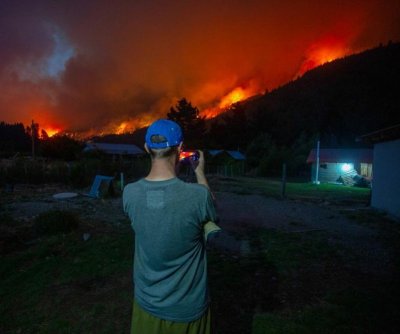
A man takes a photograph of a forest fire burning in El Hoyo, Chubut province, Argentina, on Wednesday. Forest fires in Argentine Patagonia continued to spread in the provinces of Chubut, Santa Cruz and Rio Negro. Photo by Matias Garay/EPA
Jan. 12 (UPI) — Uncontrolled wildfires have burned between 37,000 and 52,000 acres of native forest in Argentina’s Patagonia, according to the Servicio Meteorológico Nacional and the Servicio Nacional de Manejo del Fuego.
The fires have forced mass evacuations and renewed scrutiny of recent land-use policies amid a historic drought.
The first blazes were detected on Jan. 5 in the province of Chubut, and within days spread rapidly across broad forested areas of southern Argentina.
A combination of prolonged drought, high temperatures and strong winds fueled the rapid advance of the flames and complicated containment efforts.
By the weekend, the burned area had reached about 37,000 acres. The emergency prompted the preventive evacuation of some 3,000 people, most of them tourists, and destroyed homes and rural structures.
Environmental group Greenpeace Argentina estimated that 52,000 acres of Patagonian forest, plantations, grasslands and homes have burned so far this summer– an area larger than Washington, D.C.
Satellite images released by NASA showed dense smoke plumes visible from space and detected new fire fronts in protected areas, including Los Alerces National Park, as firefighting crews from multiple provinces worked to contain the flames.
Chubut’s chief prosecutor, Carlos Díaz Mayer, said evidence supports the hypothesis of an intentional origin. He said investigators found fuel residue at the ignition point of one of the main fires and warned that it started in a strategic location near a primary access route, placing thousands of people at direct risk.
The national government publicly pointed to Mapuche groups as possible perpetrators, but judicial authorities in Chubut rejected that claim for lack of evidence. The head of the Lago Puelo prosecutor’s office dismissed statements by Security Minister Patricia Bullrich, saying the investigation has not linked Indigenous communities to the origin of the fires.
On Monday, the Argentine government said that after deploying more than 500 firefighters, 22 of the 32 active fire fronts in Chubut had been extinguished. Light rainfall in some areas provided partial relief, though officials warned several fronts remain active and the situation is still delicate.
The fires come one month after President Javier Milei announced changes to the Land Law and Forest Law that removed limits on foreign purchases of rural land and lifted long-standing restrictions on changing land use after fires.
In December, Cabinet Chief Manuel Adorni said the government eliminated a rule that barred changes in land use for decades after a fire, arguing the restriction harmed production.
Climate conditions have also been central to the scale of the disaster. Chubut Gov. Ignacio Torres said in a radio interview that conditions were “calmer” Sunday morning, but remained “very critical.”
He urged officials and the public “never again to downplay the implications of climate change,” adding that the province is experiencing “the worst drought since 1965,” a scenario experts link to global warming and the increasing frequency and severity of wildfires in Patagonia.
