





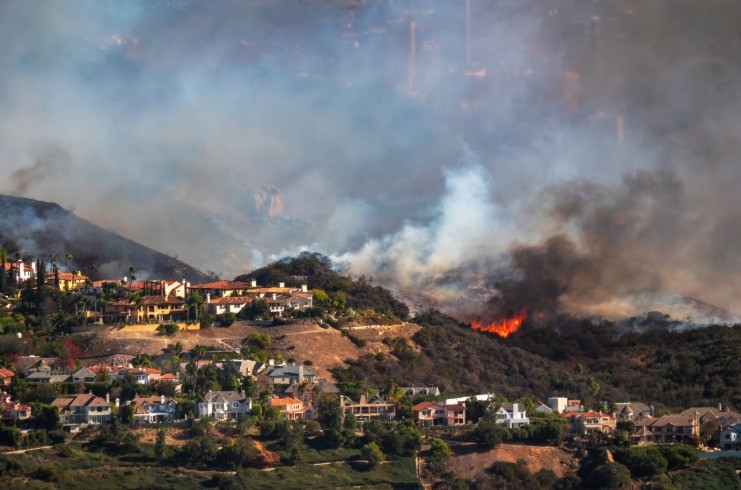


For three days in January 2025, while the Eaton and Palisades fires burned across Los Angeles County, hotels in Pasadena, Glendale, and Burbank ran 83 percent occupancy, up from 63.7 percent the same days a year earlier, according to STR. Displaced families, adjusters, first responders, and crews needed rooms at once, and the hotels that could still take a reservation got them.
The demand stays. The hotel that burns does not. After the 2017 Tubbs Fire took the Hilton Sonoma Wine Country, the site sat mostly empty for six years. One side fills every open room in a market. The other takes rooms off it for years. The question for any hotel in fire country: Which side does this property land on the week after the fire?
A Hotel Does Not Have to Burn to Close
Smoke gets into the air handlers. The utility cuts power on a red-flag day. The county orders an evacuation for the whole zone. Water pressure drops while every hydrant in the district draws, and the road in closes. Any of those takes an undamaged building off the market while debt service, taxes, the premium, and the brand standards keep running. Business interruption coverage typically carries a 48- to 72-hour waiting period, civil authority coverage commonly runs two to four weeks, and smoke without physical damage generally does not trigger a claim. Most of a wildfire closure lands on the owner.
The Cheapest Item Matters Most
After the Los Angeles fires, the Insurance Institute for Business & Home Safety assessed more than 250 properties in the Eaton and Palisades burn areas. The finding for every hotel budget: where more than a quarter of the ground within 5 feet of a structure was covered in fuel (mulch, dead vegetation, stacked pool furniture), the likelihood of damage or destruction was close to 90 percent. That is landscaping, the cheapest line in any hardening plan.
The rest works as a system. A Class A roof, noncombustible cladding, dual-pane glazing, and enclosed eaves together avoided damage 54 percent of the time; with only one of those features, 36 percent. IBHS and Headwaters Economics priced the enhanced standard at about 3 percent added to the affected building components, based on residential data. The proportion transfers to commercial construction, and against a three-week hotel closure, it is small.
Hotels carry a penetration most building types do not: a through-wall unit under every guest room window. A PTAC pulls outdoor air through a louver that the vent standards do not reach, and a 140-key property has 140 of them. Hotel fire ratings are written for fire that starts inside, from corridor walls to door closers. In fire country, the threat comes through the envelope, and where air enters each room becomes an operational question: whether the dampers close, what the filters stop, and who on staff can shut them.
Spacing matters too. IBHS saw full conflagration at 8 to 14 feet between structures and scattered ignitions at 30 to 70. Fences, trellises, and stored equipment carry fire between buildings. A resort on acreage or a select-service property with surface parking on three sides controls that variable.
California approved statewide Zone 0 regulations in August covering commercial structures, with existing buildings phasing in over three to five years, though they are not yet in force. Zone 0 clearance takes a crew and a weekend. The envelope upgrades ride the next roof replacement or property improvement plan, adding very little. These assemblies are being specified and built in the Palisades and Eaton rebuilds today.
What the Money Actually Buys
Hotel insurance premiums remain roughly double 2019 levels after years of double-digit increases, according to CBRE’s Trends in the Hotel Industry survey. Resorts carry the weight, at $2,464 per available room in 2022 against $528 at limited-service properties. Carriers now underwrite at the individual asset, and an owner who can document ignition-resistant assemblies and maintain defensible space presents a different account than the property next door.
The mitigation discount is small. What the work buys is staying insurable, and an asset that cannot get insured cannot get financed. Set that against a segment running flat occupancy and EBITDA up 0.3 percent: three weeks dark with fixed costs still running takes roughly 15 percent to 20 percent of a normal year’s EBITDA. For a single-asset owner, that can be the whole investment thesis.
The hardened hotel is also, simply, the better hotel. Whole-building backup power means lights, hot food, and WiFi on the night the utility shuts the town down. Closed dampers and real filters mean clean air when the sky turns orange. Noncombustible landscaping reads as designed: stone, gravel, the palette Arizona’s desert resorts have sold for decades.
Reopening speed is a design decision too. On-site water storage and standard, locally stocked assemblies decide whether a property reopens in days or months, because a specialty product with a 20-week lead time is a 20-week closure when every contractor in the region is already booked.
Fire seasons are running longer, whatever the cause is called, and every year the work waits, it lands in a more expensive roof cycle and a tighter underwriting file. When the next fire comes through a market, the demand will be there. Which properties will be able to take the reservation?


