






Simon Watkins
Simon Watkins is a former senior FX trader and salesman, financial journalist, and best-selling author. He was Head of Forex Institutional Sales and Trading for…
Set us as your preferred Google source
Premium Content
By Simon Watkins – Mar 09, 2026, 5:00 PM CDT
- The Middle East conflict has expanded into a multi-front war involving the U.S., Israel and Iran, with missile strikes, proxy attacks and maritime disruption affecting key energy routes.
- Donald Trump outlined goals including preventing Iran from obtaining nuclear weapons, destroying missile capabilities, pursuing regime change, and cutting support for regional proxies.
- Iran may retaliate by targeting oil infrastructure and threatening shipping through the Strait of Hormuz and Bab-el-Mandeb Strait.

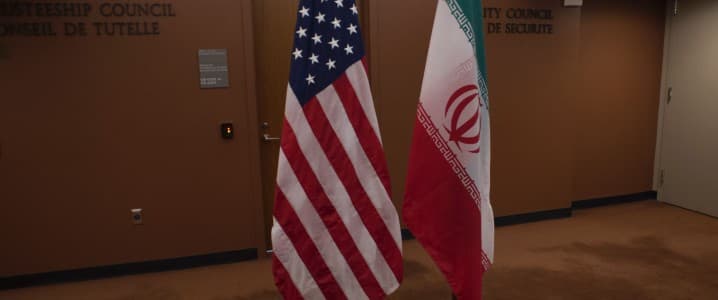
Longstanding tensions in the Middle East are no longer simmering away — they have tipped into a multi-theatre conflict the like of which the world has not seen in the region since the Six-Day War of 1967, with Iran at the centre of the escalation cycle. U.S. and Israeli forces are prosecuting a sustained campaign against Iranian territory, command infrastructure, and proxy assets across every active front. Iran and its network of militias are still managing to retaliate — from missile launches to maritime disruption — even as they absorb heavy losses and operational degradation. In Washington, Donald Trump has delineated four clear aims for the war against Iran, and he expects the current campaign to last around four weeks. Iran sees things differently. So the real question now is how this escalatory cycle evolves from here, and what that means for the energy markets.
Early in the conflict, Trump clearly laid out the four objectives he wants to achieve with the U.S.’s current actions against Iran and its proxies. In the order in which he said them, they started with making it impossible for Iran to build a nuclear arsenal and then moved on to degrading and destroying its missile stockpiles and production capabilities. The came regime change and finally the end of the financing and arming of its proxies. All these aims have been endorsed by every member of his cabinet. Aside from the U.S.’s war objectives, most analysts also seem to have missed that nearly all of them were in the draft of President Barack Obama’s original version of the ‘Joint Comprehensive Plan of Action’ (JCPOA, or colloquially ‘the nuclear deal’) agreed with Iran between 2013 and 2015. The exception was the explicit term ‘regime change’, although this was implied through the targeting of the key mechanisms by which the Islamic Revolutionary Guards Corps (IRGC) were able to finance itself and its proxies. The IRGC is the primary organisation charged with safeguarding the ideals of the 1979 Islamic Revolution at home and promulgating these through its proxies. And the principal mechanism through which its financing was to be stripped was by forcing Iran to agree to the terms of the Financial Action Task Force. Washington’s aim then was to neuter the IRGC in such a way before rolling it into Iran’s regular army (Artesh), as analysed in full in my latest book on the new global oil market order. The final version of the JCPOA after the long-running negotiations omitted much of the meat behind these aims before it was finalised and agreed to on 14 July 2015. All the original clauses of the deal are also fully detailed in my latest book, and it was to the original Obama version of the deal that Trump himself looked when he decided to unilaterally withdraw the U.S. from the JCPOA in 2018 as a prelude to renegotiating the JCPOA later. In essence, given that the tougher version meant the destruction of the IRGC and the Islamic regime over time, Iran was never going to agree to it, and if it did, it was never going to implement its key clauses.
This is why Trump has now plainly stated that regime change is one of the four key objectives, as Iran’s Islamic leaders and IRGC have known all along, so each side knows plainly the stakes at play. Given the existential nature of this conflict now, there is little chance of any meaningful negotiated settlement between the Islamic Republic and its IRGC guardians, and the U.S. and Israel. The deaths of the former Supreme Leader, Ali Khamenei, and multiple senior commanders in the IRGC are irrelevant to the continued functioning of either the Islamic theocracy or its protectors throughout Iran, as highlighted recently by former U.S. general and director of the CIA David Petraeus. “The problem is that if hundreds of thousands of armed and organised members of the regime’s security forces are still there, it is extremely difficult to take control of the country,” he highlighted in a statement last week. Specifically, he cited a well-trained and well-armed force of around one million, comprising about 200,000 each in the Basij (the IRGC-operated paramilitary volunteer militia), and the national police, and the IRGC, and around 400,000 in the Artesh. Another practical problem in changing regime in this wave of the war against Iran, he underlined, is the lack of a credible alternative leadership. The sometimes-touted (although only by the West) exiled son of the last Shah of Iran, Reza Pahlavi, is still based in the U.S. and has little genuine support in Iran itself.
Given these factors, a senior source close to the European Union’s (E.U.) security complex exclusively told OilPrice.com last week, the broad strategy of the IRGC is to keep ‘stinging’ the U.S. and Israel through multiple attacks across multiple sites until the two countries decide that they have achieved sufficient of their aims to withdraw, despite not effecting a change of regime. One such tactic in this strategy will be the continued effective closure of the key oil and liquefied natural gas (LNG) routes of the Strait of Hormuz and the Bab-el-Mandeb Strait. Although the Trump administration is rolling out a plan to secure the Strait of Hormuz — through which up to a third of the world’s oil is transported and about a fifth of its LNG — it does not yet have a timeline for when it will be safe for oil tankers. Only last year, the IRGC completed military preparations to close the Strait when required, through a combination of anti-ship missiles, fast attack boats, and naval mines in the Persian Gulf region, and has since conducted exercises using ‘swarm attack’ naval and aerial drone tactics, according to the E.U. source. Much of the same sort of weaponry could be used to attack shipping around the other crucial energy-transit chokepoint of the Bab-el-Mandeb Strait. This 16-mile-wide waterway flows between the west coast of Yemen on the one side — still controlled in large part by the Iran-backed Houthis — and the east coasts initially of Djibouti and then of Eritrea on the other, before it joins the Red Sea. It is in the lead-up to and navigation through this Strait that the real problems begin and never has the literal translation of the chokepoint’s name from Arabic – ‘The Gate of Grief’ – been more apposite than it is now.
Aside from these force-multiplier actions, Iran is also likely to ramp up attacks against U.S. allies in the region, especially Saudi Arabia, thinks the E.U. security source. Last week saw multiple drone attacks on its Ras Tanura refinery — Saudi Arabia’s largest, with crude refining capacity of around 550,000 barrels per day (bpd). Most of the drones were intercepted, although the refinery was shut temporarily as a precaution, but this and other refineries will almost certainly be in Iran’s sites for further attacks, said the source, in an attempt to mirror the huge impact of the Houthi attacks in 2019 on Saudi Arabia’s Abqaiq and Khurais oil processing facilities, as also analysed in full in my latest book on the new global oil market order. Together at the time these two facilities represented around 50% of Saudi Arabia’s oil production at the time, or about 5% of the global oil supply. As such, the attacks caused an immediate spike of up to 20% in global oil prices and were considered one of the most strategically significant energy?infrastructure strikes ever recorded. “The attacks underlined to the IRGC how a strike on a small number of high?leverage nodes in Saudi Arabia’s system can generate outsized global consequences, and the same has been seen this time around, and in Qatar’s shutdown of the North Field following relatively minor attacks on facilities linked to it,” the E.U. source added. And he underlined that Iran’s military actions on a zero-to-nine scale of its overall capabilities have barely reached two yet.
Rising oil prices have a direct and highly damaging effect on the U.S. economy and on the political ambitions of the country’s presidents, as thoroughly detailed in my latest book on the new global oil market order. This is likely to factor into Trump’s thinking, the closer the clock ticks toward the 3 November mid-term elections. To give some broader context, according to the World Bank, a ‘small disruption’ in global oil supply – reduced by 500,000 to 2 million bpd (roughly the same as the decrease seen during the Libyan civil war in 2011) – would see the oil price initially rise 3-13%. A ‘medium disruption’ – involving a 3 million to 5 million bpd loss of supply (roughly equivalent to the Iraq war in 2003) would drive the oil price up by 21-35%. And a ‘large disruption’ – featuring a supply fall of 6 million to 8 million bpd (like the drop seen in the 1973 Oil Crisis) – would push the oil price up 56-75%.
Download The Free Oilprice App Today



Simon Watkins
Simon Watkins is a former senior FX trader and salesman, financial journalist, and best-selling author. He was Head of Forex Institutional Sales and Trading for…