



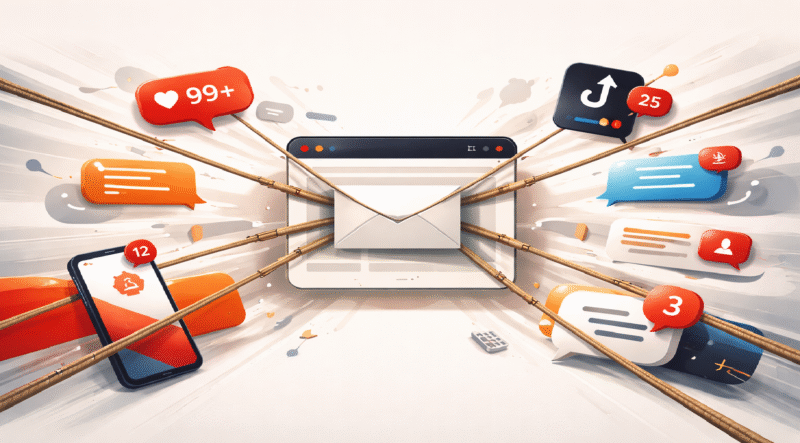
Email marketing has been declared dead every time a new digital technology appears in all its shiny newness. Yet, it remains one of the most effective, profitable and controllable digital channels available to marketers. But so much of the promotional email that I see in my inboxes feels a little tired.
Many messages look as if they were designed for the inboxes and email users of 2001. Yes, that’s 25 years ago, nearly as long as email’s commercial lifespan.
On the surface, at least, the typical email message looks a little more modern today. We don’t see many three-column email designs anymore. About 4 out of 5 emails are optimized for mobile, up from 50% or less 10 years ago.
The bigger problem with email design
It goes deeper than button or font size, into an area we haven’t talked about enough until now. Today’s email messages are disconnected from how people behave online. They haven’t changed much since the heady days of 2001, when promotional email crossed the line from novelty to business necessity.
Back then, inboxes were quieter, even as the spam flood began to rise. People’s attention spans were longer, and the way they read messages was mostly linear. The typical reader would open an email, start at the top and scroll through the message. Subject lines mattered, but they weren’t fighting for notice in a battlefield of notifications, apps and infinite scroll.
Fast-forward to 2026. The people reading our emails have been retrained by attention competitors like TikTok, Instagram Stories and Facebook Reels, YouTube Shorts and a constant stream of digital interruptions.
The environment has changed, and human behavior has evolved with it. But email marketing has remained largely unchanged. One reason for this stalemate may be the long-running competition between email and social media for attention and budget. Email still holds the edge for trust and conversions, but marketers have always known email can learn from social media as well.
Dig deeper: How persuasive email design can influence the ecommerce customer journey
What TikTok reveals about how attention actually works
Now is the time to look more closely at the changes channels like TikTok have driven and how email could benefit from acknowledging them. I’ve been researching and experimenting with TikTok for work lately, and here are my observations.
A behavioral view of TikTok
TikTok didn’t succeed because of trends, dances or viral sounds. It succeeded because it forces creators to confront reality.
On TikTok, attention is never assumed. Attention is borrowed, negotiated and easily revoked. Creators have seconds — sometimes less — to justify why someone should keep watching. They know that if they don’t capture that attention immediately, the thumb moves on without hesitation or remorse.
This has turned TikTok into the largest real-time experiment in human attention we’ve ever had. Creators learn what sparks curiosity, what creates momentum and what causes instant disengagement.
Email marketers, by contrast, optimize for the inbox instead of the human. Open rates, subject line length and best practice formulas dominate the discussion. We don’t usually explore the deeper question — how people actually decide what to engage with.
The three-hook model that stops the scroll
Successful TikTok content rarely relies on a single hook. Creators stack multiple hooks to earn attention and keep it. Most TikToks have three hooks:
- A visual hook — movement, contrast or disruption that catches the eye.
- A verbal hook introduces curiosity, tension or a pattern interrupt.
- A text hook reinforces or reframes what’s happening, often adding intrigue rather than explanation.
These hooks work together. They are not optional extras. They are how creators stop the scroll.
Now, here’s where email crosses paths with TikTok. Technically, email has all three hooks, too.
- Subject lines are verbal hooks, while preheaders offer supporting context.
- Design and layout provide visual signals.
- The interior headline or opening copy block can reinforce curiosity or momentum.
Here’s the difference: TikTok uses these hooks as a set, while email treats these elements as separate, often accidental decisions rather than an intentional system.
Dig deeper: B2B marketing on TikTok: What you need to know
Email’s reliance on a single hook
Most email campaigns expect the subject line to do almost all the heavy lifting. It must be short, clear, compelling, on-brand, benefit-driven and clickable all at once. Meanwhile, the preheader is often wasted or auto-generated. The header or opening copy defaults to context-setting rather than intrigue.
This approach made sense 20 years ago. In a quieter inbox, a decent subject line was enough to earn attention. Today, it’s a fragile strategy that puts significant pressure on a single moment of decision.
TikTok creators don’t rely on one hook because they can’t afford to. Email marketers still do, mainly because they’ve always done so.
Early CTAs and momentum on TikTok
One of the most striking structural differences between TikTok and email is how each handles calls to action. On TikTok, creators don’t wait until the end to ask for engagement. They introduce micro-CTAs early and often — low-effort actions that build momentum, such as:
- “Keep watching.”
- “Watch until the end.”
- “Comment if this sounds familiar.”
Email tends to save the CTA for the bottom of the message. A typical message has one primary action placed after all the explanation. This format assumes readers still stick around long enough to find it.
The traditional model no longer reflects how people consume content. Humans don’t wait until they reach the end of the message to make decisions. They make them along the way.
Curiosity as a driver of attention
TikTok thrives on curiosity. Open loops, unresolved questions and partial information are not tricks. They’re how humans decide where to pay attention.
Email marketers often treat curiosity with suspicion. They push subject lines toward clarity, safety and brevity, creating a sea of short, generic messages that look interchangeable in the inbox.
The irony is that curiosity doesn’t replace relevance. It precedes it. TikTok creators understand that attention is earned first, then value is delivered. Email marketers often aim to deliver value before securing attention.
Dig deeper: Your apps and social channels depend on email more than you think
Email needs a new mental model
Instead of remodeling email’s top layer to look like TikTok, we should change the assumptions we bring to the channel.
We should redesign email to accommodate interruption, not ideal reading conditions. Let’s think of engagement as momentum, not a single click. We need to accept that attention is earned in stages, not assumed at the open.
TikTok reveals how people actually allocate attention. Email marketers can apply those insights without copying the platform.
- Stack subject lines and preheaders intentionally.
- Use opening lines to earn the scroll, not explain the email.
- Test CTAs earlier in the message.
- Design for scanning, interruption and decision-making in seconds rather than minutes.
- Most importantly, stop optimizing email as if it were still 2001.
Email’s next era is about catching up with humans
Email’s greatest advantage over social media in all its forms is that marketers own the channel. The growing pace of algorithmic change highlights the risks of building a marketing program on rented land.
But this is no time to rest on our laurels. Email must evolve to remain relevant to today’s digital consumers, and that evolution won’t come from new templates or tighter character counts. It will come from understanding how humans allocate attention, make decisions and engage with content — and then designing email messages to accommodate those changes.
TikTok creators are already doing this. Not because they’re trendier, but because they have to. Email’s opportunity isn’t to compete with TikTok. It’s to learn from what TikTok has revealed about the people marketers are trying to reach and to incorporate those insights into email messages that are more engaging and valuable.
Dig deeper: 3 high-impact tactics to drive email engagement
Fuel up with free marketing insights.
Email:
Contributing authors are invited to create content for MarTech and are chosen for their expertise and contribution to the martech community. Our contributors work under the oversight of the editorial staff and contributions are checked for quality and relevance to our readers. MarTech is owned by Semrush. Contributor was not asked to make any direct or indirect mentions of Semrush. The opinions they express are their own.