






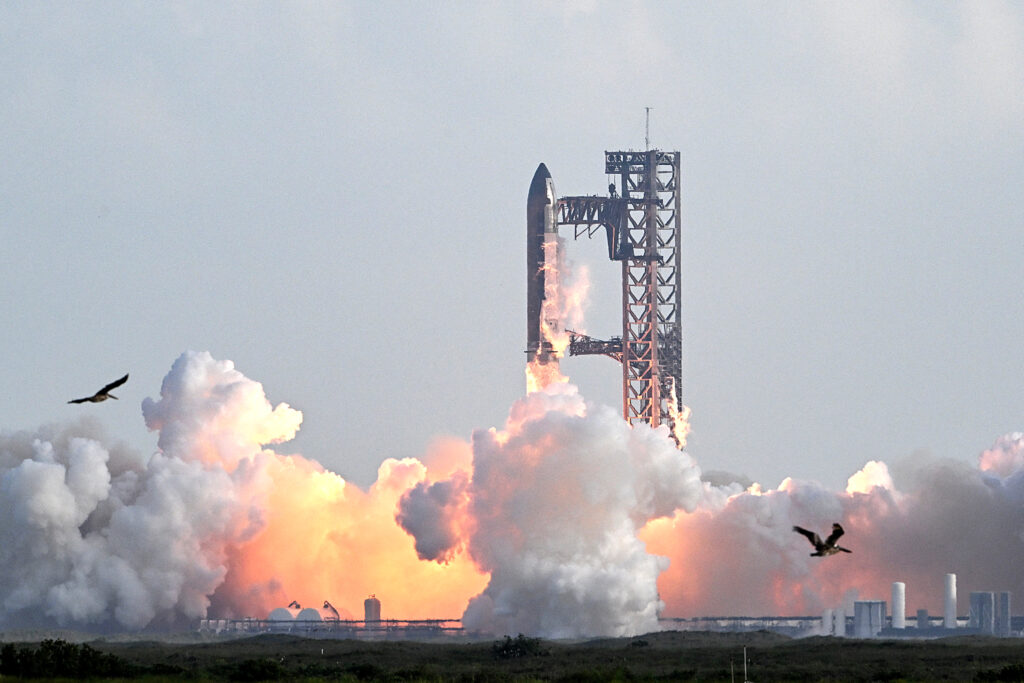
New research published Thursday bolsters growing concerns that a handful of companies and countries are using the global atmospheric commons as a dumping ground for potentially toxic and climate-altering industrial waste byproducts from loosely regulated commercial space flights.
The new study analyzed a plume of pollution trailing part of a Falcon rocket that crashed through the upper atmosphere on Feb. 19, 2025, after SpaceX lost control of its reentry. The rocket was launched earlier that month, carrying 20 to 22 Starlink satellites into orbit.
The authors said it is the first time debris from a specific spacecraft disintegration has been traced and measured in the near-space region about 80 to 110 kilometers above Earth. Changes there can affect the stratosphere, where ozone and climate processes operate. Until recent years, human activities had little impact in that region.
Element-specific monitoring could be part of a broader effort to track how re-entry emissions spread and accumulate, the researchers noted, giving policymakers a chance to understand and manage the growing atmospheric footprint of spaceflight.
“I was surprised how big the event was, visually,” lead author Robin Wing, a researcher at the Leibniz Institute of Atmospheric Physics, said via email. He said people across northern Europe captured images of the burning debris, which was concentrated enough to enable high-resolution observations and to use atmospheric models to trace the lithium to its source.
The study shows that instruments can detect rocket pollution “in the ‘Ignorosphere’ (upper atmosphere near space),” he wrote. “There is hope that we can get ahead of the problem and that we don’t run blind into a new era of emissions from space.”
SpaceX did not immediately respond to questions or requests for comment from Inside Climate News.
A 2024 report from the United Nations University found that the rapid growth of commercial space activity is outpacing unevenly followed and voluntary guidelines. Without more global monitoring and collaboration, the rising demand for satellite launches will accelerate pollution risks in the shared space environment, the report warned.
International agreements covering rocket pollution include the Outer Space Treaty and Liability Convention. They require countries to avoid harmful contamination and to accept responsibility for damage caused by their space objects. Those principles are reflected by several International Court of Justice rulings and opinions on preventing cross-border environmental harm. Debris and atmospheric pollution from space launches disperses globally, affecting many nations that do not launch rockets at all.
Potential Climate Impacts
Research led by scientists with the National Oceanic and Atmospheric Administration, published in 2025, concluded that emissions from disintegrated satellites are likely to increase sharply in the coming decades. Some projections suggest as many as 60,000 satellites could be in orbit by 2040, with reentries every one to two days, injecting up to 10,000 metric tons of aluminum oxide particles into the upper atmosphere each year.
The study found that those aerosols could warm parts of the upper atmosphere by about 1.5 degrees Celsius within one or two years of reaching that number of satellites. That could alter winds and ozone chemistry, and persist for years, indicating a rapidly growing human-made source of pollution at the highest levels of the atmosphere.

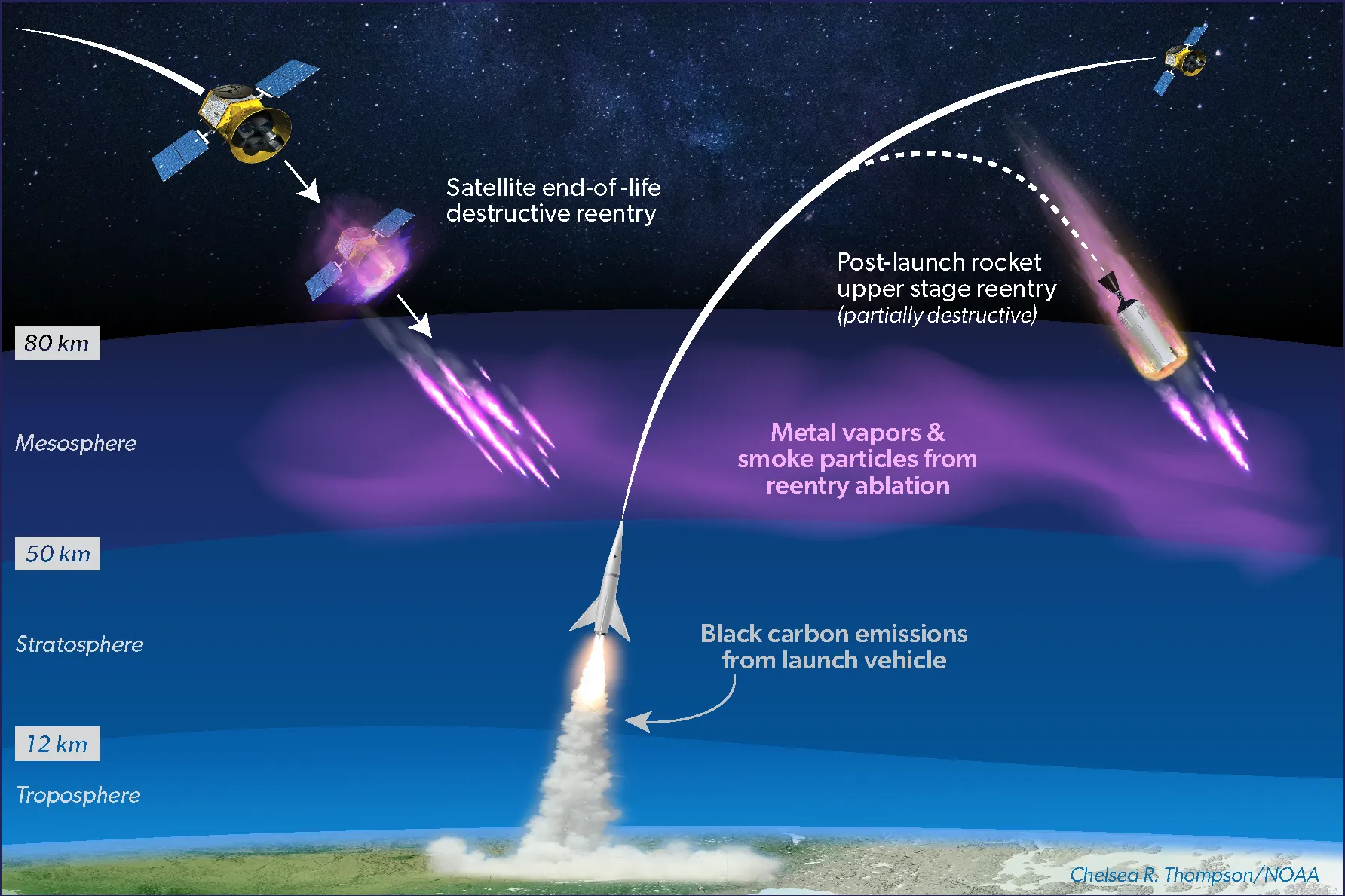
Those particles matter because they act like other catalytic aerosols in the upper atmosphere. Aluminum oxide dust from burning spacecraft absorbs and scatters sunlight, and can warm areas where it accumulates. That can subtly change atmospheric circulation, the researchers noted. As the particles drift and settle lower into the stratosphere, they can affect ozone chemistry and high-altitude clouds, altering how sunlight and heat move through the atmosphere and potentially influencing climate over time.
The potential scope of impacts from space activities was outlined by several researchers at the 2025 European Geosciences Union conference in Vienna. They said that, beyond orbital debris, the booming space industry is the source of a new form of atmospheric pollution, injected directly into the layers of air that protect the planet and regulate its climate.
Atmospheric scientist Laura Revell, with the University of Canterbury in New Zealand, presented research showing that rocket exhaust in the atmosphere can erase some of the hard-won gains in mitigating ozone depletion.
In a high-growth scenario for the space industry, there could be as many as 2,000 launches per year, which her modeling shows could result in about 3 percent ozone loss, equal to the atmospheric impacts of a bad wildfire season in Australia. She said most of the damage comes from chlorine-rich solid rocket fuels and black carbon in the plumes.
This story is funded by readers like you.
Our nonprofit newsroom provides award-winning climate coverage free of charge and advertising. We rely on donations from readers like you to keep going. Please donate now to support our work.
The black carbon could also warm parts of the stratosphere by about half-a-degree Celsius as it absorbs sunlight. That heats the surrounding air and can shift winds that steer storms and areas of precipitation.
“This is probably not a fuel type that we want to start using in massive quantities in the future,” she added.
Researchers at the conference estimated that in the past five years, the mass of human‑made material injected into the upper atmosphere by re‑entries has doubled to nearly a kiloton a year. For some metals like lithium, the amount is already much larger than that contributed by disintegrating meteors.
In the emerging field of space sustainability science, researchers say orbital space and near-space should be considered part of the global environment. A 2022 journal article co-authored by Moriba Jah, a professor of aerospace engineering and engineering mechanics at the University of Texas at Austin, argued that the upper reaches of the atmosphere are experiencing increased impacts from human activities.
The expanding commercial use of what appears to be a free resource is actually shifting its real costs onto others, the article noted.
At last year’s European Geosciences Union conference, Leonard Schulz, who studies space pollution at the Technical University Braunschweig in Germany, said, “If you put large amounts of catalytic metals in the atmosphere, I immediately think about geoengineering.”
There may not be time to wait for more scientific certainty, Schulz said: “In 10 years, it might be too late to do anything about it.”
About This Story
Perhaps you noticed: This story, like all the news we publish, is free to read. That’s because Inside Climate News is a 501c3 nonprofit organization. We do not charge a subscription fee, lock our news behind a paywall, or clutter our website with ads. We make our news on climate and the environment freely available to you and anyone who wants it.
That’s not all. We also share our news for free with scores of other media organizations around the country. Many of them can’t afford to do environmental journalism of their own. We’ve built bureaus from coast to coast to report local stories, collaborate with local newsrooms and co-publish articles so that this vital work is shared as widely as possible.
Two of us launched ICN in 2007. Six years later we earned a Pulitzer Prize for National Reporting, and now we run the oldest and largest dedicated climate newsroom in the nation. We tell the story in all its complexity. We hold polluters accountable. We expose environmental injustice. We debunk misinformation. We scrutinize solutions and inspire action.
Donations from readers like you fund every aspect of what we do. If you don’t already, will you support our ongoing work, our reporting on the biggest crisis facing our planet, and help us reach even more readers in more places?
Please take a moment to make a tax-deductible donation. Every one of them makes a difference.
Thank you,


Reporter, Austria
Bob Berwyn is an Austria-based reporter who has covered climate science and international climate policy for more than a decade. Previously, he reported on the environment, endangered species and public lands for several Colorado newspapers, and also worked as editor and assistant editor at community newspapers in the Colorado Rockies.


