



There are rituals we perform when getting dressed that can feel almost sacred—quiet, repeated gestures that mirror the structure and intention of religious practice. It’s a prelude, a private ceremony before the public one.
In Islam, the relationship between adornment and devotion is explicit. On Eid—marking the end of Ramadan’s 30 days of fasting—Muslims draw from the teachings of Prophet Muhammad, who encouraged wearing one’s best clothes for the occasion. This was not simply a matter of appearance, but about embodying a state of purity, gratitude, and dignity. Here, cleanliness and beauty are not superficial, but outward signs of the internal transformation that has taken place over the last month.
Dressing for Eid last year, I directly referenced the spiritual vocabulary of Islam. I wore a maroon abaya with a pomegranate motif—a fruit revered in the Qur’an as a symbol of abundance and nearness to Jannah—with a matching hijab. (For a bit of contrast, on my feet I wore Maison Margiela Tabi boots.) My clothing felt more than merely customary; the fabric, the color, and the symbolism connected me even more deeply to the meaning of the day.
That sentiment was shared by four stylish Muslims I spoke to this week. For all of them, dressing up for Eid was not an act of vanity, but a form of recognition, joy, acknowledgment, and fulfillment. Here, those four people share their fashion philosophies and dressing traditions around Eid.
Noor Elkhaldi


Edited in Tezza with: CocoaPhoto: Courtesy of Noor Elkhaldi
I have a really big immediate family, so any time my entire family is able to be together on Eid is my favorite. It’s Sunnah to wear your best clothes on Eid, so I just try to wear something that reflects that. I also make sure I’m freshly showered and smell nice.
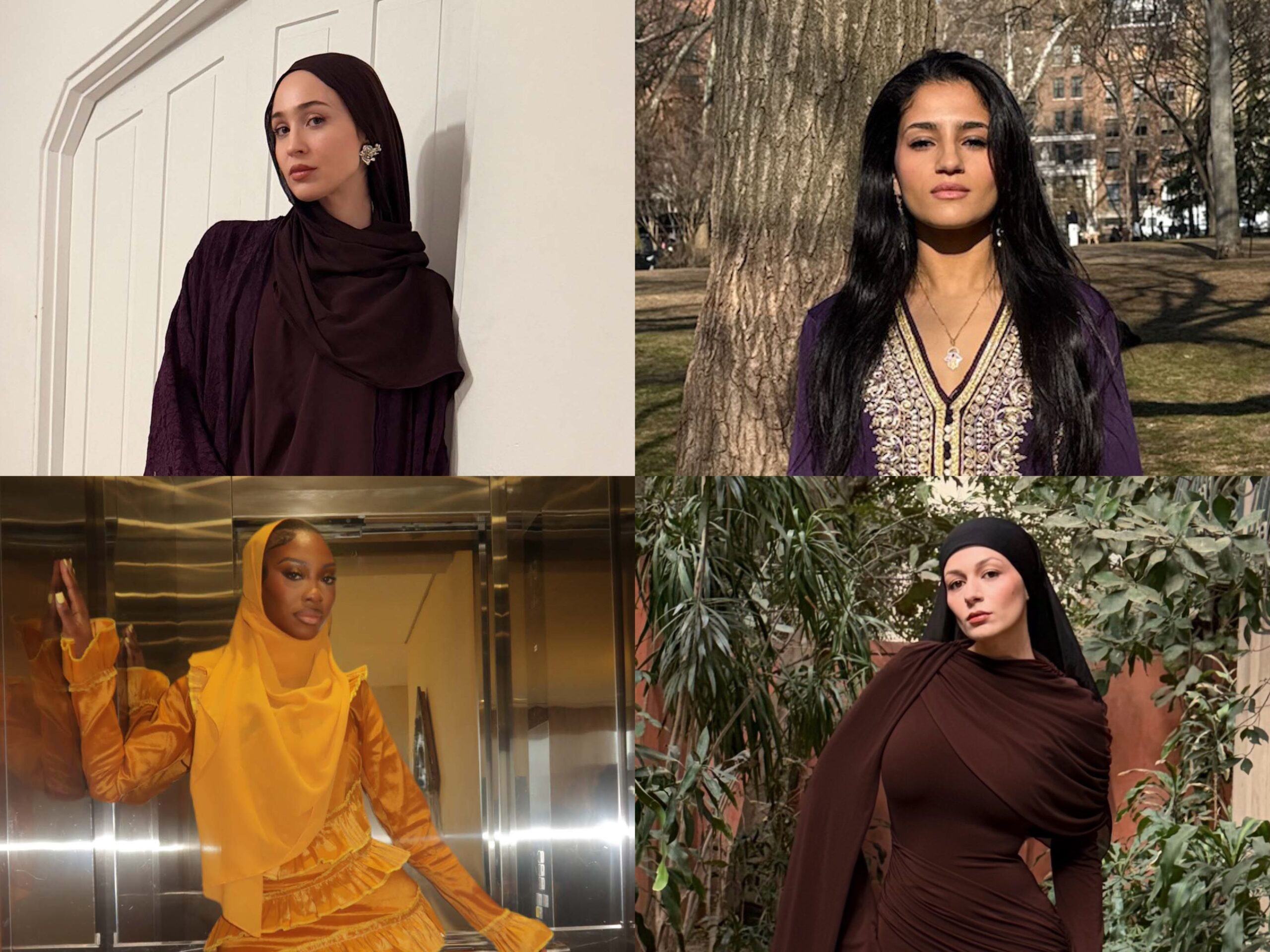
This year, I’m wearing a long dress in a rich brown shade by Khanum’s, with a draped overlay detail that falls across the chest and cascades down one arm, a black crinkle chiffon hijab from Vela Scarves, and a sage green Prada Cleo shoulder bag (that I “borrowed” from my sister). Also, I’m wearing my favorite platforms by Coperni that probably won’t show at all, but I need the extra height, and they’re really comfortable for six-inch heels.
Abayas have obviously always been around, but they’ve really been having a moment for the last few years, and I honestly love to see it. My favorite look that I’ve worn, however, was in 2022, when I wore a Palestinian thobe that my sister bought for me from Gaza, where my family is from. It felt really special to wear a piece from my homeland.
In the last few years, I’ve become such a procrastinator—I don’t start thinking about my outfit until a few days before Eid, sometimes even the night before. Once I figure out my outfit, then I start thinking about my hijab, shoes, bag, and jewelry. Makeup isn’t something I typically put too much thought into; I usually keep it pretty simple unless I have extra time, which I most likely do not, because I’m definitely always running late on Eid.
Tia Adeola


Edited with PrettyUpPhoto: Courtesy of Tia Adeola
This is actually my first Eid observing Ramadan again since I was around 13, which has made this year feel especially meaningful. Growing up, though, Eid was always such a big moment in my family. My mum would dress my sister and me in full Nigerian attire: iro, buba, gele, and then layer a hijab over it. Looking back at those photos now, there’s something so beautiful about that blend of culture and faith.
Some of my favorite memories are just the feeling of togetherness—getting ready as a family, the excitement in the morning, and the sense of occasion. There was always so much intention in how we dressed and showed up for the day, and that’s something I’ve carried with me.
Growing up, my mum would dress my sister and me for Eid, so this year feels especially meaningful—being able to choose my own look, not just as an adult, but also as a designer whose world revolves around dressing and storytelling through clothing. This year, I started with the outfit and built everything around it. I thought about how the silhouette of my dress worked with the hijab, and then layered in jewelry and glam in a way that feels cohesive but still effortless. It’s less about being overly styled and more about feeling aligned, comfortable, and present for the day.
This Eid, I’ll be wearing a more modest Tia Adeola dress, designed with soft ruffles and a sculpted silhouette. The neckline is lower, but I’ll be styling it with a hijab that drapes in a way that offers coverage while still allowing the design to come through. A hijab is always my Eid essential, especially when praying with my family or being in the mosque; it becomes more than just a styling choice. As a designer, it was important for me to feel aligned with both my faith and my creative identity, finding a balance where modesty doesn’t take away from expression, but enhances it.
I’ve noticed a beautiful evolution in abayas over the past few years. Going to the mosque when I was much younger, growing up in Nigeria, they were often very understated. Now, there’s so much more exploration—color, embroidery, structure, even subtle waist definition. It’s been exciting to see modest fashion expand in this way, offering more versatility and individuality while still honoring tradition and modesty.
Sarah Daoui


Photo: Courtesy of Sarah Daoui
Eid mornings are always about my siblings for me. When we all lived together, it would be a joyful chaos of waking each other up (none of us are exactly morning people) and the smell of my dad making us all coffee. Even now that we’re older and living on our own, we’ve continued that tradition. I’ll have my siblings come sleep over the night before Eid just so we can share those moments together. Each of my siblings is their own distinct individual, and this is one of the only days of the year when, with my parents, we move completely as a unit. Seeing them all walk through the New York streets in their best traditional outfits brings me so much joy. Praying in Washington Square Park is always my favorite Eid memory: the vibration of everyone peacefully praying together, the sound of birds flying by overhead, and the city beginning to wake up around us. It feels surreal.
In terms of getting ready, I’m not a planner, but I will usually pick my Eid outfit at least the day before. From the jewelry to the belt to the kaftan’s layers, there are a few different elements that require more intention and thought than an everyday outfit would. I’ll always start with the color of my dress first and then build the look from there.
I think this year might be my best: I’m wearing an Algerian kaftan from my parents’ hometown, Oran; my grandmother’s jewels—her Hand of Fatima necklace is something I wear almost every day, but on Eid I choose a larger, more ceremonial version—and a lot of black kohl on my eyes. I love honoring my ancestors on this day. One of my great-grandmothers had long, black hair and always wore heavily kohl-lined eyes, both as a beauty ritual and a form of protection, while the other always wore powerfully colored dresses and big jewels. This look feels like a conversation between the two of them.
I think what I continue to notice most within Eid outfits is a feeling of timelessness. They never feel too trendy—more so like a moment of sharing heritage and culture through style. Every Muslim on Eid in New York seems to do that in their own distinctive way. That’s part of the beauty of this city.
Maria Al-Sadek


Photo: Courtesy of Maria Al-Sadek
This year I actually ordered my abaya earlier in Ramadan, which was a nice switch-up from the last two Eids. I think I do prefer planning ahead, just to avoid the chaos and full closet explosion that happens when I do my last-minute thing. I always decide on the outfit first, then makeup and jewelry last.
This Eid I’m wearing an RS Archive purple lace abaya and underdress, layered over a vintage Prada spring 1996 skirt and Fanci Club boots and Margiela bag. For my hijab, I’m wearing a Vela in the shade Deep Berry. To be honest, I’m not usually an abaya-Eid-outfit girl, but when I saw this specific shade of purple I knew I needed her. It felt perfect because I wanted something relatively easy, and an abaya matching set is exactly that. But of course, I’m a little extra, so I had to put my spin on it by adding a pop of green with the skirt and boots to make it feel a bit more me.
I’ve definitely noticed, and loved, the cultural-wear trend; I did a traditional Palestinian thobe a few Eids ago. I really love seeing people from every culture fitted down in their own cultural wear. There’s something really special about that. I want to put together a Puerto Rican cultural look for a future Eid.