

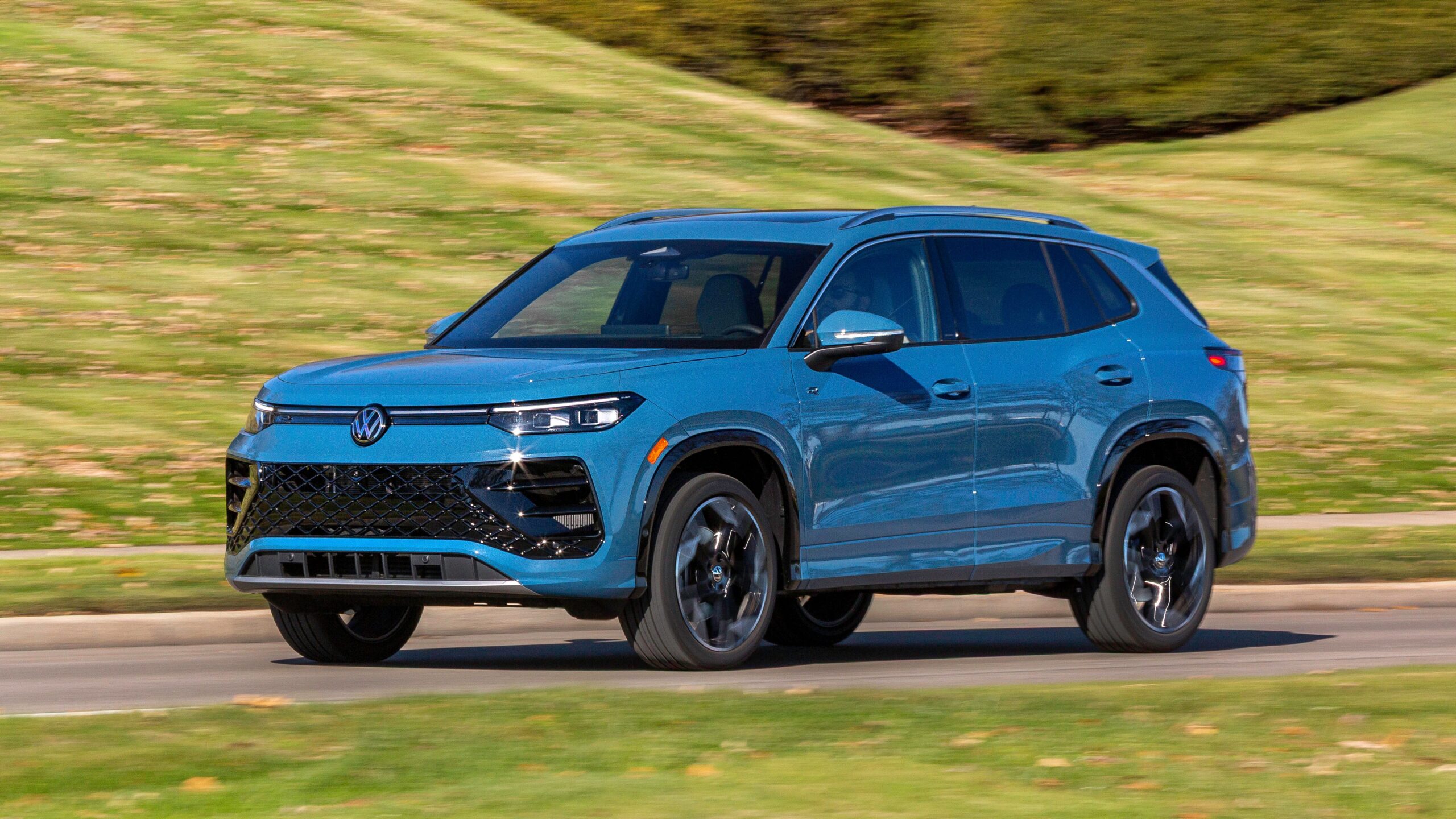
How’s It Drive?
This is clearly a more athletic Tiguan than we’ve become accustomed to over the years. Drop the hammer, and the turbo spools quickly, whooshing the compact crossover away from a stop with the urgency of the late VW Arteon, which weighed nearly as much and shared the same engine output specs and a similar eight-speed automatic. In MotorTrend testing, the Tiguan SEL R-Line Turbo dashed from 0 to 60 mph in 7.0 seconds, a 1.1-second improvement over a 201-hp 2025 Tiguan SEL R-Line 4Motion.
Depress the lovely volume knob on the center console once, then rotate it a click to engage Sport mode (the others are Eco, Comfort, Custom, Off-Road, and Snow). This also engages S mode shifting, which is pretty good about holding gears when slowing for curves, although in some low-speed sections of our drive we still felt the need to grab a downshift paddle and upshifts could be quicker. The chassis at least serves as a perfectly willing partner in the type of driving parents engage in when their impressionable spawn are onboard, and the ride is mercifully supple.
The 2026 Tiguan Turbo is no oversized Volkswagen GTI in terms of steering or braking feel (rear brake size is increased slightly over the lower level turbo/AWD model), but the 255/40 all-season tires that wrap around its 20-inch wheels never begged us for mercy while cornering at mild-misdemeanor velocities on twisty rural Michigan roads. Pushed to their limits in our figure-eight track test, they helped the Tiguan achieve a respectable 0.85 g of cornering grip. Under full-force braking, the 4,018-pound Turbo stopped from 60 mph in 111 feet, about 10 feet better than what’s typical for the segment.
Is the Tiguan Turbo Worth the Money?
The base price of the 2026 Volkswagen Tiguan SEL R-Line Turbo is $44,560, or $4,340 more than the next closest SE R-Line Black 4Motion. Note that this premium includes a lot of swag, including three-zone climate control, extended 30-color ambient lighting, quilted Varenna leather seats, a heated wheel, ventilated and massaging front seats, heated rear seats, power liftgate, 12-speaker Harman Kardon audio, and more.
For reference, that’s about $2,300 more than a top-of-the-line Honda CR-V AWD Sport Touring Hybrid, and about $585 less than a similarly equipped Toyota RAV4 Hybrid Limited. With hybridization, the Honda and Toyota approach the Tiguan Turbo’s performance, but of course those two also achieve roughly 50 percent better fuel economy.
There’s no question, however, that the 2026 Tiguan Turbo makes a better first impression than its more efficient competition when settling in behind the wheel. Its interior is vastly dressier and more richly equipped, with bigger screens, snazzier contrasting leather seats, an available Wi-Fi hotspot, and improved smartphone integration that shares phone navigation directions on the driver’s info screen.
Pressing the volume knob twice lets you toggle between seven cockpit “atmospheres”: Lounge, Nature, Joy, Energetic, Minimal, Me, and Inactive. Each adjusts the ambient lighting, driver-info screen designs, radio volume, and more. As for that seat massage function: It’s legit, featuring 10 actuators that can perform six programs at varying intensity levels. The luxury drops off in the second row, however, with hard plastic door panels surrounding the contrasting-color vinyl insert and no attempt to duplicate the molded-in stitching that adorns the front doors.
This perceptible swank in the front row is designed to overwhelm your emotional right brain, shouting down all the rational arguments your left brain will be making in favor of the sensible-shoes Honda CR-V or Toyota RAV4 regarding reliability, resale value, efficiency, and overall cost of ownership. Choose wisely!
This story was originally published on October 15, 2025. It has been updated with instrumented testing results and additional insights.
This story was originally published on 10/15/2025. It has been updated with instrumented test results and additional impressions.
